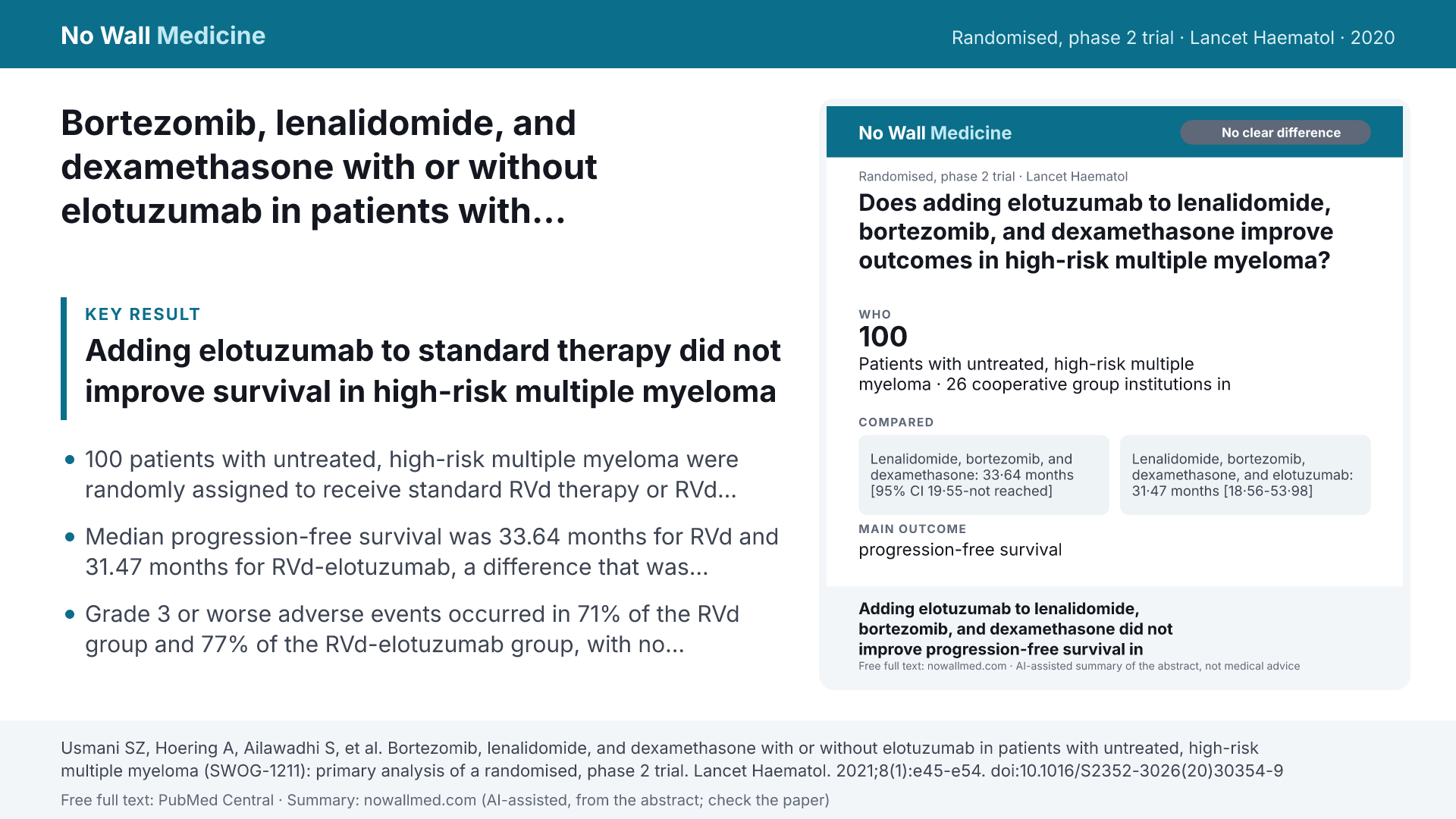
Adding elotuzumab to standard therapy did not change progression-free survival in high-risk multiple myeloma
Bortezomib, lenalidomide, and dexamethasone with or without elotuzumab in patients with untreated, high-risk multiple myeloma (SWOG-1211): primary analysis of a randomised, phase 2 trial
Randomised, phase 2 trialNo clear difference
Does adding elotuzumab to lenalidomide, bortezomib, and dexamethasone improve outcomes in high-risk multiple myeloma?
Who
100
Patients with untreated, high-risk multiple myeloma · 26 cooperative group institutions in the USA
Compared
Lenalidomide, bortezomib, and dexamethasone: 33·64 months [95% CI 19·55-not reached]
Lenalidomide, bortezomib, dexamethasone, and elotuzumab: 31·47 months [18·56-53·98]
Main outcome
progression-free survival
Result: hazard ratio 0·968 [80% CI 0·697-1·344]
Bottom line: Adding elotuzumab to lenalidomide, bortezomib, and dexamethasone did not improve progression-free survival in high-risk multiple myeloma.
Lancet Haematol · 2020-12-22Download image
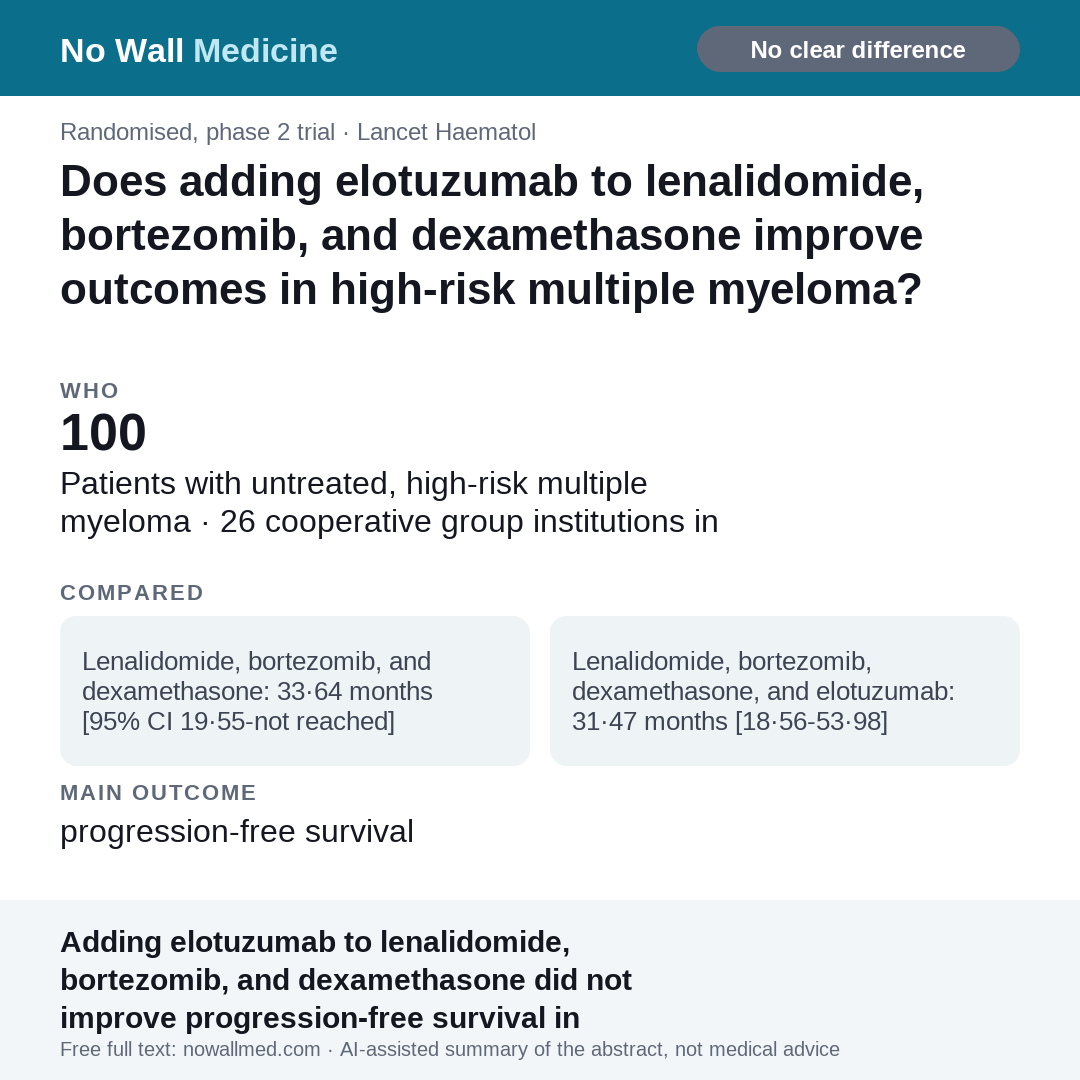
Clinical question: Does adding elotuzumab to lenalidomide, bortezomib, and dexamethasone improve outcomes in high-risk multiple myeloma?
Why it matters: The optimal treatment for patients with high-risk multiple myeloma, who have a poor long-term prognosis, remains unknown.
Key points
- Researchers studied 100 patients with high-risk multiple myeloma, comparing three drugs (bortezomib, lenalidomide, and dexamethasone) to those same drugs plus elotuzumab.
- Median progression-free survival was 33.64 months for the three-drug group and 31.47 months for the group receiving elotuzumab, showing no significant difference.
- Grade 3 or worse adverse events occurred in 71% of the three-drug group and 77% of the group receiving elotuzumab.
Headline and key points written with AI from the paper’s abstract, with every number checked against it. Read the paper before relying on them.
Was this summary helpful?
Subject terms
Cite this article
Usmani SZ, Hoering A, Ailawadhi S, Sexton R, Lipe B, Hita SF. Bortezomib, lenalidomide, and dexamethasone with or without elotuzumab in patients with untreated, high-risk multiple myeloma (SWOG-1211): primary analysis of a randomised, phase 2 trial. Lancet Haematol. 2020. doi:10.1016/S2352-3026(20)30354-9
Spotted a mistake? Suggest a correction