Bortezomib, lenalidomide, and dexamethasone with or without elotuzumab in patients with untreated, high-risk multiple myeloma (SWOG-1211): primary analysis of a randomised, phase 2 trial
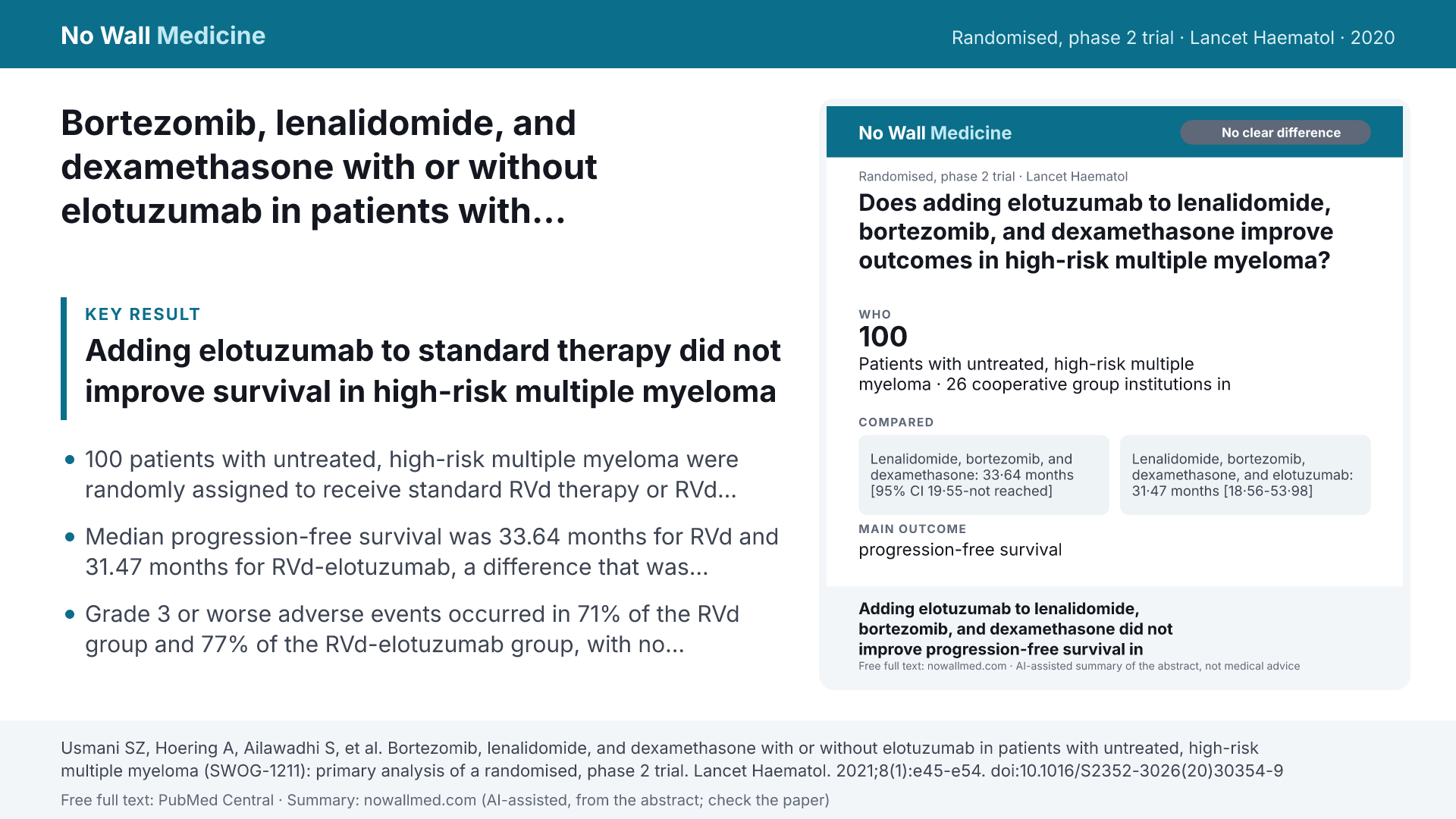
Key result: Adding elotuzumab to standard therapy did not improve survival in high-risk multiple myeloma
Key points
- 100 patients with untreated, high-risk multiple myeloma were randomly assigned to receive standard RVd therapy or RVd plus elotuzumab.
- Median progression-free survival was 33.64 months for RVd and 31.47 months for RVd-elotuzumab, a difference that was not statistically significant.
- Grade 3 or worse adverse events occurred in 71% of the RVd group and 77% of the RVd-elotuzumab group, with no significant safety differences.
Why it matters: Patients with high-risk multiple myeloma have a poor long-term prognosis, and optimal treatment strategies for this specific group were not previously established.
Discussion prompts
- Would these patients look like yours? Who was left out?
- Is the main outcome one that matters to patients?
- Is the difference large enough to change what you do?
Cite: Usmani SZ, Hoering A, Ailawadhi S, et al. Bortezomib, lenalidomide, and dexamethasone with or without elotuzumab in patients with untreated, high-risk multiple myeloma (SWOG-1211): primary analysis of a randomised, phase 2 trial. Lancet Haematol. 2021;8(1):e45-e54. doi:10.1016/S2352-3026(20)30354-9
Free full text: PubMed Central · Summary and visual abstract: nowallmed.com/a/bortezomib-lenalidomide-and-dexamethasone-with-or-without-elotuzumab-144kmbq/ (AI-assisted from the abstract; check the paper before relying on it).