Data management protocols helped detect automated bots and manual participant deception in remote research
Bot or Not? Detecting and Managing Participant Deception When Conducting Digital Research Remotely: Case Study of a Randomized Controlled Trial
Case study of a randomized controlled trialMixed results
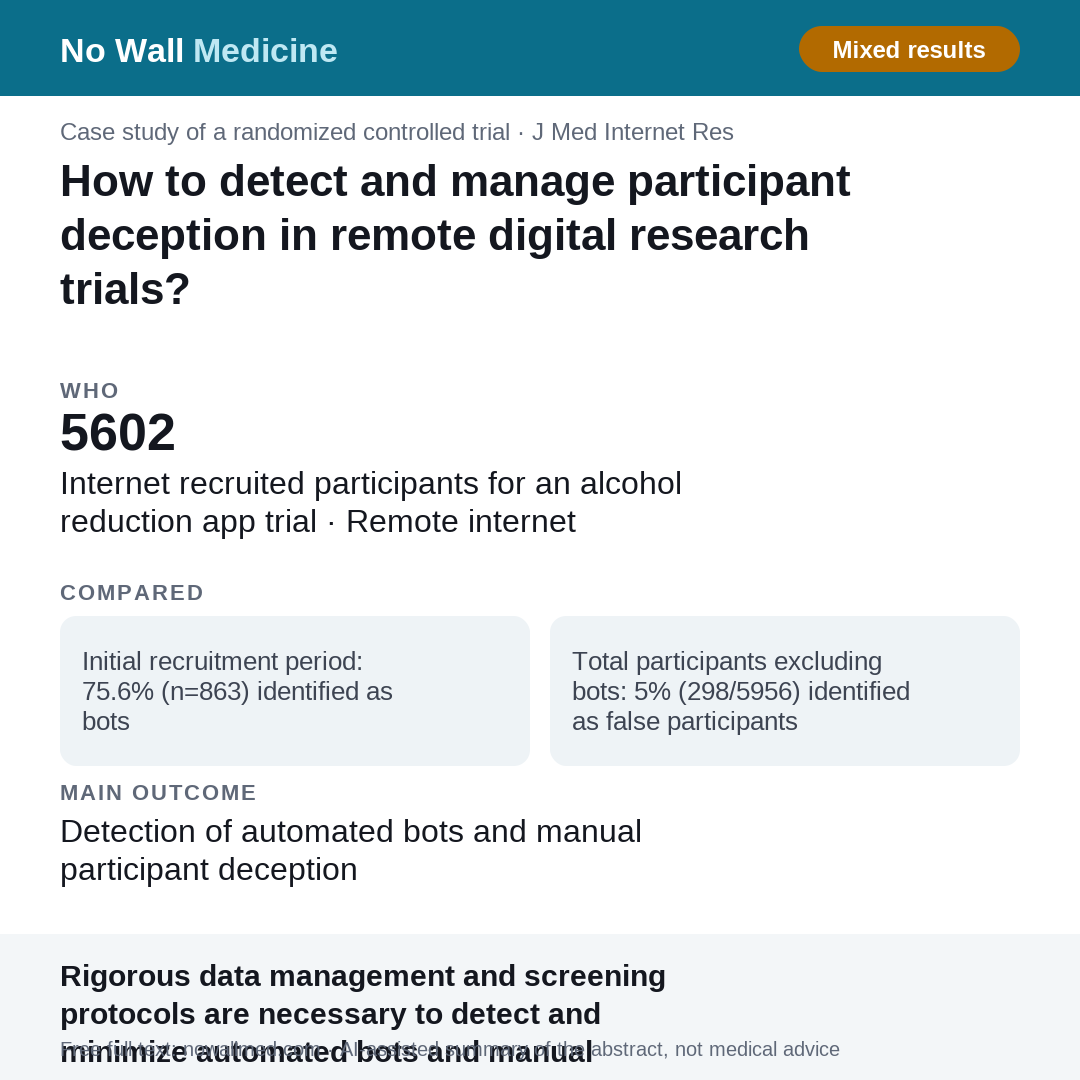
How to detect and manage participant deception in remote digital research trials?
Who
5602
Internet recruited participants for an alcohol reduction app trial · Remote internet recruitment
Compared
Initial recruitment period: 75.6% (n=863) identified as bots
Total participants excluding bots: 5% (298/5956) identified as false participants
Main outcome
Detection of automated bots and manual participant deception
Bottom line: Rigorous data management and screening protocols are necessary to detect and minimize automated bots and manual participant deception.
J Med Internet Res · 2023-09-14Download image
Clinical question: How to detect and manage participant deception in remote digital research trials?
Why it matters: Remote research using self-reports and financial compensation is vulnerable to automated bots and participants providing false information.
Key points
- Researchers analyzed a randomized controlled trial of 5602 participants evaluating an alcohol reduction app called Drink Less.
- Of 1142 participants enrolled in the first 2 months, 75.6% (n=863) were identified as bots, while 5% (n=298) of the 5956 non-bot participants were identified as manual deceivers.
- Adding a CAPTCHA, attention checks, and phone verification was associated with a decrease in identified deception.
Headline and key points written with AI from the paper’s abstract, with every number checked against it. Read the paper before relying on them.
Topics
Cite this article
Loebenberg G, Oldham M, Brown J, Dinu L, Michie S, Field M. Bot or Not? Detecting and Managing Participant Deception When Conducting Digital Research Remotely: Case Study of a Randomized Controlled Trial. J Med Internet Res. 2023. doi:10.2196/46523
Spotted a mistake? Suggest a correction
Top studies every Monday
The week’s key trials and guidelines in your specialties, plus any topics you follow. By email, free.
Get the weekly digest