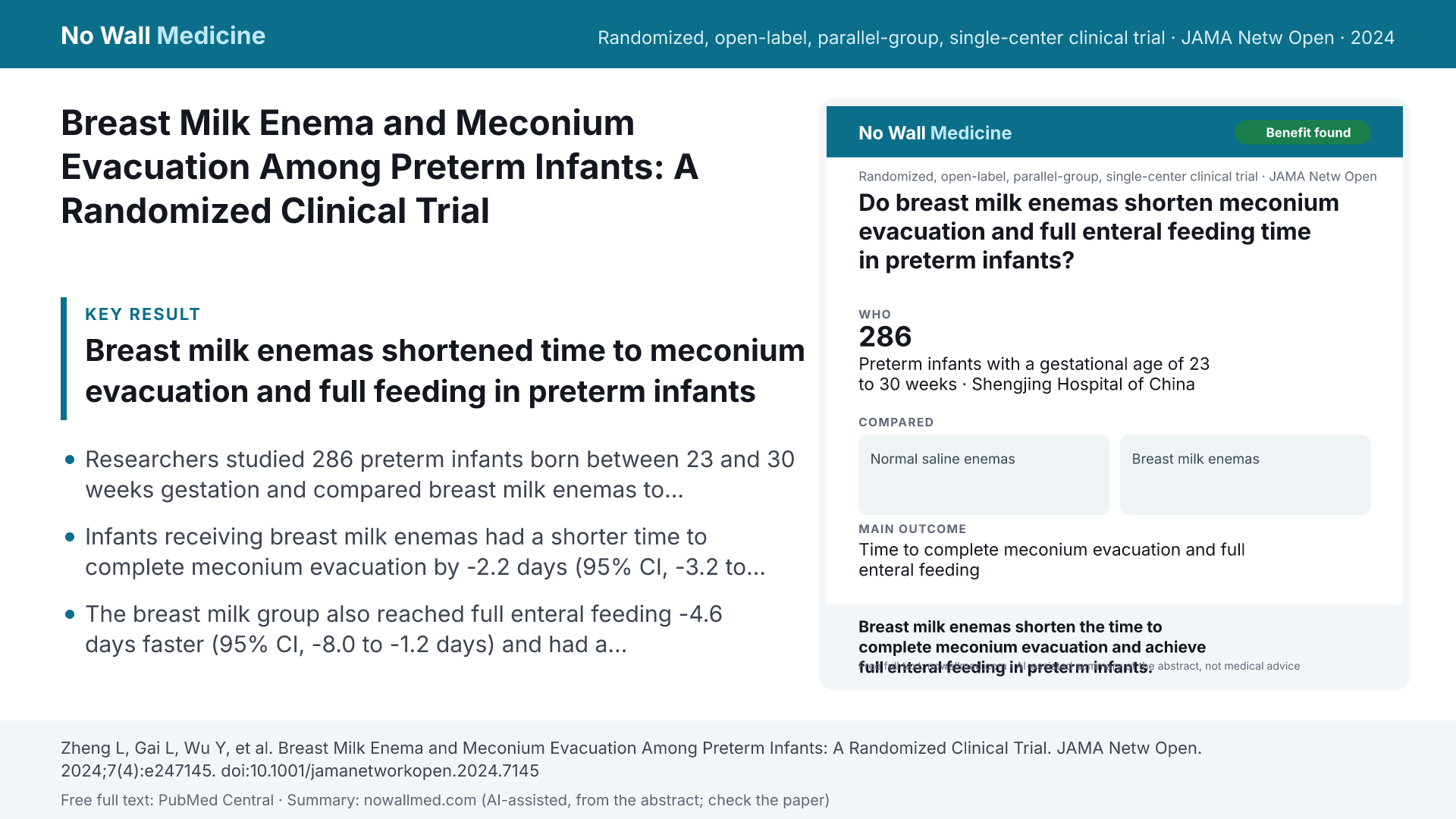
Breast milk enemas shortened time to meconium evacuation and full feeding in preterm infants
Breast Milk Enema and Meconium Evacuation Among Preterm Infants: A Randomized Clinical Trial
Randomized, open-label, parallel-group, single-center clinical trialBenefit found
Do breast milk enemas shorten meconium evacuation and full enteral feeding time in preterm infants?
Who
286
Preterm infants with a gestational age of 23 to 30 weeks · Shengjing Hospital of China Medical University in Shenyang
Compared
Normal saline enemas
Breast milk enemas
Main outcome
Time to complete meconium evacuation and full enteral feeding
Result: -2.2 days (95% CI, -3.2 to -1.2 days) for meconium evacuation
Bottom line: Breast milk enemas shorten the time to complete meconium evacuation and achieve full enteral feeding in preterm infants.
JAMA Netw Open · 2024-04-01 · Save PNG
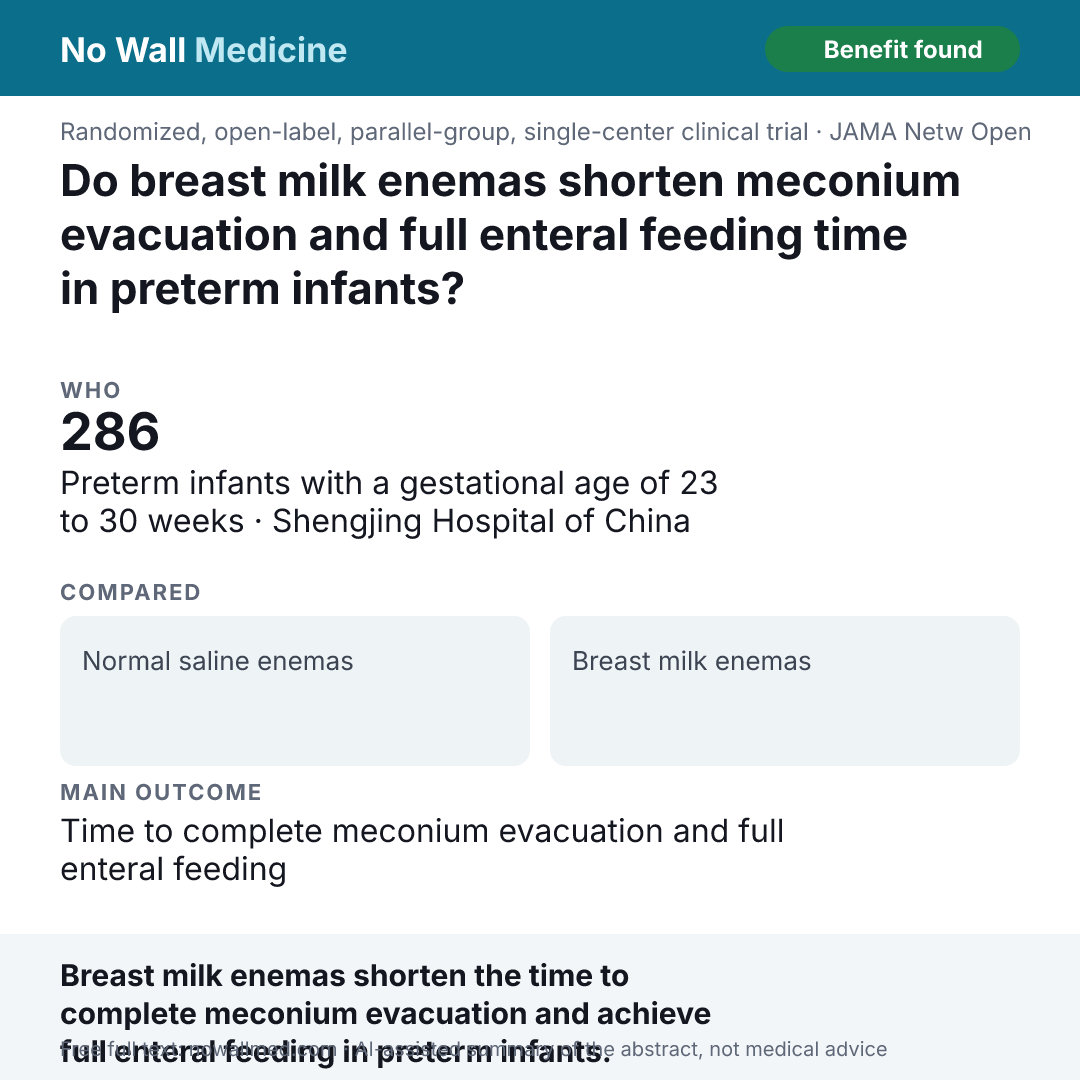
Clinical question: Do breast milk enemas shorten meconium evacuation and full enteral feeding time in preterm infants?
Why it matters: Delayed meconium evacuation and delayed achievement of full enteral feeding are associated with poor short- and long-term outcomes in premature infants.
Key points
- Researchers studied 286 preterm infants born between 23 and 30 weeks gestation and compared breast milk enemas to normal saline enemas.
- Infants receiving breast milk enemas had a shorter time to complete meconium evacuation by -2.2 days (95% CI, -3.2 to -1.2 days).
- The breast milk group also reached full enteral feeding -4.6 days faster (95% CI, -8.0 to -1.2 days) and had a shorter duration of total parenteral nutrition (intravenous feeding) by -4.6 days (95% CI, -8.6 to -1.0 days).
Headline and key points written with AI from the paper’s abstract, with every number checked against it. Read the paper before relying on them.
Was this summary helpful?
Subject terms
Headline, design, result, key points, caveat and citation as plain text.
Cite this article
Zheng L, Gai L, Wu Y, et al. Breast Milk Enema and Meconium Evacuation Among Preterm Infants: A Randomized Clinical Trial. JAMA Netw Open. 2024;7(4):e247145. doi:10.1001/jamanetworkopen.2024.7145
Spotted a mistake? Suggest a correction