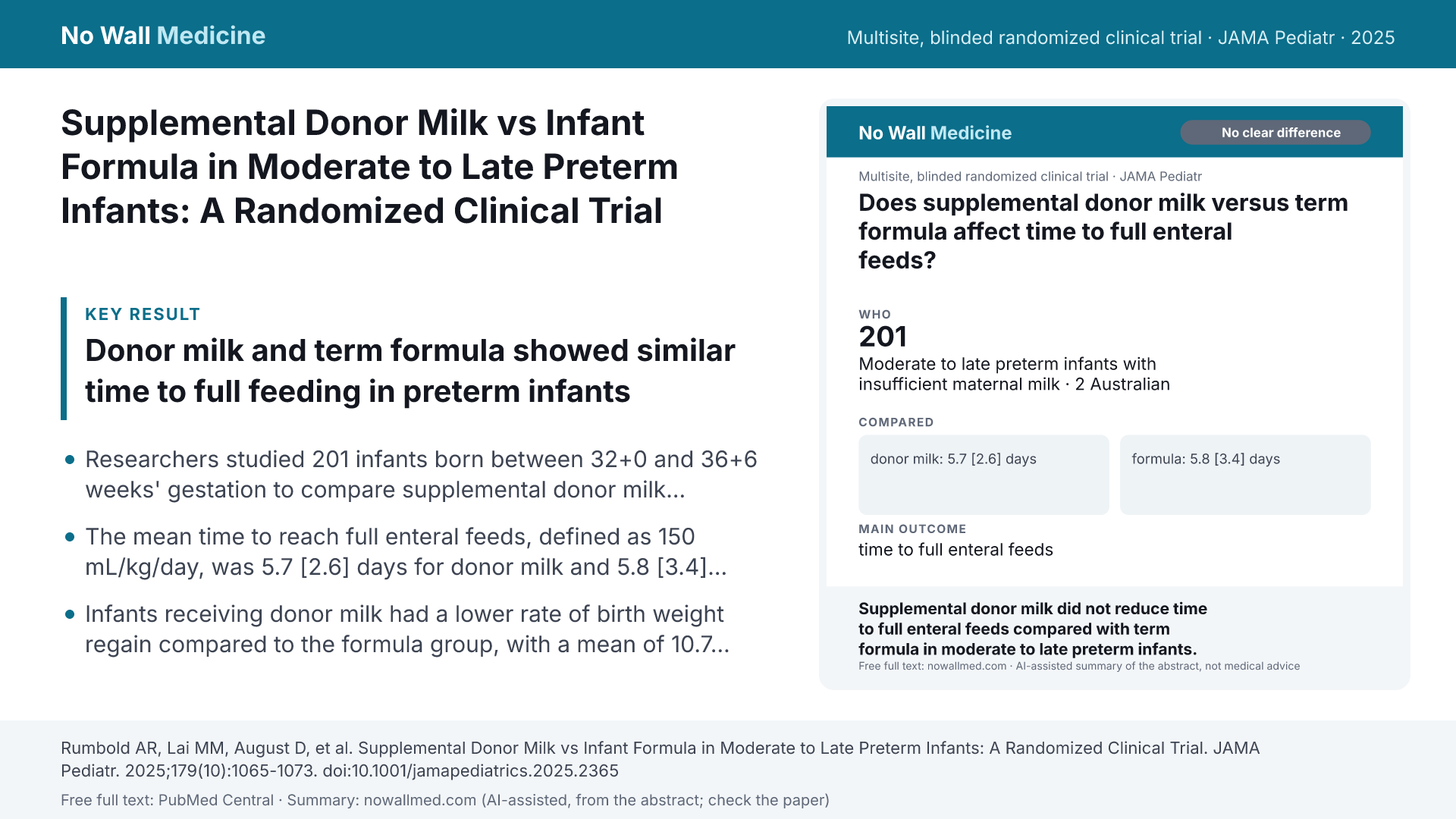
Donor milk and term formula showed similar time to full feeding in preterm infants
Supplemental Donor Milk vs Infant Formula in Moderate to Late Preterm Infants: A Randomized Clinical Trial
Multisite, blinded randomized clinical trialNo clear difference
Does supplemental donor milk versus term formula affect time to full enteral feeds?
Who
201
Moderate to late preterm infants with insufficient maternal milk · 2 Australian neonatal units
Compared
donor milk: 5.7 [2.6] days
formula: 5.8 [3.4] days
Main outcome
time to full enteral feeds
Result: adjusted mean difference, -0.07; 95% CI, -0.90 to 0.76
Bottom line: Supplemental donor milk did not reduce time to full enteral feeds compared with term formula in moderate to late preterm infants.
JAMA Pediatr · 2025-08-04Download image
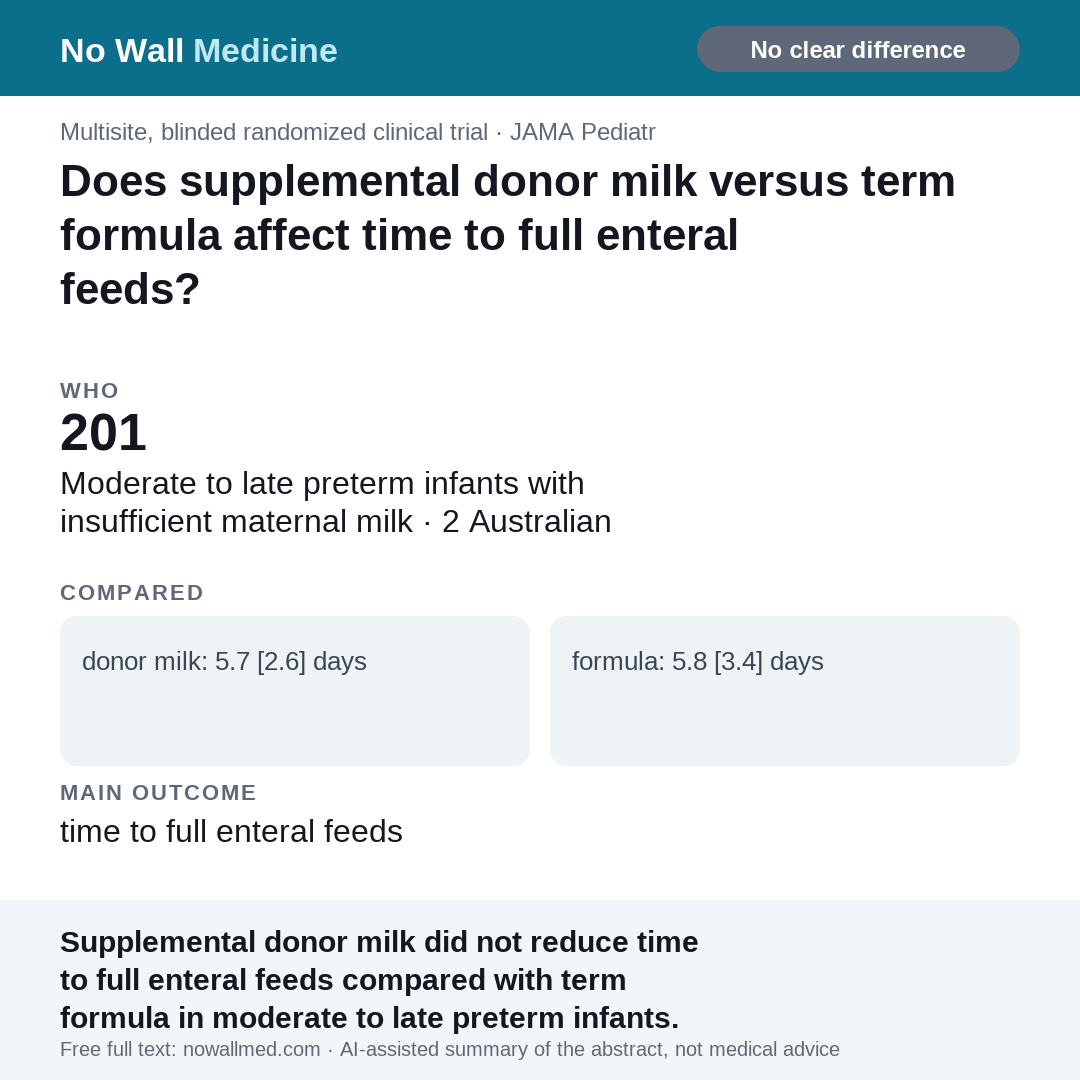
Clinical question: Does supplemental donor milk versus term formula affect time to full enteral feeds?
Key points
- Researchers studied 201 infants born between 32+0 and 36+6 weeks' gestation to compare supplemental donor milk against term infant formula.
- The mean time to reach full enteral feeds, defined as 150 mL/kg/day, was 5.7 [2.6] days for donor milk and 5.8 [3.4] days for formula.
- Infants receiving donor milk had a lower rate of birth weight regain compared to the formula group, with a mean of 10.7 [5.7] days versus 8.4 [4.4] days.
Headline and key points written with AI from the paper’s abstract, with every number checked against it. Read the paper before relying on them.
Was this summary helpful?
Subject terms
Headline, design, result, key points, caveat and citation as plain text.
Cite this article
Rumbold AR, Lai MM, August D, et al. Supplemental Donor Milk vs Infant Formula in Moderate to Late Preterm Infants: A Randomized Clinical Trial. JAMA Pediatr. 2025;179(10):1065-1073. doi:10.1001/jamapediatrics.2025.2365
Spotted a mistake? Suggest a correction