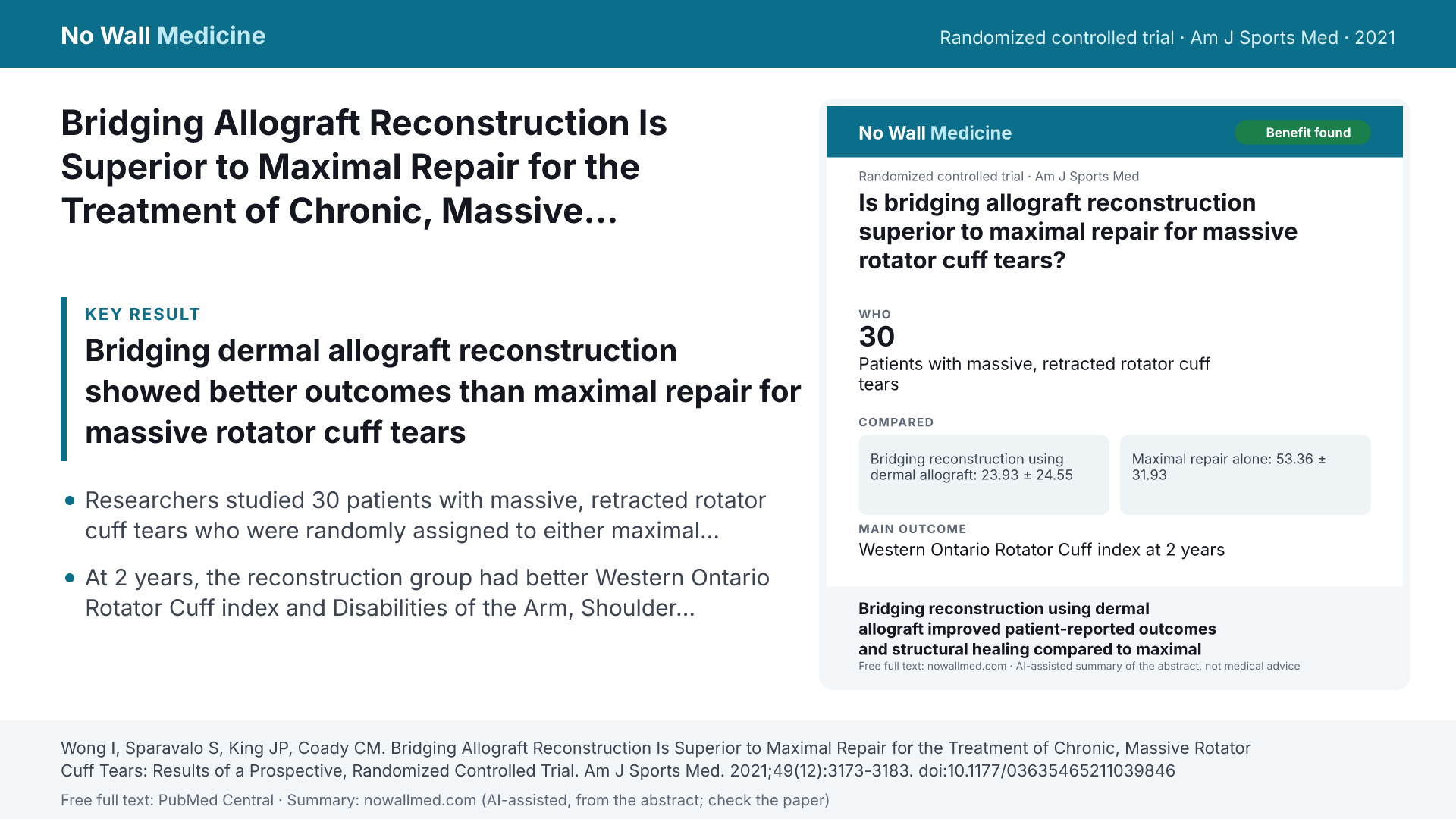
Bridging dermal allograft reconstruction showed better outcomes than maximal repair for massive rotator cuff tears
Bridging Allograft Reconstruction Is Superior to Maximal Repair for the Treatment of Chronic, Massive Rotator Cuff Tears: Results of a Prospective, Randomized Controlled Trial
Randomized controlled trialBenefit found
Is bridging allograft reconstruction superior to maximal repair for massive rotator cuff tears?
Who
30
Patients with massive, retracted rotator cuff tears
Compared
Bridging reconstruction using dermal allograft: 23.93 ± 24.55
Maximal repair alone: 53.36 ± 31.93
Main outcome
Western Ontario Rotator Cuff index at 2 years
Bottom line: Bridging reconstruction using dermal allograft improved patient-reported outcomes and structural healing compared to maximal repair.
Am J Sports Med · 2021-09-08 · Save PNG
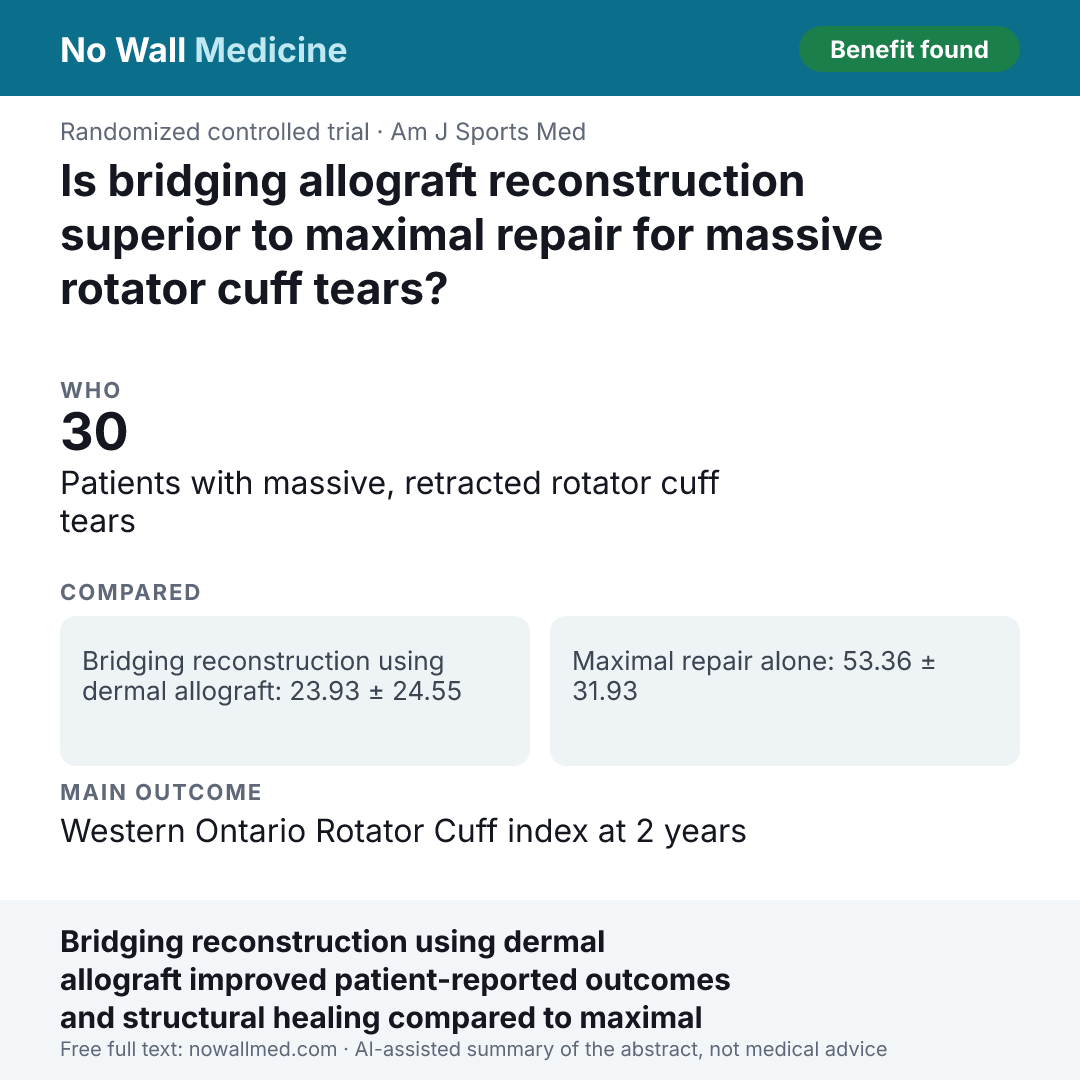
Clinical question: Is bridging allograft reconstruction superior to maximal repair for massive rotator cuff tears?
Key points
- Researchers studied 30 patients with massive, retracted rotator cuff tears who were randomly assigned to either maximal repair or bridging reconstruction using a dermal allograft.
- At 2 years, the reconstruction group had better Western Ontario Rotator Cuff index and Disabilities of the Arm, Shoulder and Hand scores than the maximal repair group.
- The maximal repair group had an 87% retear rate compared to 21% in the reconstruction group and showed more progression to rotator cuff arthropathy.
Headline and key points written with AI from the paper’s abstract, with every number checked against it. Read the paper before relying on them.
Was this summary helpful?
Subject terms
Headline, design, result, key points, caveat and citation as plain text.
Cite this article
Wong I, Sparavalo S, King JP, Coady CM. Bridging Allograft Reconstruction Is Superior to Maximal Repair for the Treatment of Chronic, Massive Rotator Cuff Tears: Results of a Prospective, Randomized Controlled Trial. Am J Sports Med. 2021;49(12):3173-3183. doi:10.1177/03635465211039846
Spotted a mistake? Suggest a correction