Brief psychological interventions for schizophrenia: a systematic review and meta-analysis
Systematic review and random effects meta-analysisBenefit found
Are brief individual psychological interventions effective for people with schizophrenia?
Who
1,382
People diagnosed with schizophrenia · Community settings
Compared
Brief psychological interventions
Control
Main outcome
Clinical outcomes including psychotic symptoms, paranoia, depression, and wellbeing
Result: SMD -0.285 (p < 0.01) for psychotic symptoms
Bottom line: Brief psychological interventions are effective for several key difficulties associated with schizophrenia.
Psychol Med · 2025-05-13Download image
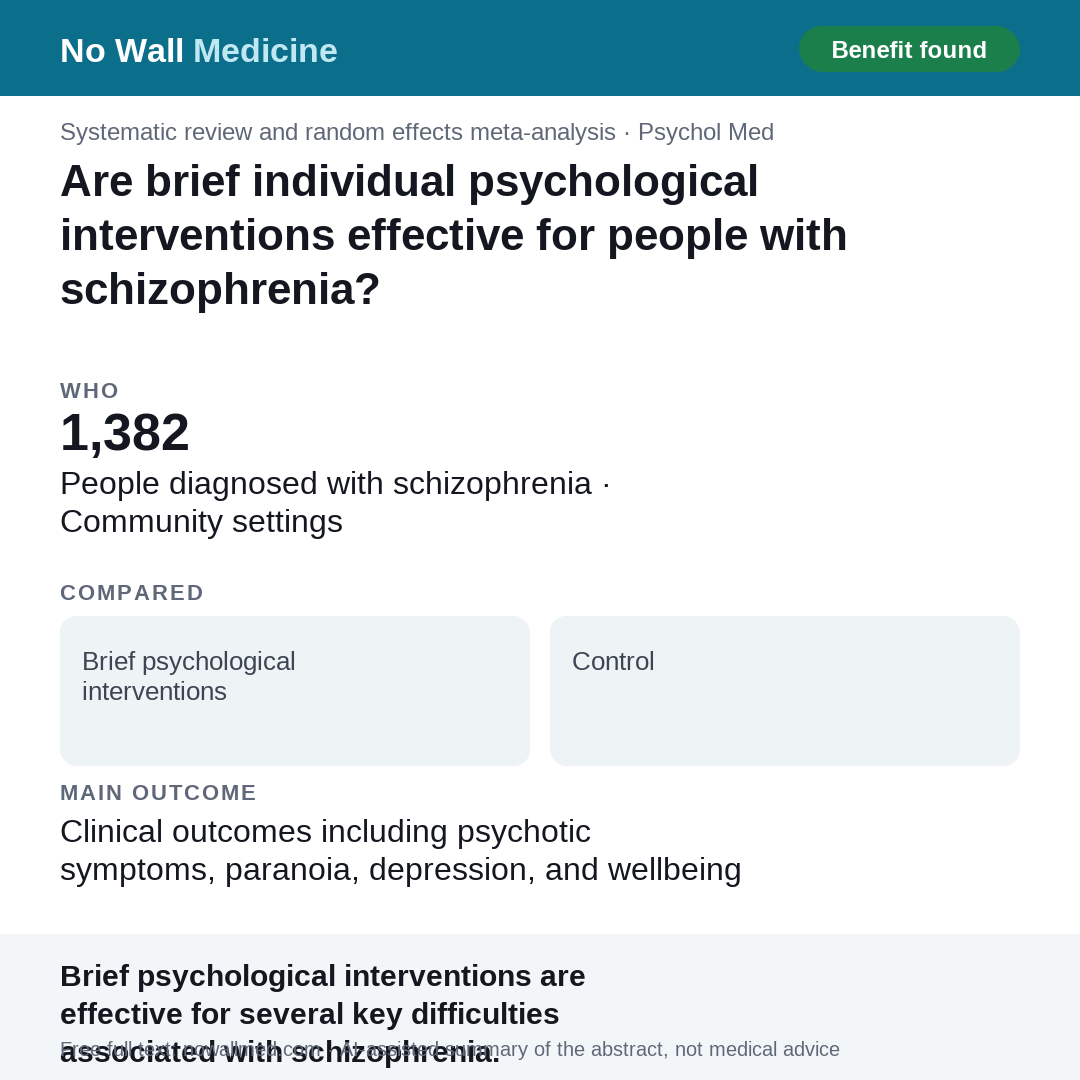
Clinical question: Are brief individual psychological interventions effective for people with schizophrenia?
Abstract
Background
Although cognitive behavioral therapy for people diagnosed with schizophrenia (CBTp) is recommended in clinical guidelines internationally, rates of implementation are low. One consequence of this has been the development of brief individual psychological interventions, which are shorter than the recommended minimum of 16 sessions for CBTp. This article is the first to systematically identify the brief interventions that exist for people diagnosed with schizophrenia and to determine their effectiveness using meta-analysis. Methods
Five electronic databases (PsycINFO, MEDLINE, CINAHL, EMBASE, and Web of Science) were searched for peer-reviewed randomized controlled trials or experimental studies of brief individual psychological interventions delivered in community settings. Random effects meta-analysis was used to integrate effect sizes, due to the heterogeneity of included studies. Results
Fourteen studies were identified (n = 1,382) that measured thirty clinical outcomes and included six intervention types - brief CBT, memory training, digital motivation support, reasoning training, psychoeducation, and virtual reality. Collectively, brief psychological interventions were found to be effective for psychotic symptoms (SMD -0.285, p < 0.01), paranoia (SMD -0.277, p < 0.05), data gathering (SMD 0.38, p < 0.01), depression (SMD -0.906, p < 0.05) and wellbeing (SMD 0.405, p < 0.01). For intervention types, brief CBT was effective for psychotic symptoms (SMD -0.32, p < .001), and reasoning training was effective for data gathering (SMD 0.38, p < 0.01). Conclusions
Overall, the evidence suggests that brief psychological interventions are effective for several key difficulties associated with schizophrenia, providing an opportunity to improve both access to, and choice of, treatment for individuals diagnosed with schizophrenia.
Topics
Cite this article
Pike B, Ambrosio L, Ellett L. Brief psychological interventions for schizophrenia: a systematic review and meta-analysis. Psychol Med. 2025. doi:10.1017/S0033291725001126
Spotted a mistake? Suggest a correction
Top studies every Monday
The week’s key trials and guidelines in your specialties, by email. Free.
Get the weekly digest