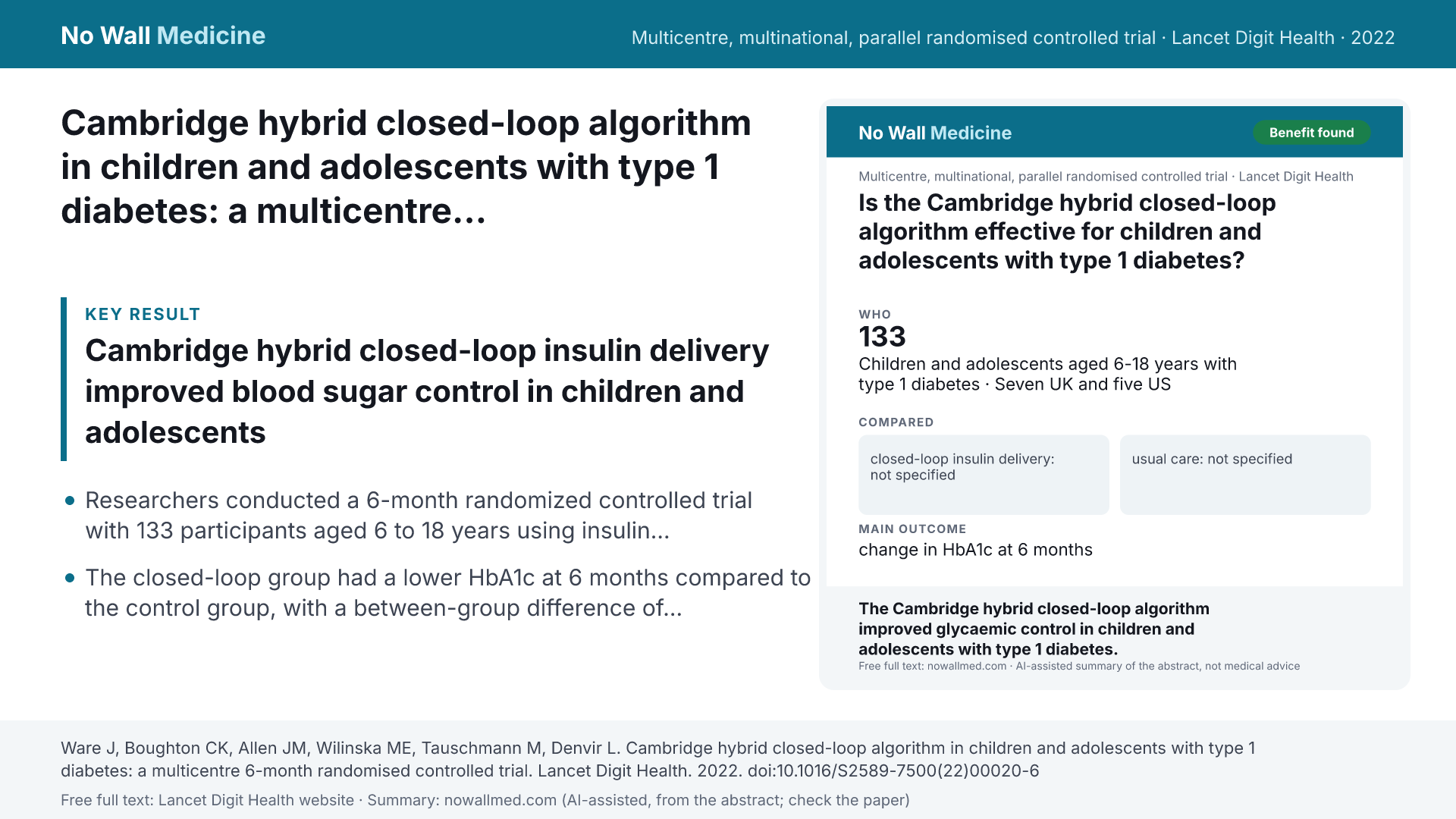
Cambridge hybrid closed-loop insulin delivery improved blood sugar control in children and adolescents
Cambridge hybrid closed-loop algorithm in children and adolescents with type 1 diabetes: a multicentre 6-month randomised controlled trial
Multicentre, multinational, parallel randomised controlled trialBenefit found
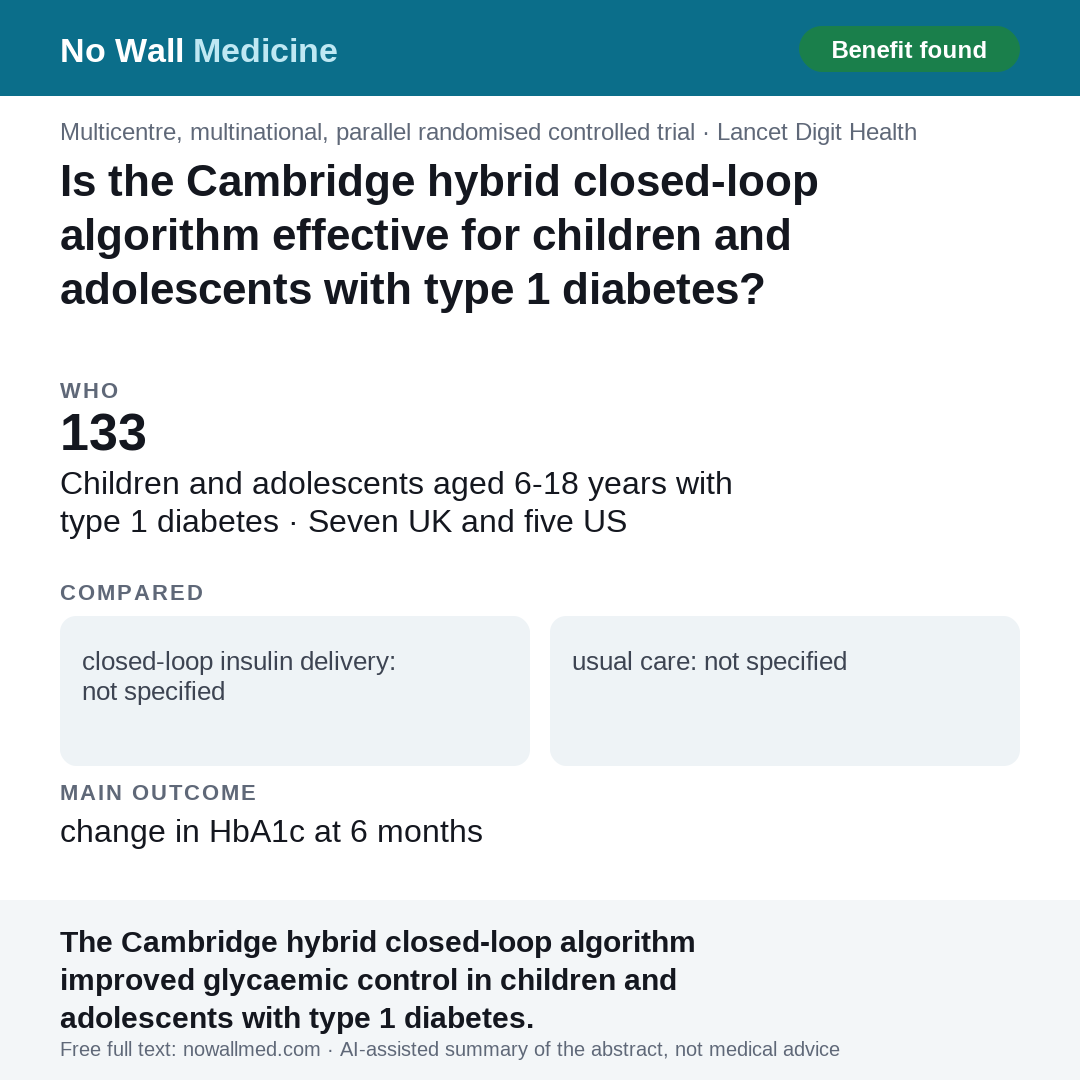
Is the Cambridge hybrid closed-loop algorithm effective for children and adolescents with type 1 diabetes?
Who
133
Children and adolescents aged 6-18 years with type 1 diabetes · Seven UK and five US paediatric diabetes centres
Compared
closed-loop insulin delivery: not specified
usual care: not specified
Main outcome
change in HbA1c at 6 months
Result: -3.5 mmol/mol (95% CI -6.5 to -0.5 [-0.32 percentage points, -0.59 to -0.04]; p=0.023)
Bottom line: The Cambridge hybrid closed-loop algorithm improved glycaemic control in children and adolescents with type 1 diabetes.
Funded by: National Institute of Diabetes and Digestive and Kidney Diseases
Lancet Digit Health · 2022-03-07Download image
Clinical question: Is the Cambridge hybrid closed-loop algorithm effective for children and adolescents with type 1 diabetes?
Why it matters: It was unknown if a hybrid closed-loop insulin delivery system could safely and effectively improve glucose control in children and adolescents with type 1 diabetes.
Key points
- Researchers conducted a 6-month randomized controlled trial with 133 participants aged 6 to 18 years using insulin pump therapy.
- The closed-loop group had a lower HbA1c at 6 months compared to the control group, with a between-group difference of -3.5 mmol/mol.
- A total of 155 adverse events occurred, including seven severe hypoglycemia events and two diabetic ketoacidosis events, both of which were in the closed-loop group.
Headline and key points written with AI from the paper’s abstract, with every number checked against it. Read the paper before relying on them.
Was this summary helpful?
Abstract
Background
Closed-loop insulin delivery systems have the potential to address suboptimal glucose control in children and adolescents with type 1 diabetes. We compared safety and efficacy of the Cambridge hybrid closed-loop algorithm with usual care over 6 months in this population. Methods
In a multicentre, multinational, parallel randomised controlled trial, participants aged 6-18 years using insulin pump therapy were recruited at seven UK and five US paediatric diabetes centres. Key inclusion criteria were diagnosis of type 1 diabetes for at least 12 months, insulin pump therapy for at least 3 months, and screening HbA1c levels between 53 and 86 mmol/mol (7·0-10·0%). Using block randomisation and central randomisation software, we randomly assigned participants to either closed-loop insulin delivery (closed-loop group) or to usual care with insulin pump therapy (control group) for 6 months. Randomisation was stratified at each centre by local baseline HbA1c. The Cambridge closed-loop algorithm running on a smartphone was used with either (1) a modified Medtronic 640G pump, Medtronic Guardian 3 sensor, and Medtronic prototype phone enclosure (FlorenceM configuration), or (2) a Sooil Dana RS pump and Dexcom G6 sensor (CamAPS FX configuration). The primary endpoint was change in HbA1c at 6 months combining data from both configurations. The primary analysis was done in all randomised patients (intention to treat). Trial registration ClinicalTrials.gov, NCT02925299. Findings
Of 147 people initially screened, 133 participants (mean age 13·0 years [SD 2·8]; 57% female, 43% male) were randomly assigned to either the closed-loop group (n=65) or the control group (n=68). Mean baseline HbA1c was 8·2% (SD 0·7) in the closed-loop group and 8·3% (0·7) in the control group. At 6 months, HbA1c was lower in the closed-loop group than in the control group (between-group difference -3·5 mmol/mol (95% CI -6·5 to -0·5 [-0·32 percentage points, -0·59 to -0·04]; p=0·023). Closed-loop usage was low with FlorenceM due to failing phone enclosures (median 40% [IQR 26-53]), but consistently high with CamAPS FX (93% [88-96]), impacting efficacy. A total of 155 adverse events occurred after randomisation (67 in the closed-loop group, 88 in the control group), including seven severe hypoglycaemia events (four in the closed-loop group, three in the control group), two diabetic ketoacidosis events (both in the closed-loop group), and two non-treatment-related serious adverse events. There were 23 reportable hyperglycaemia events (11 in the closed-loop group, 12 in the control group), which did not meet criteria for diabetic ketoacidosis. Interpretation
The Cambridge hybrid closed-loop algorithm had an acceptable safety profile, and improved glycaemic control in children and adolescents with type 1 diabetes. To ensure optimal efficacy of the closed-loop system, usage needs to be consistently high, as demonstrated with CamAPS FX. Funding
National Institute of Diabetes and Digestive and Kidney Diseases.
Abstract reproduced under the article’s CC BY licence.
Subject terms
Cite this article
Ware J, Boughton CK, Allen JM, Wilinska ME, Tauschmann M, Denvir L. Cambridge hybrid closed-loop algorithm in children and adolescents with type 1 diabetes: a multicentre 6-month randomised controlled trial. Lancet Digit Health. 2022. doi:10.1016/S2589-7500(22)00020-6
Spotted a mistake? Suggest a correction