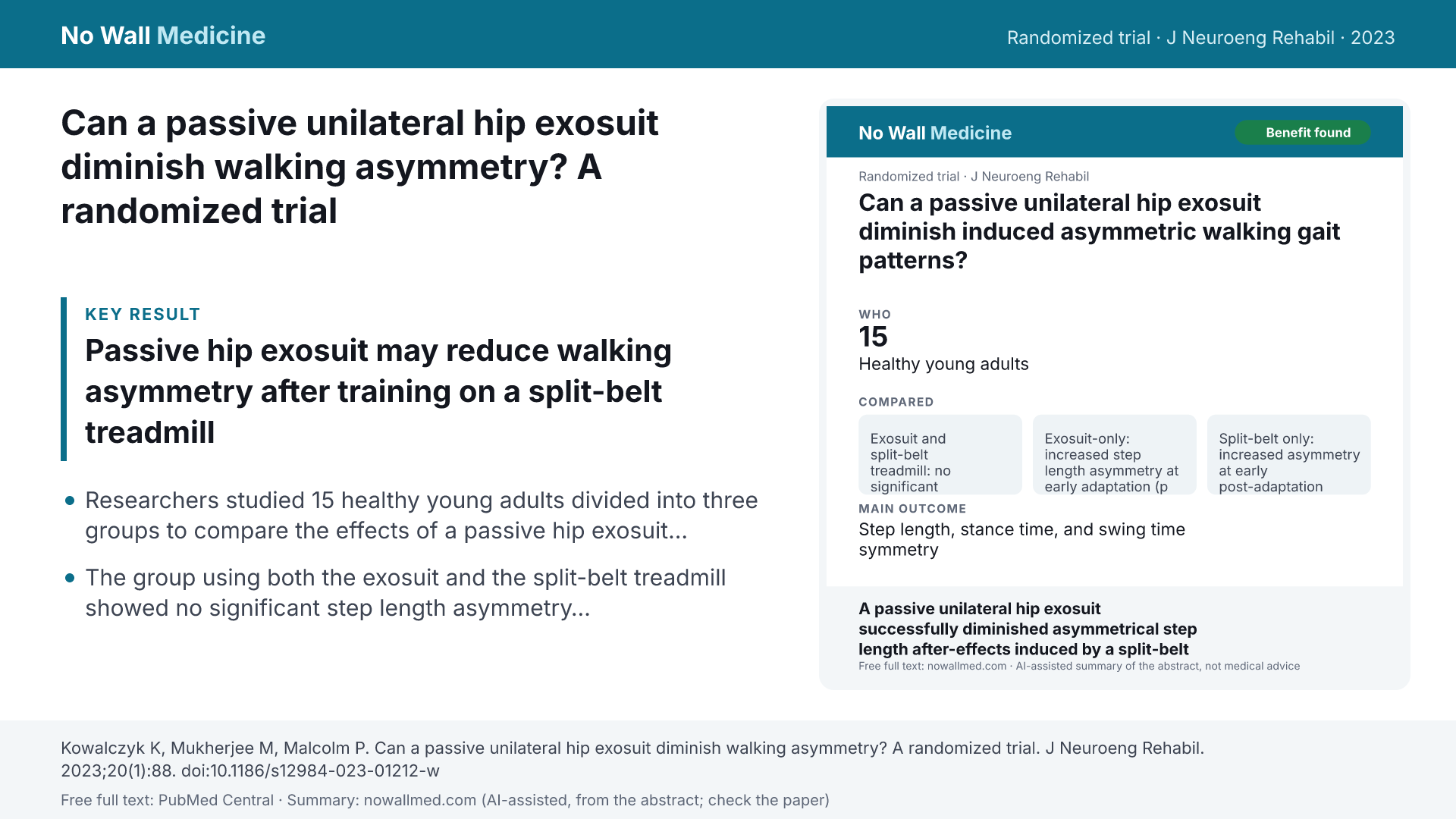
Passive hip exosuit may reduce walking asymmetry after training on a split-belt treadmill
Can a passive unilateral hip exosuit diminish walking asymmetry? A randomized trial
Randomized trialBenefit found
Can a passive unilateral hip exosuit diminish induced asymmetric walking gait patterns?
Who
15
Healthy young adults
Compared
Exosuit and split-belt treadmill: no significant after-effect between early post-adaptation and baseline (p = 0.0885)
Exosuit-only: increased step length asymmetry at early adaptation (p = 0.0392)
Split-belt only: increased asymmetry at early post-adaptation compared to baseline (p < 0.0001)
Main outcome
Step length, stance time, and swing time symmetry
Bottom line: A passive unilateral hip exosuit successfully diminished asymmetrical step length after-effects induced by a split-belt treadmill.
J Neuroeng Rehabil · 2023-07-12 · Save PNG
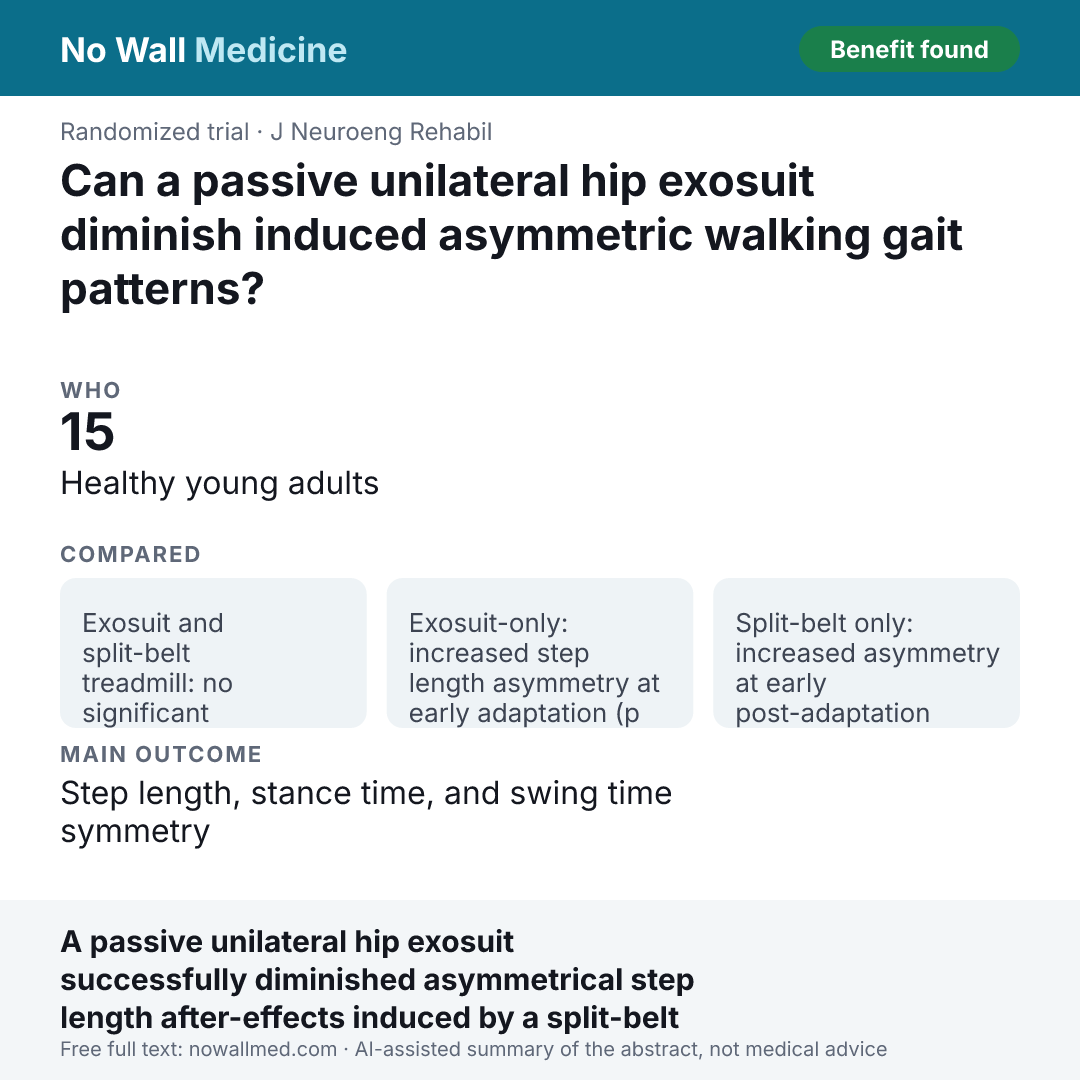
Clinical question: Can a passive unilateral hip exosuit diminish induced asymmetric walking gait patterns?
Key points
- Researchers studied 15 healthy young adults divided into three groups to compare the effects of a passive hip exosuit and split-belt treadmill training on walking symmetry.
- The group using both the exosuit and the split-belt treadmill showed no significant step length asymmetry after-effect between early post-adaptation and baseline (p = 0.0885).
- The split-belt treadmill only group showed increased step length asymmetry at early adaptation (p < 0.0001) and an after-effect at early post-adaptation (p < 0.0001).
Headline and key points written with AI from the paper’s abstract, with every number checked against it. Read the paper before relying on them.
Was this summary helpful?
Subject terms
Headline, design, result, key points, caveat and citation as plain text.
Cite this article
Kowalczyk K, Mukherjee M, Malcolm P. Can a passive unilateral hip exosuit diminish walking asymmetry? A randomized trial. J Neuroeng Rehabil. 2023;20(1):88. doi:10.1186/s12984-023-01212-w
Spotted a mistake? Suggest a correction