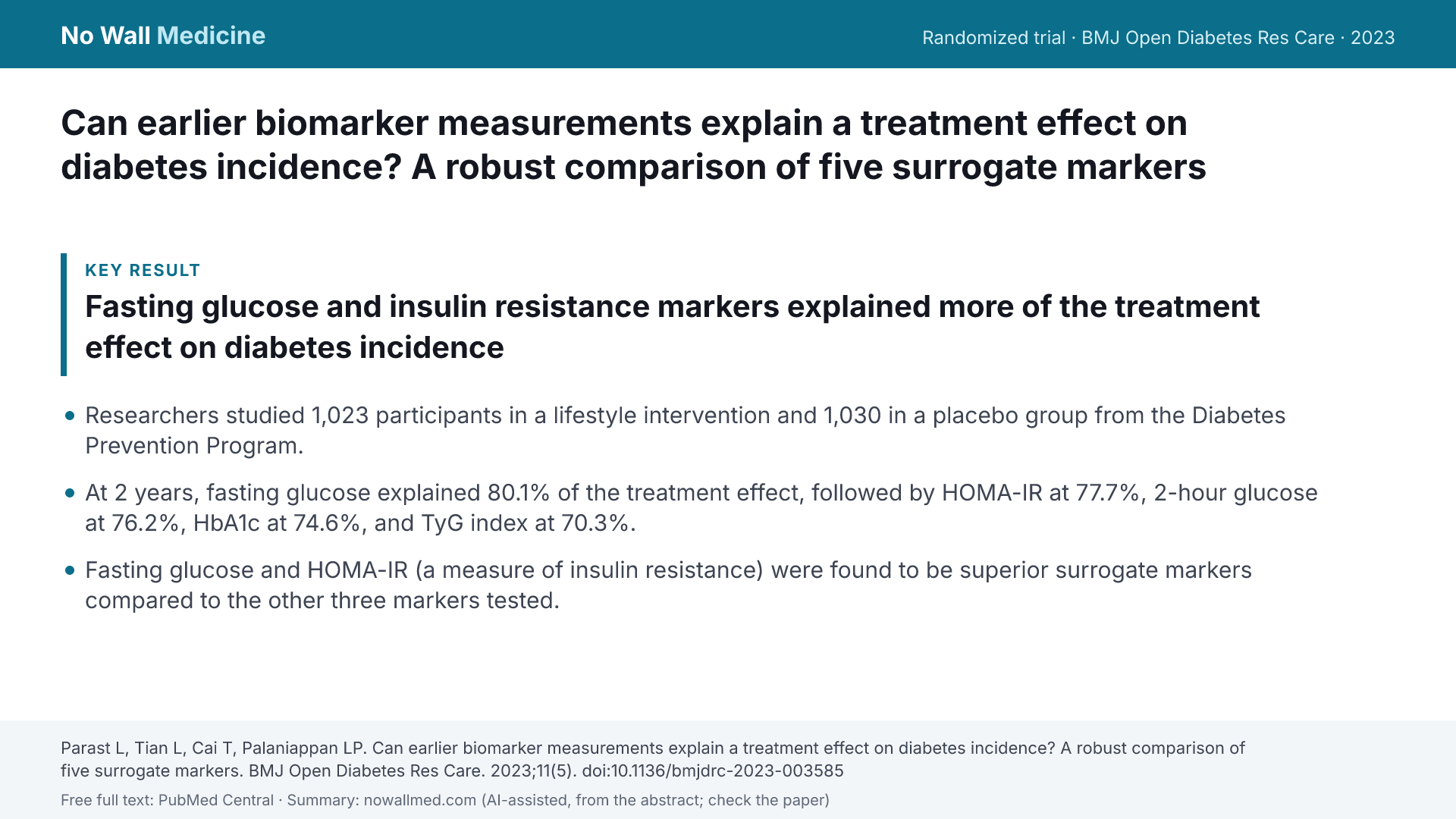
Fasting glucose and insulin resistance markers explained more of the treatment effect on diabetes incidence
Can earlier biomarker measurements explain a treatment effect on diabetes incidence? A robust comparison of five surrogate markers
Key points
- Researchers studied 1,023 participants in a lifestyle intervention and 1,030 in a placebo group from the Diabetes Prevention Program.
- At 2 years, fasting glucose explained 80.1% of the treatment effect, followed by HOMA-IR at 77.7%, 2-hour glucose at 76.2%, HbA1c at 74.6%, and TyG index at 70.3%.
- Fasting glucose and HOMA-IR (a measure of insulin resistance) were found to be superior surrogate markers compared to the other three markers tested.
Headline and key points written with AI from the paper’s abstract, with every number checked against it. Read the paper before relying on them.
Was this summary helpful?
Abstract
Introduction
We measured and compared five individual surrogate markers-change from baseline to 1 year after randomization in hemoglobin A1c (HbA1c), fasting glucose, 2-hour postchallenge glucose, triglyceride-glucose index (TyG) index, and homeostatic model assessment of insulin resistance (HOMA-IR)-in terms of their ability to explain a treatment effect on reducing the risk of type 2 diabetes mellitus at 2, 3, and 4 years after treatment initiation. Research design and methods
Study participants were from the Diabetes Prevention Program study, randomly assigned to either a lifestyle intervention (n=1023) or placebo (n=1030). The surrogate markers were measured at baseline and 1 year, and diabetes incidence was examined at 2, 3, and 4 years postrandomization. Surrogacy was evaluated using a robust model-free estimate of the proportion of treatment effect explained (PTE) by the surrogate marker. Results
Across all time points, change in fasting glucose and HOMA-IR explained higher proportions of the treatment effect than 2-hour glucose, TyG index, or HbA1c. For example, at 2 years, glucose explained the highest (80.1%) proportion of the treatment effect, followed by HOMA-IR (77.7%), 2-hour glucose (76.2%), and HbA1c (74.6%); the TyG index explained the smallest (70.3%) proportion. Conclusions
These data suggest that, of the five examined surrogate markers, glucose and HOMA-IR were the superior surrogate markers in terms of PTE, compared with 2-hour glucose, HbA1c, and TyG index.
Abstract reproduced under the article’s CC BY NC licence.
Subject terms
Headline, design, result, key points, caveat and citation as plain text.
Cite this article
Parast L, Tian L, Cai T, Palaniappan LP. Can earlier biomarker measurements explain a treatment effect on diabetes incidence? A robust comparison of five surrogate markers. BMJ Open Diabetes Res Care. 2023. doi:10.1136/bmjdrc-2023-003585
Spotted a mistake? Suggest a correction