Using implantable cardioverter-defibrillator data during ablation did not significantly change ventricular tachycardia recurrence rates
Can ICD Electrograms Help Ventricular Tachycardia Ablation?: Results From the Multicenter Randomized AIDEG-VTA Trial
Multicenter randomized trialMixed results
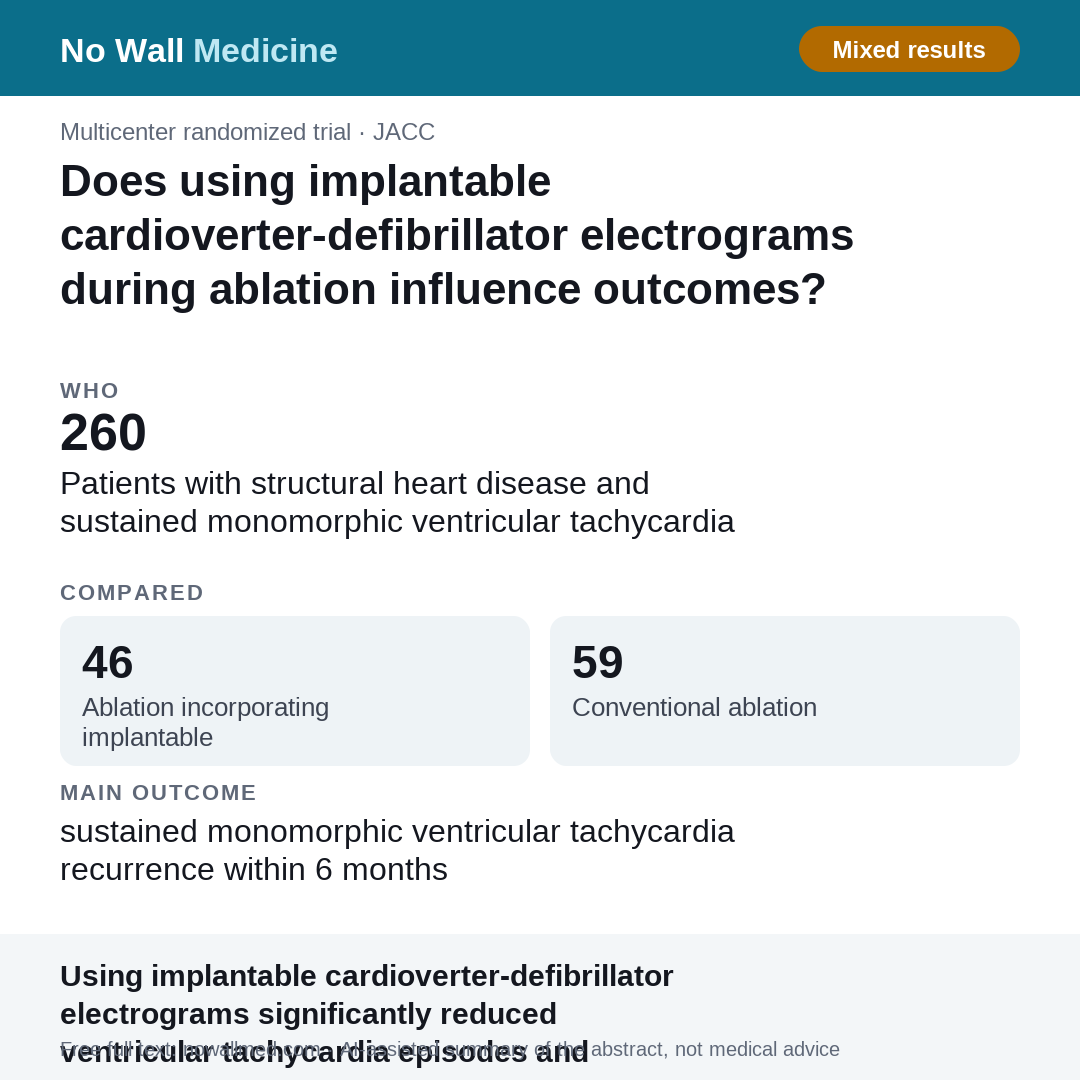
Does using implantable cardioverter-defibrillator electrograms during ablation influence outcomes?
Who
260
Patients with structural heart disease and sustained monomorphic ventricular tachycardia · 15 centers
Compared
46Ablation incorporating implantable cardioverter-defibrillator electrogram data (36%)
59Conventional ablation (46%)
Main outcome
sustained monomorphic ventricular tachycardia recurrence within 6 months
Result: hazard ratio 0.73 (95% CI 0.49-1.07)
Bottom line: Using implantable cardioverter-defibrillator electrograms significantly reduced ventricular tachycardia episodes and electrical storm but did not significantly decrease recurrence.
JACC · 2025-01-08Download image
Clinical question: Does using implantable cardioverter-defibrillator electrograms during ablation influence outcomes?
Why it matters: It is unknown if using electrical signals from an implantable cardioverter-defibrillator to target specific heart rhythms during ablation improves patient outcomes.
Key points
- Researchers randomized 260 patients with structural heart disease and sustained monomorphic ventricular tachycardia to receive either conventional ablation or ablation incorporating implantable cardioverter-defibrillator electrograms.
- In the intention-to-treat analysis, 6-month recurrence occurred in 36% of the intervention group and 46% of the conventional group, which was not a statistically significant difference.
- The intervention group had a significantly lower number of ventricular tachycardia episodes and a lower rate of electrical storm, which is 23% compared to 41%.
Headline and key points written with AI from the paper’s abstract, with every number checked against it. Read the paper before relying on them.
Topics
Cite this article
Ibáñez Criado JL, Ortiz M, García-Fernández J, Martínez-Alday JD, Rodríguez Font E, Moreno J. Can ICD Electrograms Help Ventricular Tachycardia Ablation?: Results From the Multicenter Randomized AIDEG-VTA Trial. JACC. 2025. doi:10.1016/j.jacc.2024.10.104
Spotted a mistake? Suggest a correction
Top studies every Monday
The week’s key trials and guidelines in your specialties, by email. Free.
Get the weekly digest