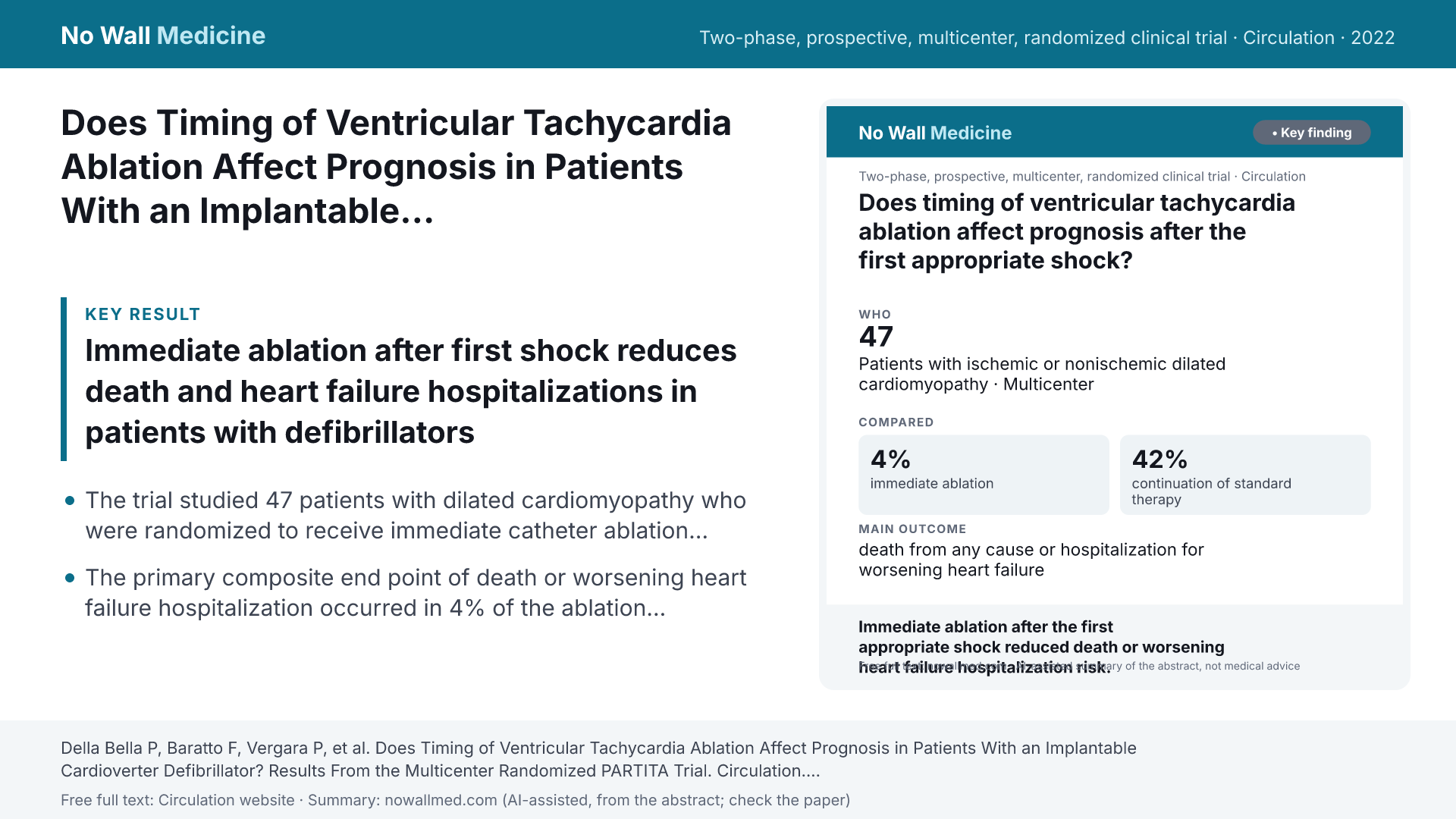
Immediate ablation after first shock reduces death and heart failure hospitalizations in patients with defibrillators
Does Timing of Ventricular Tachycardia Ablation Affect Prognosis in Patients With an Implantable Cardioverter Defibrillator? Results From the Multicenter Randomized PARTITA Trial
Two-phase, prospective, multicenter, randomized clinical trialKey finding
Does timing of ventricular tachycardia ablation affect prognosis after the first appropriate shock?
Who
47
Patients with ischemic or nonischemic dilated cardiomyopathy · Multicenter
Compared
4%immediate ablation
42%continuation of standard therapy
Main outcome
death from any cause or hospitalization for worsening heart failure
Result: hazard ratio 0.11 (95% CI 0.01-0.85)
Bottom line: Immediate ablation after the first appropriate shock reduced death or worsening heart failure hospitalization risk.
Circulation · 2022-04-03 · Save PNG
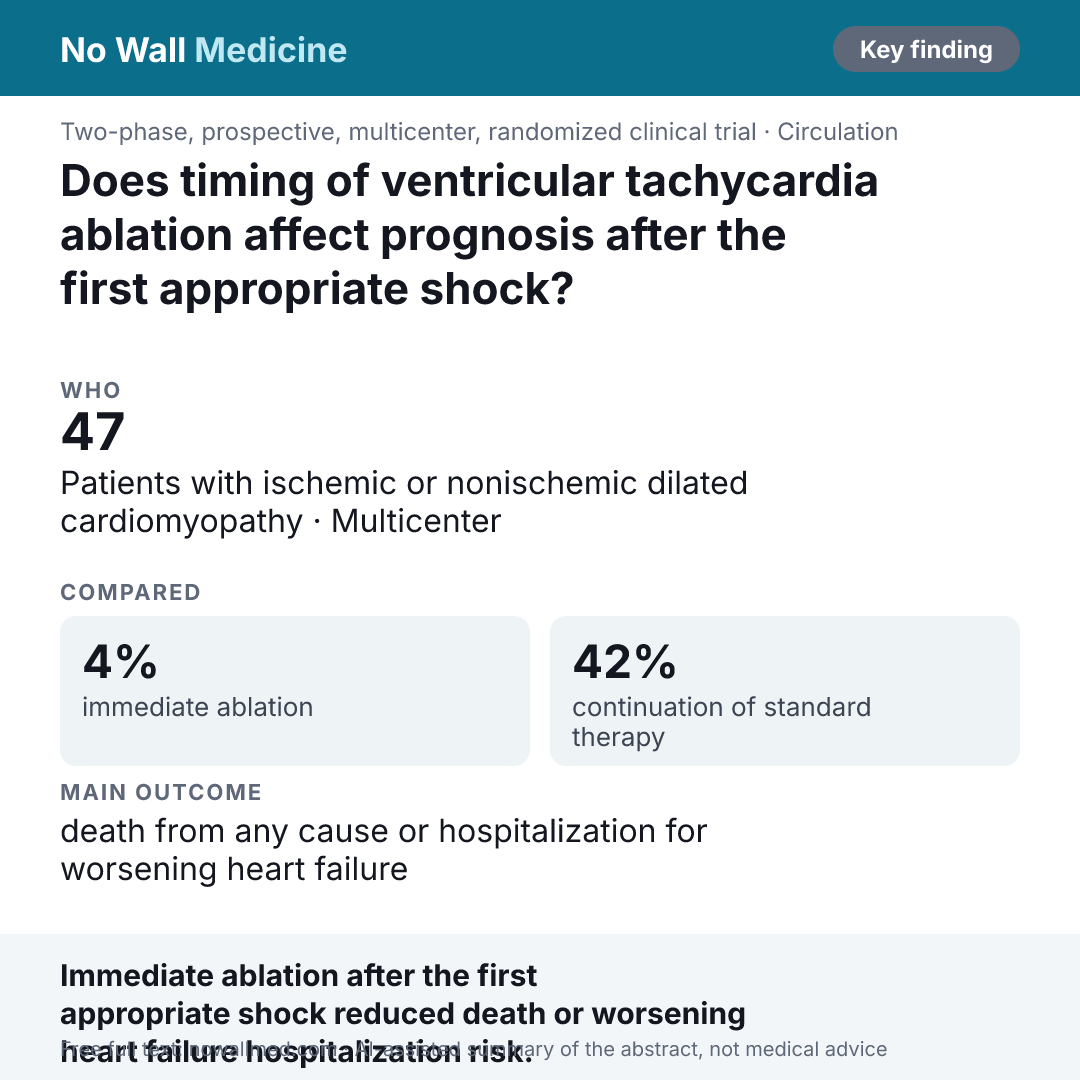
Clinical question: Does timing of ventricular tachycardia ablation affect prognosis after the first appropriate shock?
Key points
- The trial studied 47 patients with dilated cardiomyopathy who were randomized to receive immediate catheter ablation for ventricular tachycardia or continue standard therapy after their first appropriate shock.
- The primary composite end point of death or worsening heart failure hospitalization occurred in 4% of the ablation group compared to 42% in the control group.
- No deaths were observed in the ablation group versus 8 deaths (33%) in the control group, and implantable cardioverter defibrillator shocks were 9% in the ablation group versus 42% in the control group.
Headline and key points written with AI from the paper’s abstract, with every number checked against it. Read the paper before relying on them.
Was this summary helpful?
Subject terms
Headline, design, result, key points, caveat and citation as plain text.
Cite this article
Della Bella P, Baratto F, Vergara P, et al. Does Timing of Ventricular Tachycardia Ablation Affect Prognosis in Patients With an Implantable Cardioverter Defibrillator? Results From the Multicenter Randomized PARTITA Trial. Circulation. 2022;145(25):1829-1838. doi:10.1161/CIRCULATIONAHA.122.059598
Spotted a mistake? Suggest a correction