Can Lifestyle and Behavioral Interventions Improve Weight Management in Individuals With Spinal Cord Injury? A Systematic Review and Meta-analysis
Systematic review and meta-analysis of 5 randomized controlled trialsBenefit found
Do lifestyle and behavioral interventions improve weight management in individuals with spinal cord injury?
Who
Individuals with spinal cord injury
Compared
Exercise regimen: BMI decrease mean difference -0.38 kg/m2
Usual activities: BMI decrease mean difference -0.38 kg/m2
Main outcome
Anthropometric indices and body composition
Result: mean difference -0.38 kg/m2 (95% CI, -0.57 to -0.19)
Bottom line: Exercise regimens compared to usual activities decrease body mass index and waist circumference in individuals with spinal cord injury.
Arch Phys Med Rehabil · 2024-11-12Download image
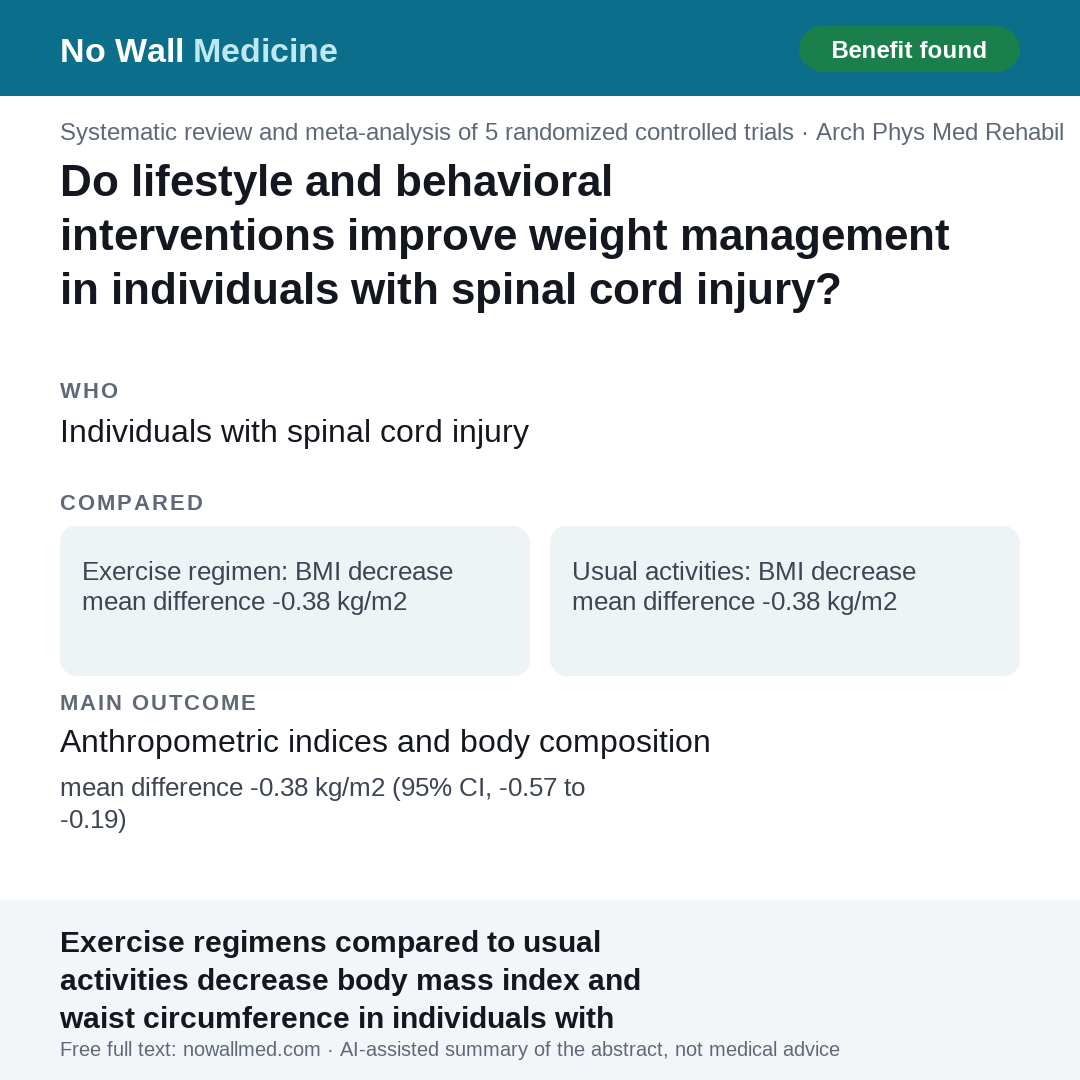
Clinical question: Do lifestyle and behavioral interventions improve weight management in individuals with spinal cord injury?
Abstract
Objective
To evaluate the effect of lifestyle and behavioral interventions on anthropometric indices and body composition in individuals with spinal cord injury (SCI). Data sources
MEDLINE, EMBASE, Web of Science, and Cochrane Library were searched from inception to January 22, 2024. Study selection
Randomized controlled trials (RCTs), non-RCTs, and pre-post studies on the effectiveness of lifestyle and/or behavioral interventions in improving body composition (including body mass index, waist circumference, fat mass, and lean mass) were eligible. Data extraction
Study design characteristics, number of participants, intervention/control characteristics, and outcomes were extracted. Data synthesis
Sixty-one interventional studies were included in the systematic review, among which 5 RCTs contributed to meta-analysis. Exercise, alone or combined with functional electrical stimulation (FES), supplements, or educational sessions, was the most studied intervention across the identified studies, accounting for 75% of studies. Exercise regimen compared with the usual activities yielded a decrease in BMI (mean difference [MD], -0.38 kg/m2; 95% CI, -0.57 to -0.19; I2: 0%; Pq:.45]) and waist circumference (MD, -2.93 cm; 95% CI, -3.98 to -1.88; I2: 0%; Pq: 0.59). No significant differences were observed when comparing changes in total body fat percentage nor lean body mass between the 2 groups. Exercise with FES and testosterone, exercise and personalized diet, high-protein diet, and α-lipoic acid supplementation were mapped as other potentially beneficial interventions, whereas studies targeting behavioral changes were inconclusive. Conclusions
Exercise-based interventions alone or combined with FES or standardized/personalized dietary regimens show promise as effective strategies for improving anthropometric indices and body composition among individuals with SCI, emphasizing the potential benefit of the weight management program. The present findings may not be applicable to individuals with high SCI lesions. Further research to evaluate the effectiveness of a more complex lifestyle and/or behavioral interventions in individuals with SCI is warranted.
Subject terms
Cite this article
Chieh C, Stojic S, Boehl G, Wong S, Lüscher J, Bertolo A. Can Lifestyle and Behavioral Interventions Improve Weight Management in Individuals With Spinal Cord Injury? A Systematic Review and Meta-analysis. Arch Phys Med Rehabil. 2024. doi:10.1016/j.apmr.2024.10.014
Spotted a mistake? Suggest a correction
Top studies every Monday
The week’s key trials and guidelines in your specialties, plus any topics you follow. By email, free.
Get the weekly digest