Functional electrical stimulation cycling exercise after spinal cord injury: a systematic review of health and fitness-related outcomes
Systematic reviewBenefit found
Does functional electrical stimulation cycling exercise improve health and fitness after spinal cord injury?
Who
999
Adults with spinal cord injury
Compared
Functional electrical stimulation cycling
Control
Main outcome
Muscle health, power output, and aerobic fitness
Bottom line: Functional electrical stimulation cycling improves muscle health and may increase power output and aerobic fitness in adults with spinal cord injury.
Limitation: Lacking Level 1-2 studies for power output and aerobic fitness outcomes.
J Neuroeng Rehabil · 2021-06-12Download image
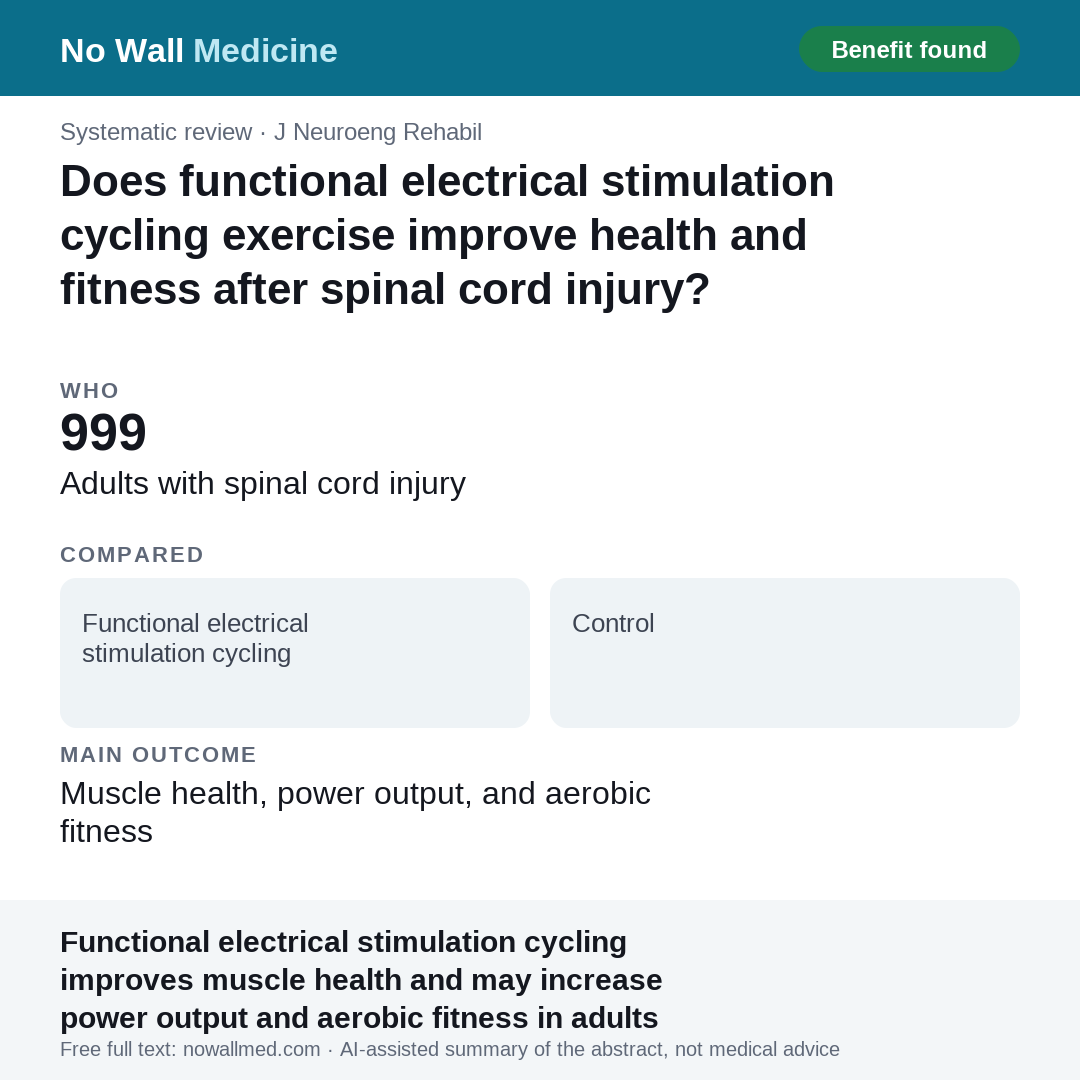
Clinical question: Does functional electrical stimulation cycling exercise improve health and fitness after spinal cord injury?
Abstract
Objectives
The objective of this review was to summarize and appraise evidence on functional electrical stimulation (FES) cycling exercise after spinal cord injury (SCI), in order to inform the development of evidence-based clinical practice guidelines. Methods
PubMed, the Cochrane Central Register of Controlled Trials, EMBASE, SPORTDiscus, and CINAHL were searched up to April 2021 to identify FES cycling exercise intervention studies including adults with SCI. In order to capture the widest array of evidence available, any outcome measure employed in such studies was considered eligible. Two independent reviewers conducted study eligibility screening, data extraction, and quality appraisal using Cochranes' Risk of Bias or Downs and Black tools. Each study was designated as a Level 1, 2, 3 or 4 study, dependent on study design and quality appraisal scores. The certainty of the evidence for each outcome was assessed using GRADE ratings ('High', 'Moderate', 'Low', or 'Very low'). Results
Ninety-two studies met the eligibility criteria, comprising 999 adults with SCI representing all age, sex, time since injury, lesion level and lesion completeness strata. For muscle health (e.g., muscle mass, fiber type composition), significant improvements were found in 3 out of 4 Level 1-2 studies, and 27 out of 32 Level 3-4 studies (GRADE rating: 'High'). Although lacking Level 1-2 studies, significant improvements were also found in nearly all of 35 Level 3-4 studies on power output and aerobic fitness (e.g., peak power and oxygen uptake during an FES cycling test) (GRADE ratings: 'Low'). Conclusion
Current evidence indicates that FES cycling exercise improves lower-body muscle health of adults with SCI, and may increase power output and aerobic fitness. The evidence summarized and appraised in this review can inform the development of the first international, evidence-based clinical practice guidelines for the use of FES cycling exercise in clinical and community settings of adults with SCI. Registration review protocol: CRD42018108940 (PROSPERO).
Subject terms
Cite this article
van der Scheer JW, Goosey-Tolfrey VL, Valentino SE, Davis GM, Ho CH. Functional electrical stimulation cycling exercise after spinal cord injury: a systematic review of health and fitness-related outcomes. J Neuroeng Rehabil. 2021. doi:10.1186/s12984-021-00882-8
Spotted a mistake? Suggest a correction
Top studies every Monday
The week’s key trials and guidelines in your specialties, plus any topics you follow. By email, free.
Get the weekly digest