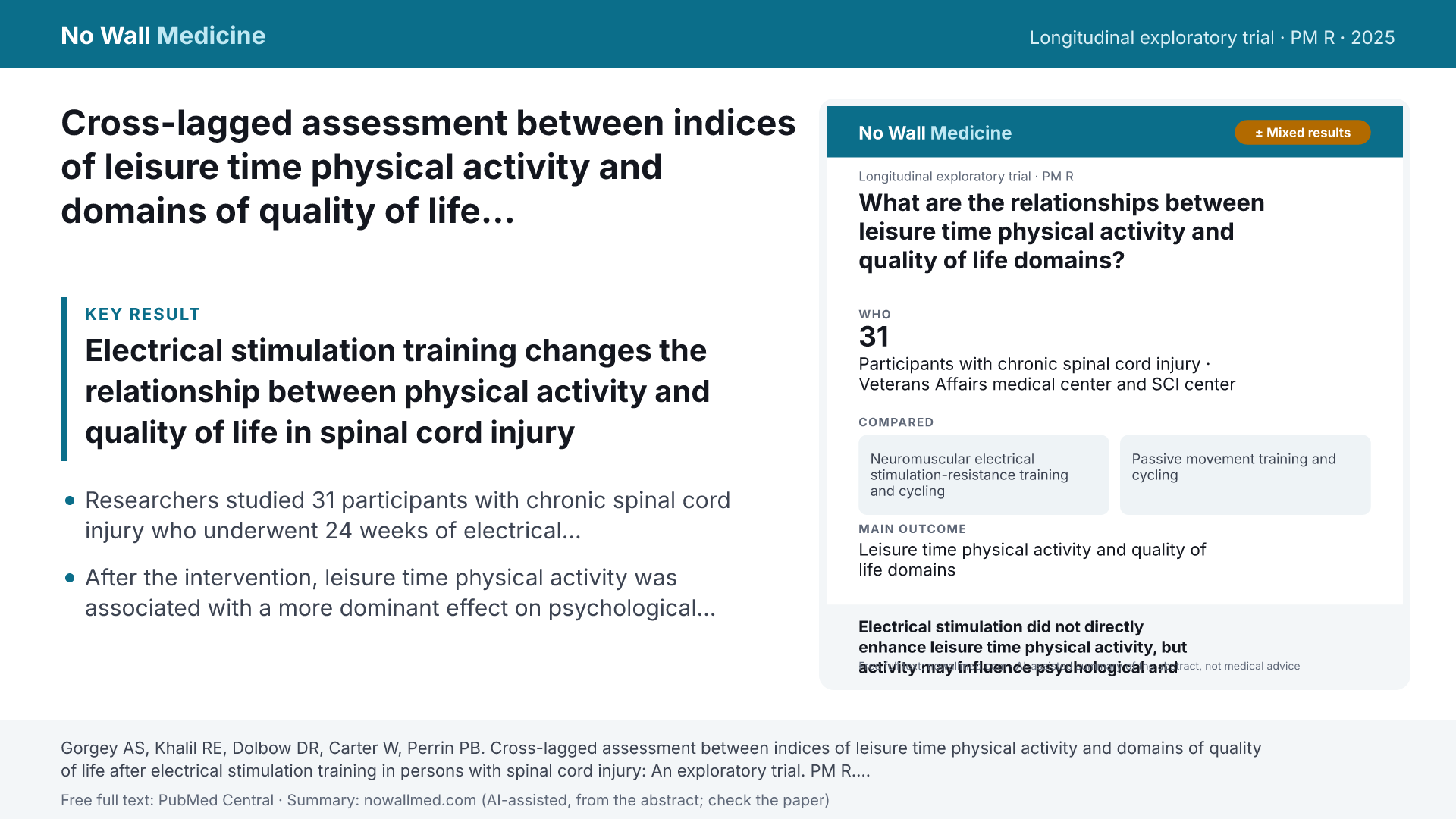
Electrical stimulation training changes the relationship between physical activity and quality of life in spinal cord injury
Cross-lagged assessment between indices of leisure time physical activity and domains of quality of life after electrical stimulation training in persons with spinal cord injury: An exploratory trial
Longitudinal exploratory trialMixed results
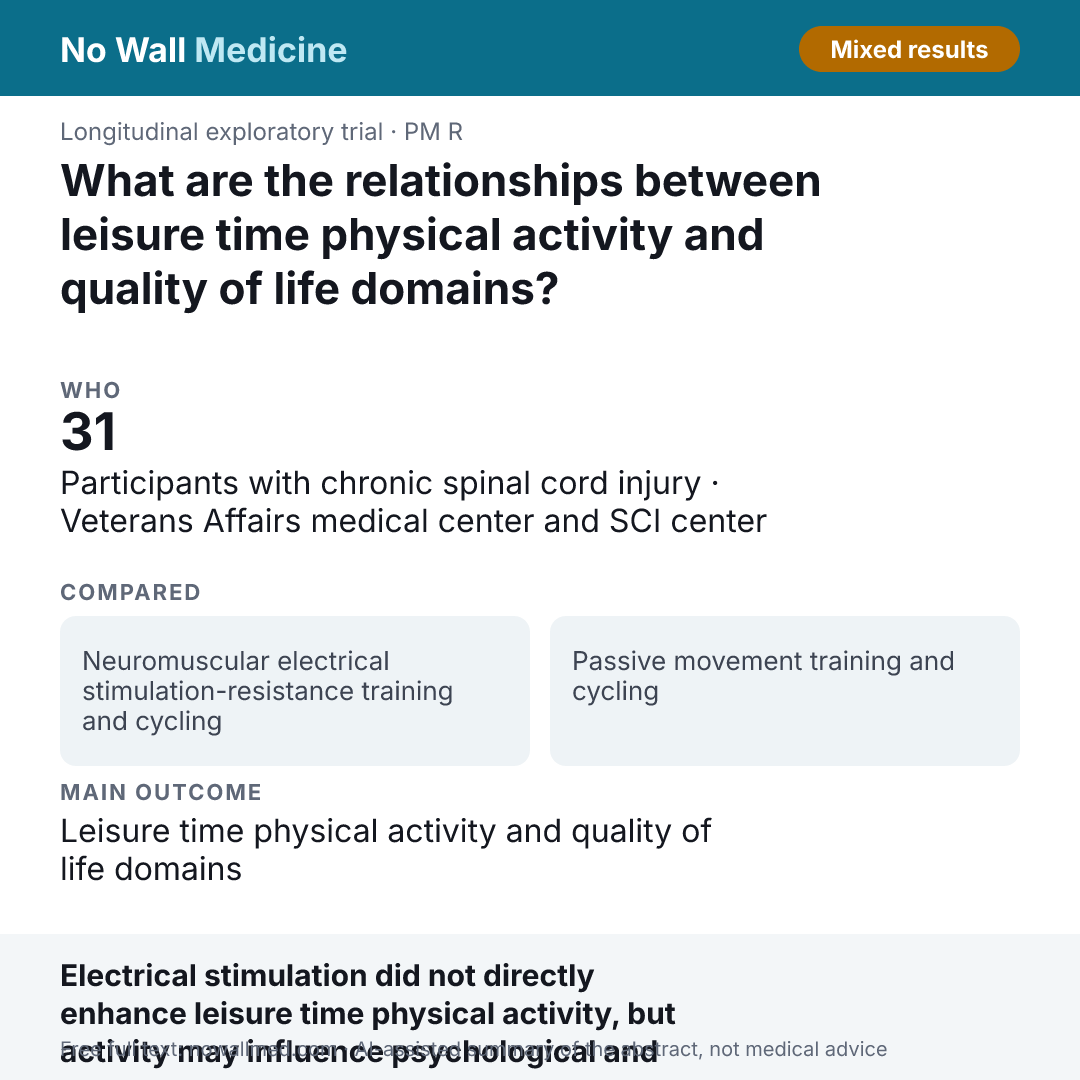
What are the relationships between leisure time physical activity and quality of life domains?
Who
31
Participants with chronic spinal cord injury · Veterans Affairs medical center and SCI center
Compared
Neuromuscular electrical stimulation-resistance training and cycling
Passive movement training and cycling
Main outcome
Leisure time physical activity and quality of life domains
Bottom line: Electrical stimulation did not directly enhance leisure time physical activity, but activity may influence psychological and social quality of life.
Limitation: Exploratory trial using a convenience sample
PM R · 2025-07-10 · Save PNG
Clinical question: What are the relationships between leisure time physical activity and quality of life domains?
Why it matters: The relative direction of causality between leisure time physical activity and quality of life domains before and after electrical stimulation training is not well studied.
Key points
- Researchers studied 31 participants with chronic spinal cord injury who underwent 24 weeks of electrical stimulation exercise programs.
- After the intervention, leisure time physical activity was associated with a more dominant effect on psychological health quality of life compared to the reverse.
- The 24 weeks of electrical stimulation training was not linked to a direct enhancement of leisure time physical activity indices.
Limitation the authors note: The study used a convenience sample of 31 participants.
Headline and key points written with AI from the paper’s abstract, with every number checked against it. Read the paper before relying on them.
Was this summary helpful?
Subject terms
Headline, design, result, key points, caveat and citation as plain text.
Cite this article
Gorgey AS, Khalil RE, Dolbow DR, Carter W, Perrin PB. Cross-lagged assessment between indices of leisure time physical activity and domains of quality of life after electrical stimulation training in persons with spinal cord injury: An exploratory trial. PM R. 2026;18(2):140-151. doi:10.1002/pmrj.13422
Spotted a mistake? Suggest a correction