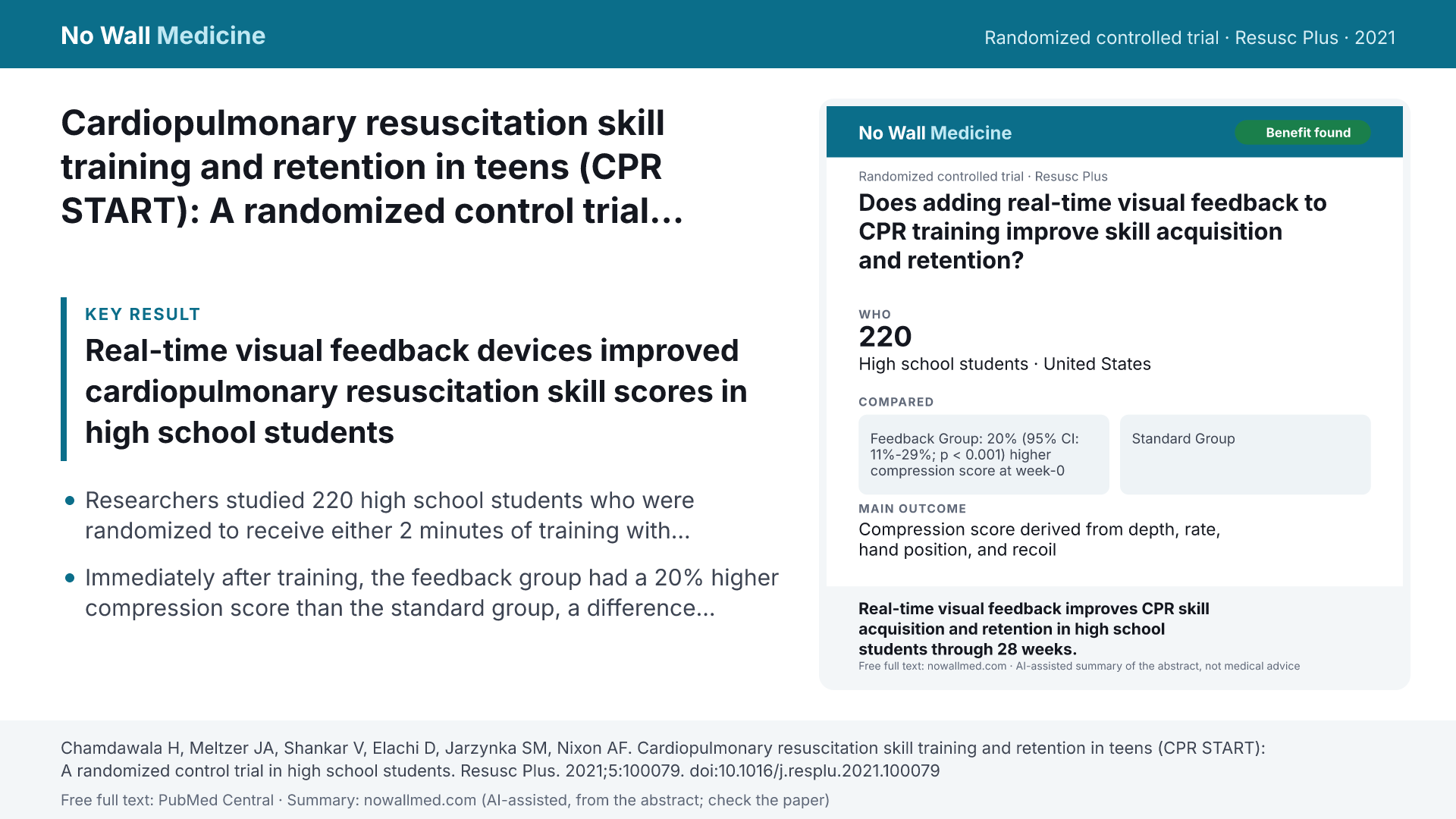
Cardiopulmonary resuscitation skill training and retention in teens (CPR START): A randomized control trial in high school students
Key result: Real-time visual feedback devices improved cardiopulmonary resuscitation skill scores in high school students
Randomized controlled trialBenefit found
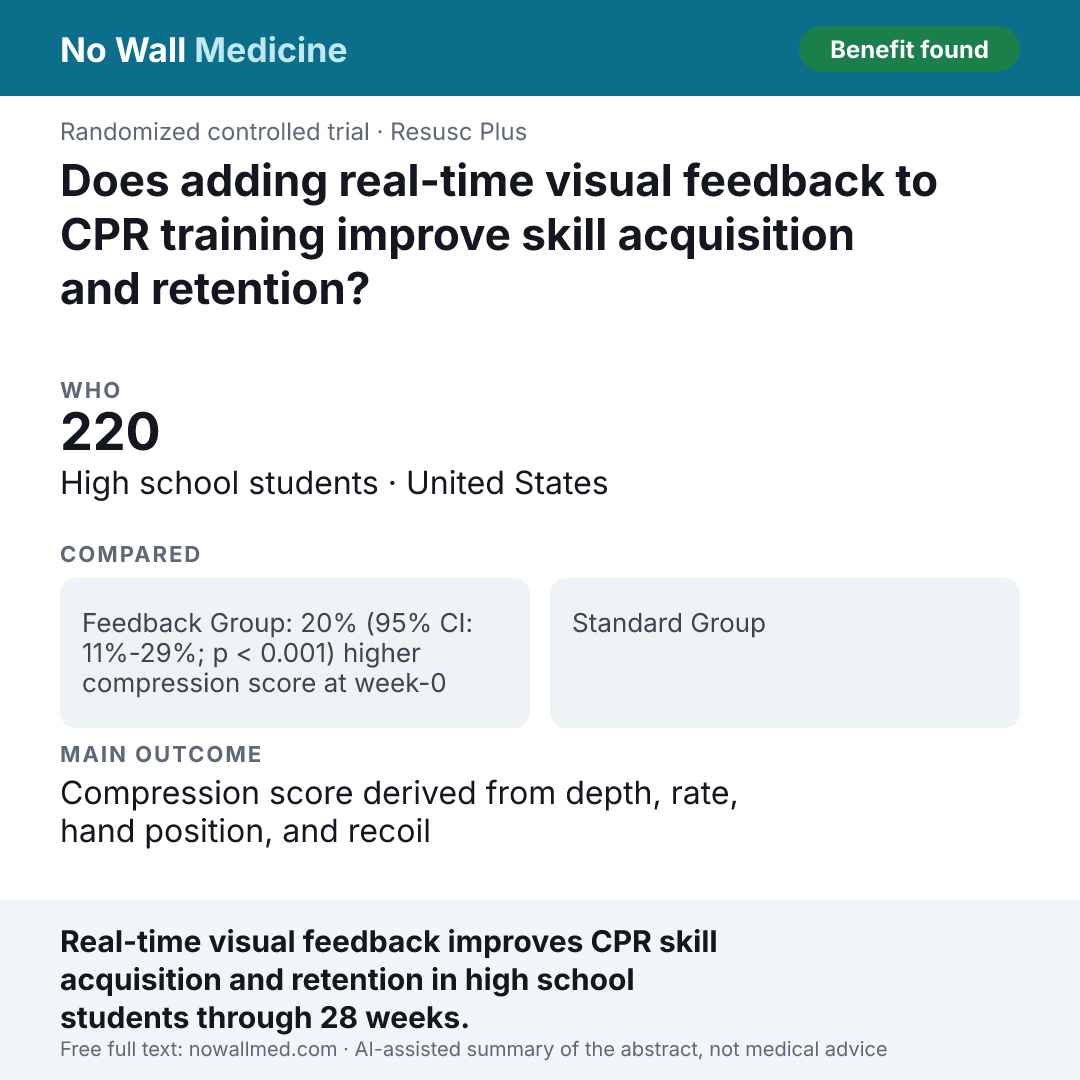
Does adding real-time visual feedback to CPR training improve skill acquisition and retention?
Who
220
High school students · United States
Compared
Feedback Group: 20% (95% CI: 11%-29%; p < 0.001) higher compression score at week-0
Standard Group
Main outcome
Compression score derived from depth, rate, hand position, and recoil
Result: adjusted difference: 20% (95% CI: 11%-29%; p < 0.001)
Bottom line: Real-time visual feedback improves CPR skill acquisition and retention in high school students through 28 weeks.
Resusc Plus · 2021-02-06 · Save PNG
Key points
- Researchers studied 220 high school students who were randomized to receive either 2 minutes of training with a real-time visual feedback device or standard instructor-led training.
- Immediately after training, the feedback group had a 20% higher compression score than the standard group, a difference that remained significant at week-10 and week-28.
- By the week-52 follow-up, there was no significant difference in compression scores between the two groups.
Discussion prompts
- Would these patients look like yours? Who was left out?
- Is the main outcome one that matters to patients?
- Is the difference large enough to change what you do?
Cite: Chamdawala H, Meltzer JA, Shankar V, Elachi D, Jarzynka SM, Nixon AF. Cardiopulmonary resuscitation skill training and retention in teens (CPR START): A randomized control trial in high school students. Resusc Plus. 2021;5:100079. doi:10.1016/j.resplu.2021.100079
Free full text: PubMed Central · Summary and visual abstract: nowallmed.com/a/cardiopulmonary-resuscitation-skill-training-and-retention-in-teens-4bhsv0/ (AI-assisted from the abstract; check the paper before relying on it).