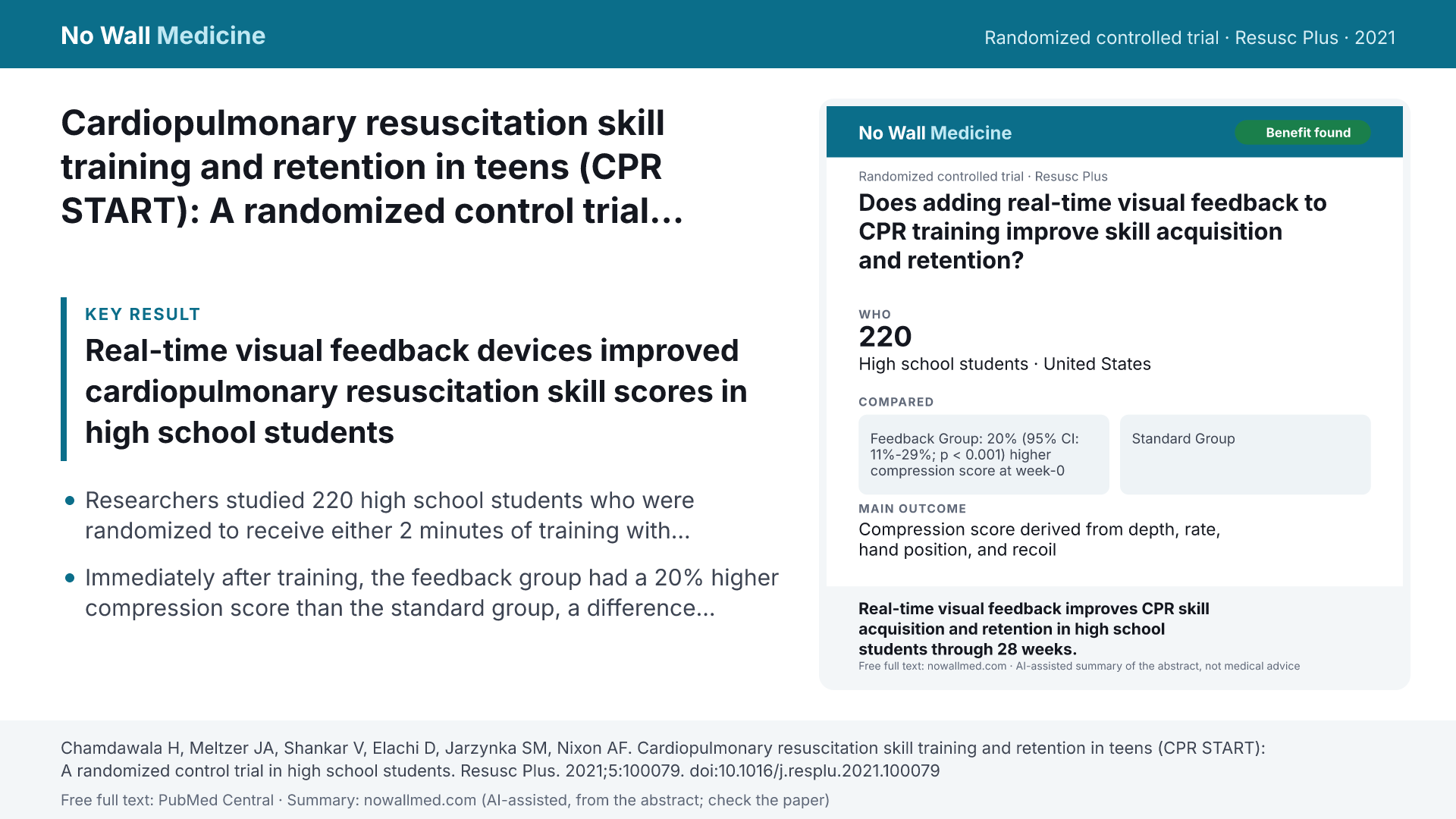
Real-time visual feedback devices improved cardiopulmonary resuscitation skill scores in high school students
Cardiopulmonary resuscitation skill training and retention in teens (CPR START): A randomized control trial in high school students
Randomized controlled trialBenefit found
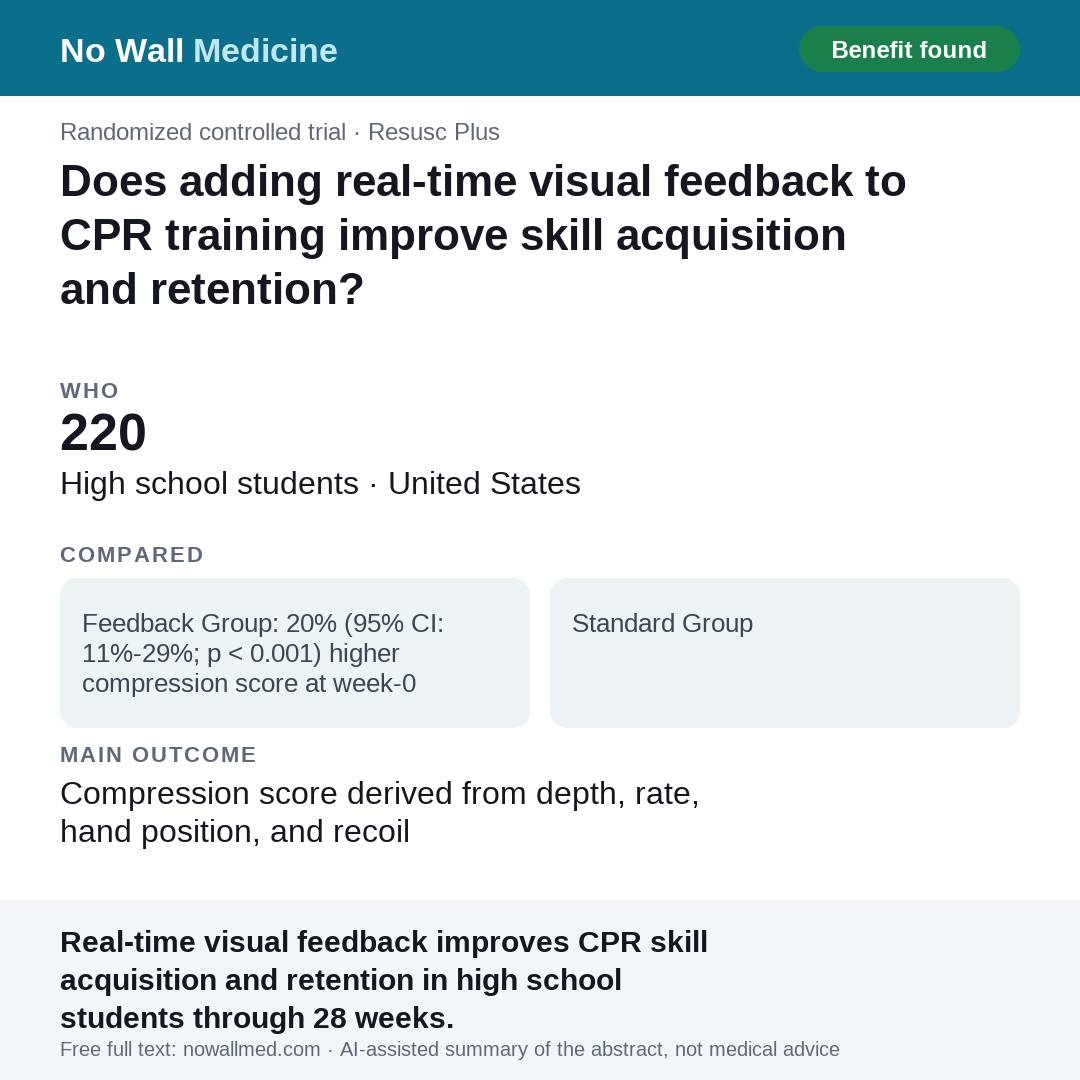
Does adding real-time visual feedback to CPR training improve skill acquisition and retention?
Who
220
High school students · United States
Compared
Feedback Group: 20% (95% CI: 11%-29%; p < 0.001) higher compression score at week-0
Standard Group
Main outcome
Compression score derived from depth, rate, hand position, and recoil
Result: adjusted difference: 20% (95% CI: 11%-29%; p < 0.001)
Bottom line: Real-time visual feedback improves CPR skill acquisition and retention in high school students through 28 weeks.
Resusc Plus · 2021-02-06Download image
Clinical question: Does adding real-time visual feedback to CPR training improve skill acquisition and retention?
Why it matters: It was unknown if adding a real-time visual feedback device to standard instructor-led cardiopulmonary resuscitation training improves how well students learn and retain skills.
Key points
- Researchers studied 220 high school students who were randomized to receive either 2 minutes of training with a real-time visual feedback device or standard instructor-led training.
- Immediately after training, the feedback group had a 20% higher compression score than the standard group, a difference that remained significant at week-10 and week-28.
- By the week-52 follow-up, there was no significant difference in compression scores between the two groups.
Headline and key points written with AI from the paper’s abstract, with every number checked against it. Read the paper before relying on them.
Was this summary helpful?
Cite this article
Chamdawala H, Meltzer JA, Shankar V, Elachi D, Jarzynka SM, Nixon AF. Cardiopulmonary resuscitation skill training and retention in teens (CPR START): A randomized control trial in high school students. Resusc Plus. 2021. doi:10.1016/j.resplu.2021.100079
Spotted a mistake? Suggest a correction