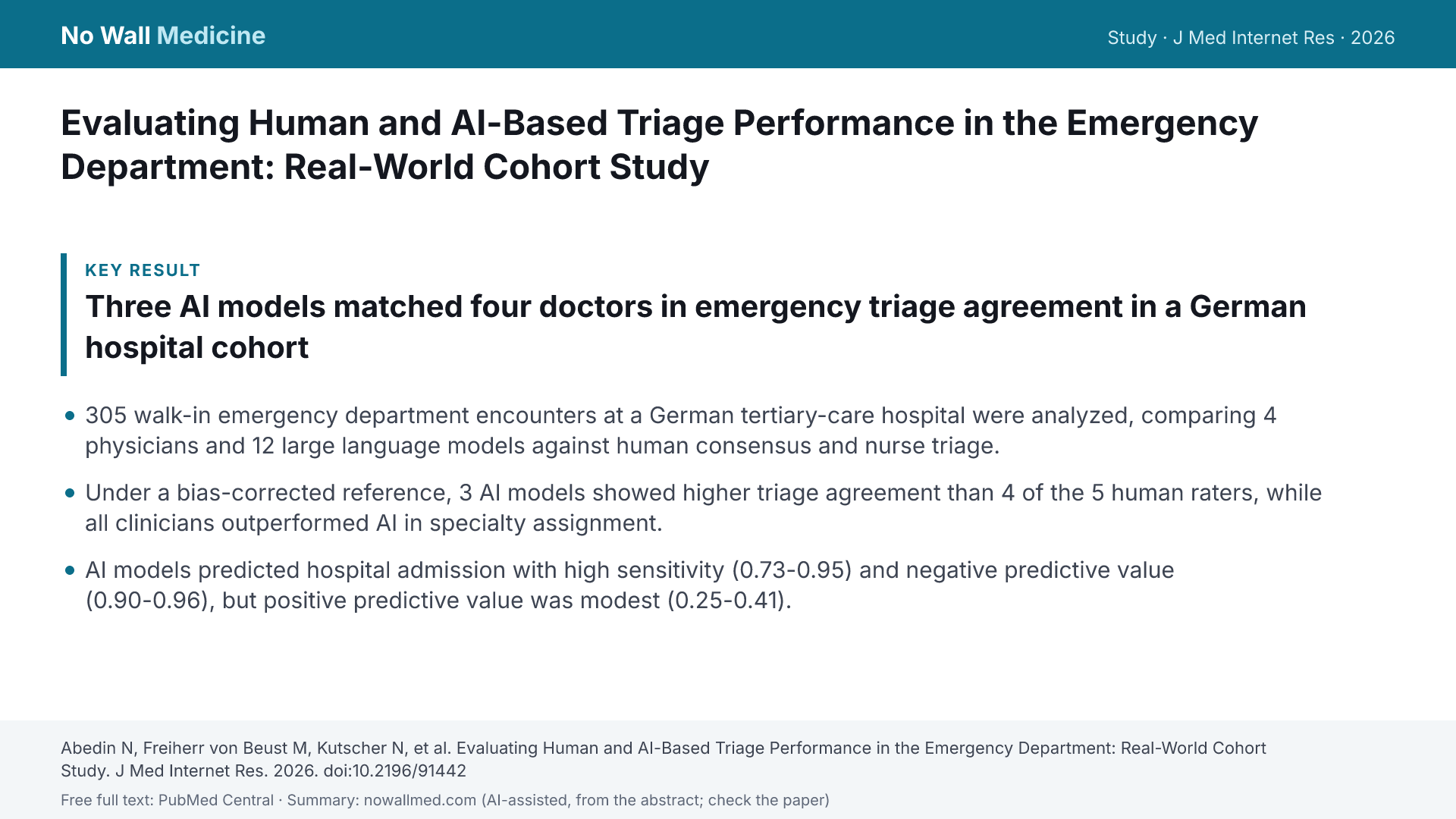
Three AI models matched four doctors in emergency triage agreement in a German hospital cohort
Evaluating Human and AI-Based Triage Performance in the Emergency Department: Real-World Cohort Study
Why it matters: Real-world comparative evaluations of large language models versus clinicians for emergency department triage accuracy and specialty assignment remain scarce.
Key points
- 305 walk-in emergency department encounters at a German tertiary-care hospital were analyzed, comparing 4 physicians and 12 large language models against human consensus and nurse triage.
- Under a bias-corrected reference, 3 AI models showed higher triage agreement than 4 of the 5 human raters, while all clinicians outperformed AI in specialty assignment.
- AI models predicted hospital admission with high sensitivity (0.73-0.95) and negative predictive value (0.90-0.96), but positive predictive value was modest (0.25-0.41).
Limitation the authors note: The study used empirical reference standards rather than outcome-anchored gold standards, so findings represent agreement against expert consensus rather than absolute correctness.
Study type: Observational study: it can show a link, but not prove that one thing causes another.
Headline and key points written with AI from the paper’s abstract, with every number checked against it. Read the paper before relying on them.
Was this summary helpful?
Subject terms
Cite this article
Abedin N, Freiherr von Beust M, Kutscher N, et al. Evaluating Human and AI-Based Triage Performance in the Emergency Department: Real-World Cohort Study. J Med Internet Res. 2026. doi:10.2196/91442
Spotted a mistake? Suggest a correction