Cardiovascular disease risk communication and prevention: a meta-analysis
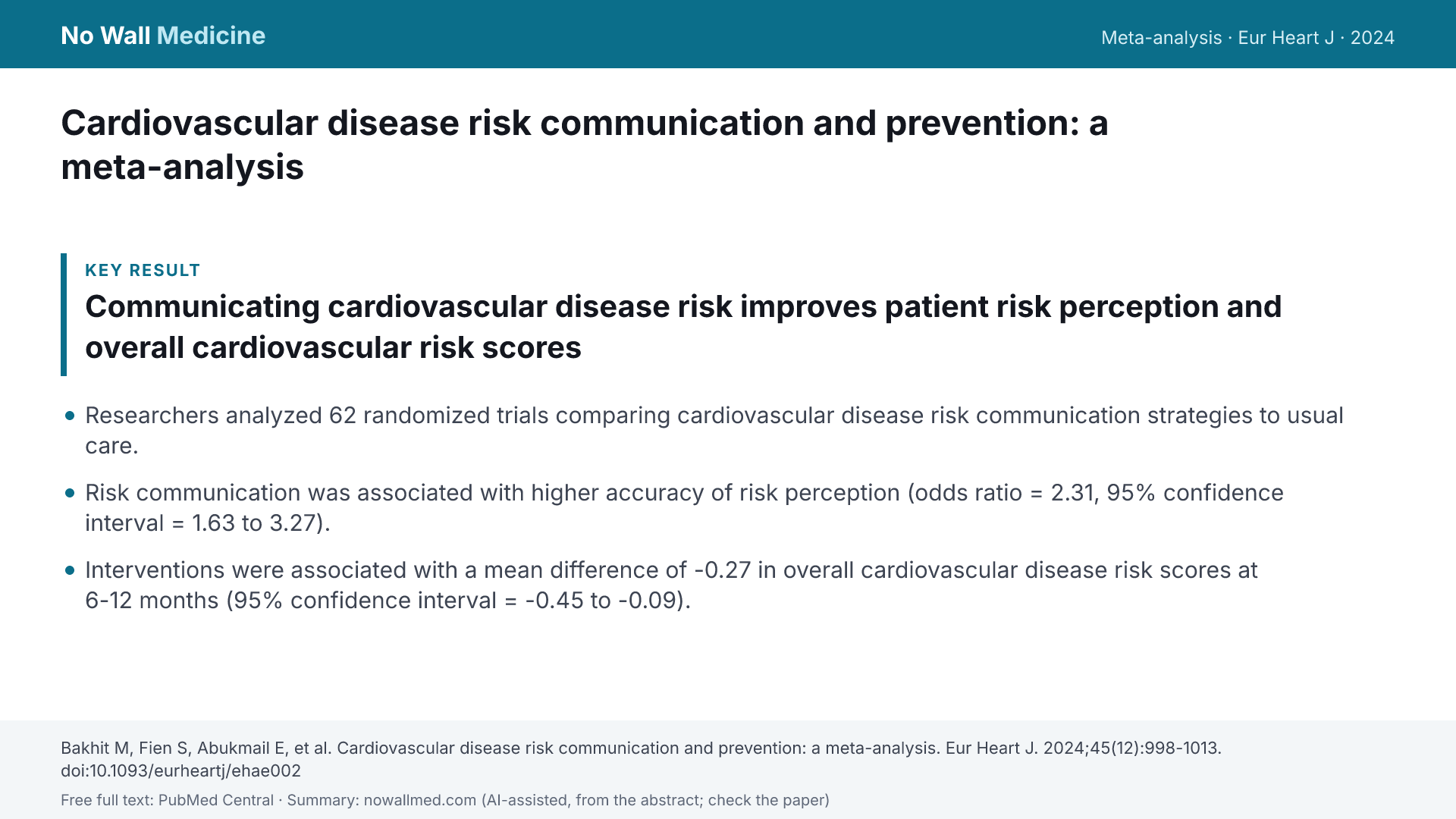
Key result: Communicating cardiovascular disease risk improves patient risk perception and overall cardiovascular risk scores
Key points
- Researchers analyzed 62 randomized trials comparing cardiovascular disease risk communication strategies to usual care.
- Risk communication was associated with higher accuracy of risk perception (odds ratio = 2.31, 95% confidence interval = 1.63 to 3.27).
- Interventions were associated with a mean difference of -0.27 in overall cardiovascular disease risk scores at 6-12 months (95% confidence interval = -0.45 to -0.09).
Why it matters: It was unknown how communicating quantifiable cardiovascular disease risk affects how patients perceive their risk and their actual cardiovascular risk factors.
Discussion prompts
- Would these patients look like yours? Who was left out?
- Is the main outcome one that matters to patients?
- Is the difference large enough to change what you do?
Cite: Bakhit M, Fien S, Abukmail E, et al. Cardiovascular disease risk communication and prevention: a meta-analysis. Eur Heart J. 2024. doi:10.1093/eurheartj/ehae002
Free full text: PubMed Central · Summary and visual abstract: nowallmed.com/a/cardiovascular-disease-risk-communication-and-prevention-a-meta-mbek9u/ (AI-assisted from the abstract; check the paper before relying on it).