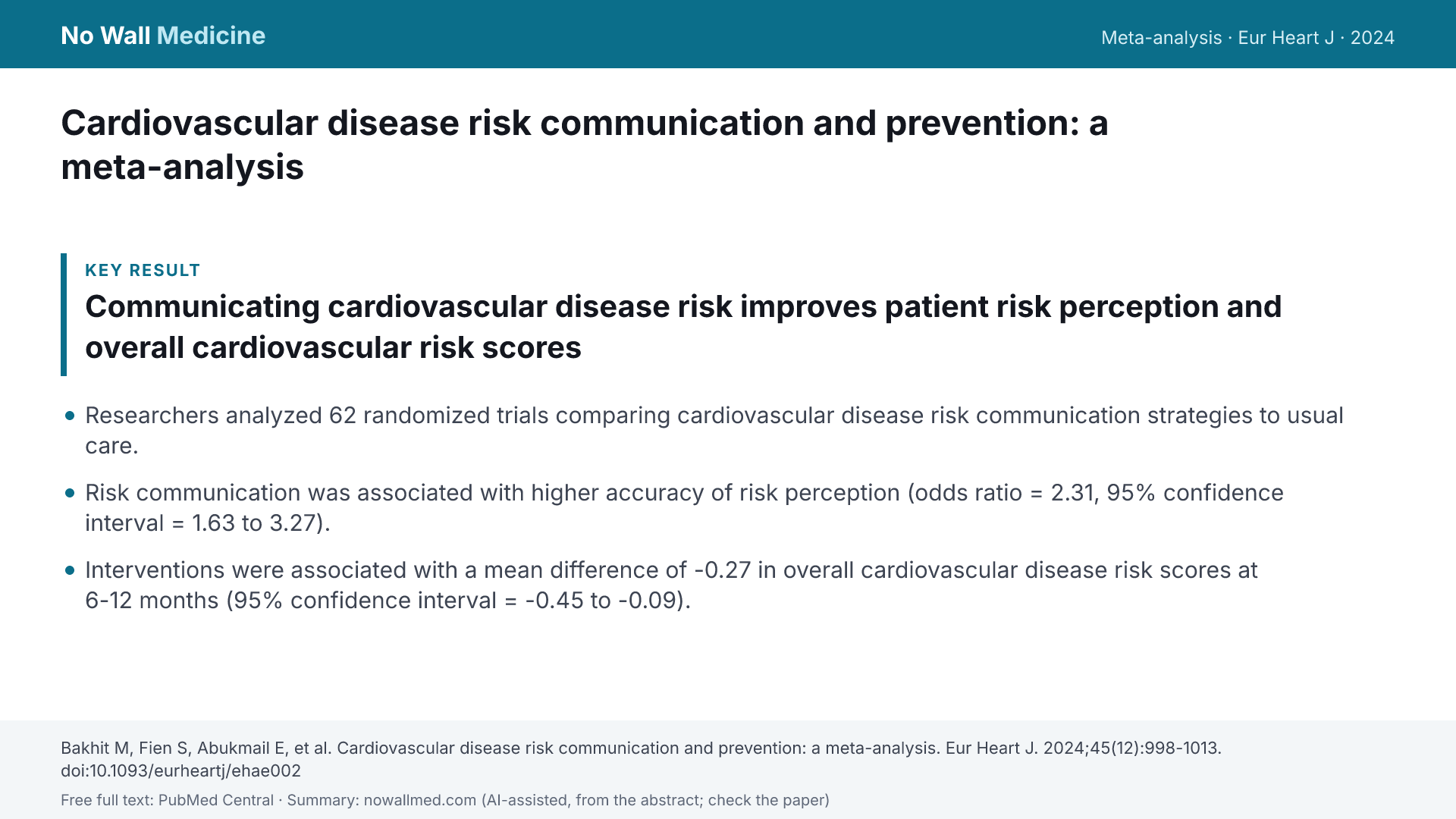
Communicating cardiovascular disease risk improves patient risk perception and overall cardiovascular risk scores
Cardiovascular disease risk communication and prevention: a meta-analysis
Why it matters: It was unknown how communicating quantifiable cardiovascular disease risk affects how patients perceive their risk and their actual cardiovascular risk factors.
Key points
- Researchers analyzed 62 randomized trials comparing cardiovascular disease risk communication strategies to usual care.
- Risk communication was associated with higher accuracy of risk perception (odds ratio = 2.31, 95% confidence interval = 1.63 to 3.27).
- Interventions were associated with a mean difference of -0.27 in overall cardiovascular disease risk scores at 6-12 months (95% confidence interval = -0.45 to -0.09).
Headline and key points written with AI from the paper’s abstract, with every number checked against it. Read the paper before relying on them.
Was this summary helpful?
Subject terms
Cite this article
Bakhit M, Fien S, Abukmail E, Jones M, Clark J, Scott AM. Cardiovascular disease risk communication and prevention: a meta-analysis. Eur Heart J. 2024. doi:10.1093/eurheartj/ehae002
Spotted a mistake? Suggest a correction
Top studies every Monday
The week’s key trials and guidelines in your specialties, plus any topics you follow. By email, free.
Get the weekly digest