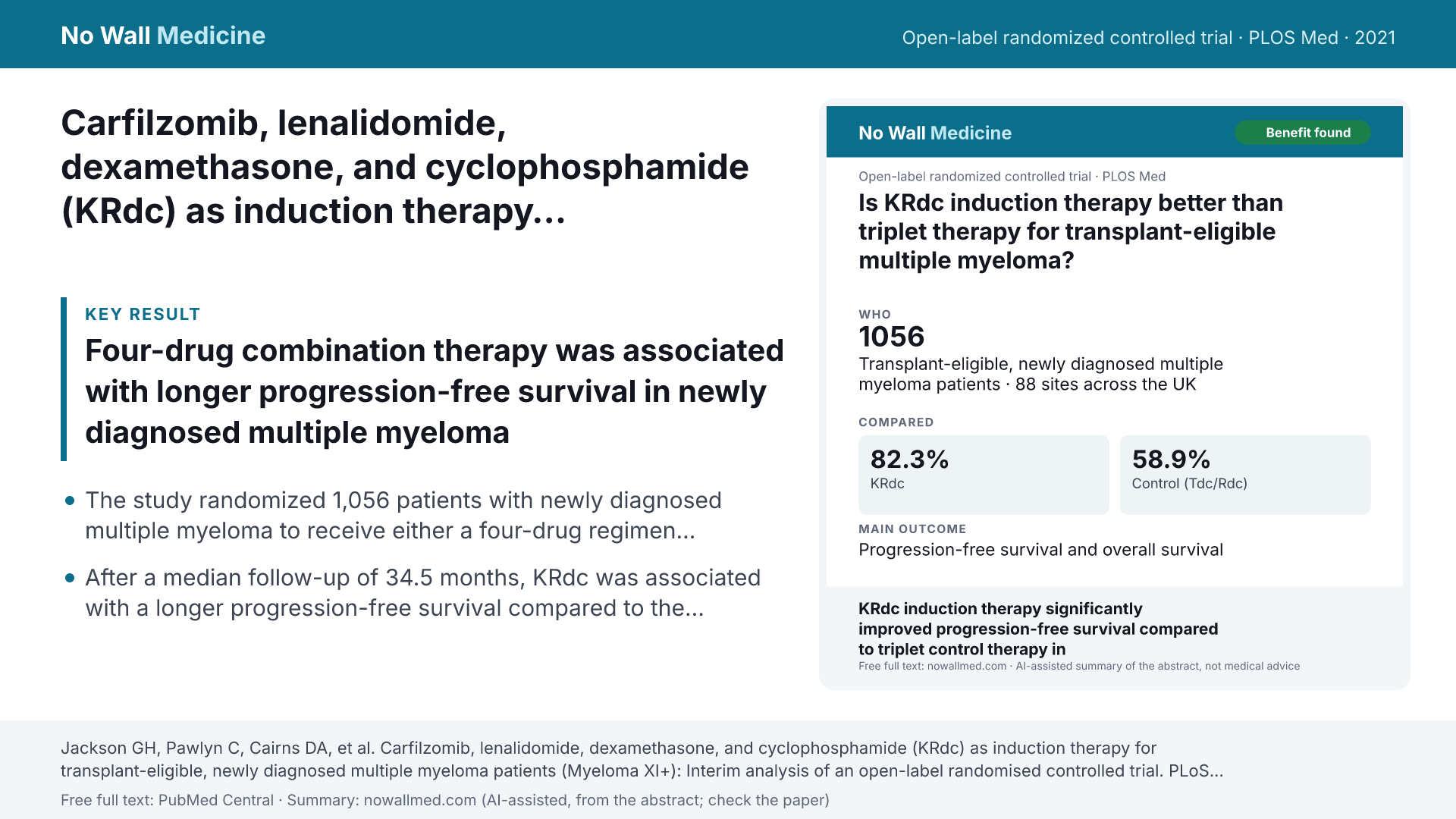
Four-drug combination therapy was associated with longer progression-free survival in newly diagnosed multiple myeloma
Carfilzomib, lenalidomide, dexamethasone, and cyclophosphamide (KRdc) as induction therapy for transplant-eligible, newly diagnosed multiple myeloma patients (Myeloma XI+): Interim analysis of an open-label randomised controlled trial
Open-label randomized controlled trialBenefit found
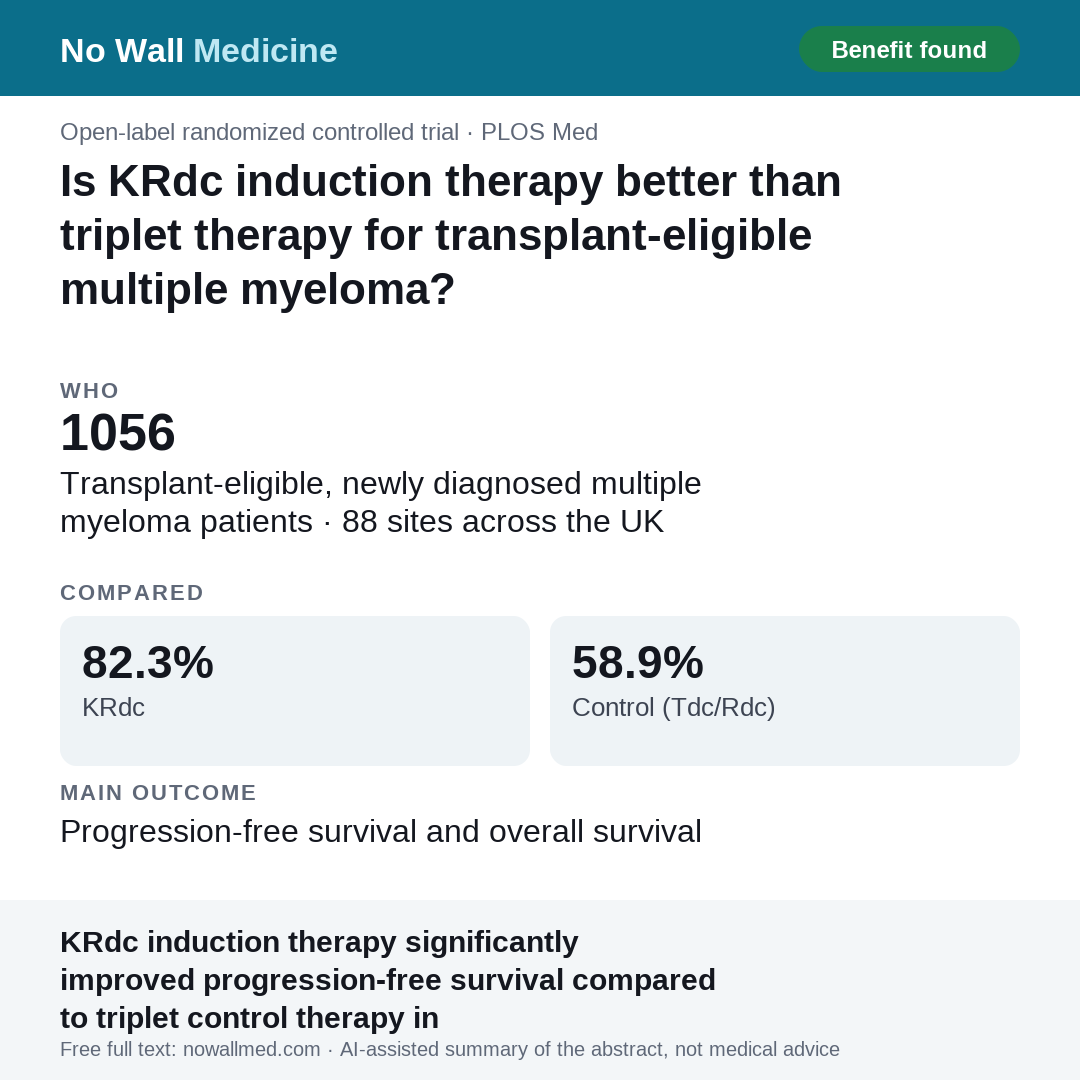
Is KRdc induction therapy better than triplet therapy for transplant-eligible multiple myeloma?
Who
1056
Transplant-eligible, newly diagnosed multiple myeloma patients · 88 sites across the UK
Compared
82.3%KRdc (at least a very good partial response)
58.9%Control (Tdc/Rdc) (at least a very good partial response)
Main outcome
Progression-free survival and overall survival
Result: hazard ratio 0.63 (95% CI 0.51-0.76)
Bottom line: KRdc induction therapy significantly improved progression-free survival compared to triplet control therapy in transplant-eligible patients.
Limitation: Lack of blinding and control regimen did not include a proteasome inhibitor for all patients.
PLOS Med · 2021-01-11Download image
Clinical question: Is KRdc induction therapy better than triplet therapy for transplant-eligible multiple myeloma?
Why it matters: It was unknown if adding a proteasome inhibitor to a three-drug regimen improves progression-free survival for patients eligible for stem cell transplantation.
In absolute numbers
KRdc: 82.3% · Control (Tdc/Rdc): 58.9% → a difference of 23.4 percentage points, so about 5 people would need the treatment for 1 more to benefit (number needed to treat) over the trial’s follow-up.
Worked out by us from the two group results above, not reported by the authors. Check the paper for the exact outcome and timing.
Key points
- The study randomized 1,056 patients with newly diagnosed multiple myeloma to receive either a four-drug regimen (KRdc) or a three-drug control group (Tdc/Rdc).
- After a median follow-up of 34.5 months, KRdc was associated with a longer progression-free survival compared to the control group (hazard ratio 0.63, 95% CI 0.51-0.76).
- At the end of induction, 82.3% of patients in the KRdc group achieved at least a very good partial response compared to 58.9% in the control group.
Limitation the authors note: The authors stated there was a lack of blinding to treatment regimen and the control group did not include a proteasome inhibitor for all patients.
Headline and key points written with AI from the paper’s abstract, with every number checked against it. Read the paper before relying on them.
Was this summary helpful?
Subject terms
Cite this article
Jackson GH, Pawlyn C, Cairns DA, et al. Carfilzomib, lenalidomide, dexamethasone, and cyclophosphamide (KRdc) as induction therapy for transplant-eligible, newly diagnosed multiple myeloma patients (Myeloma XI+): Interim analysis of an open-label randomised controlled trial. PLOS Med. 2021. doi:10.1371/journal.pmed.1003454
Spotted a mistake? Suggest a correction