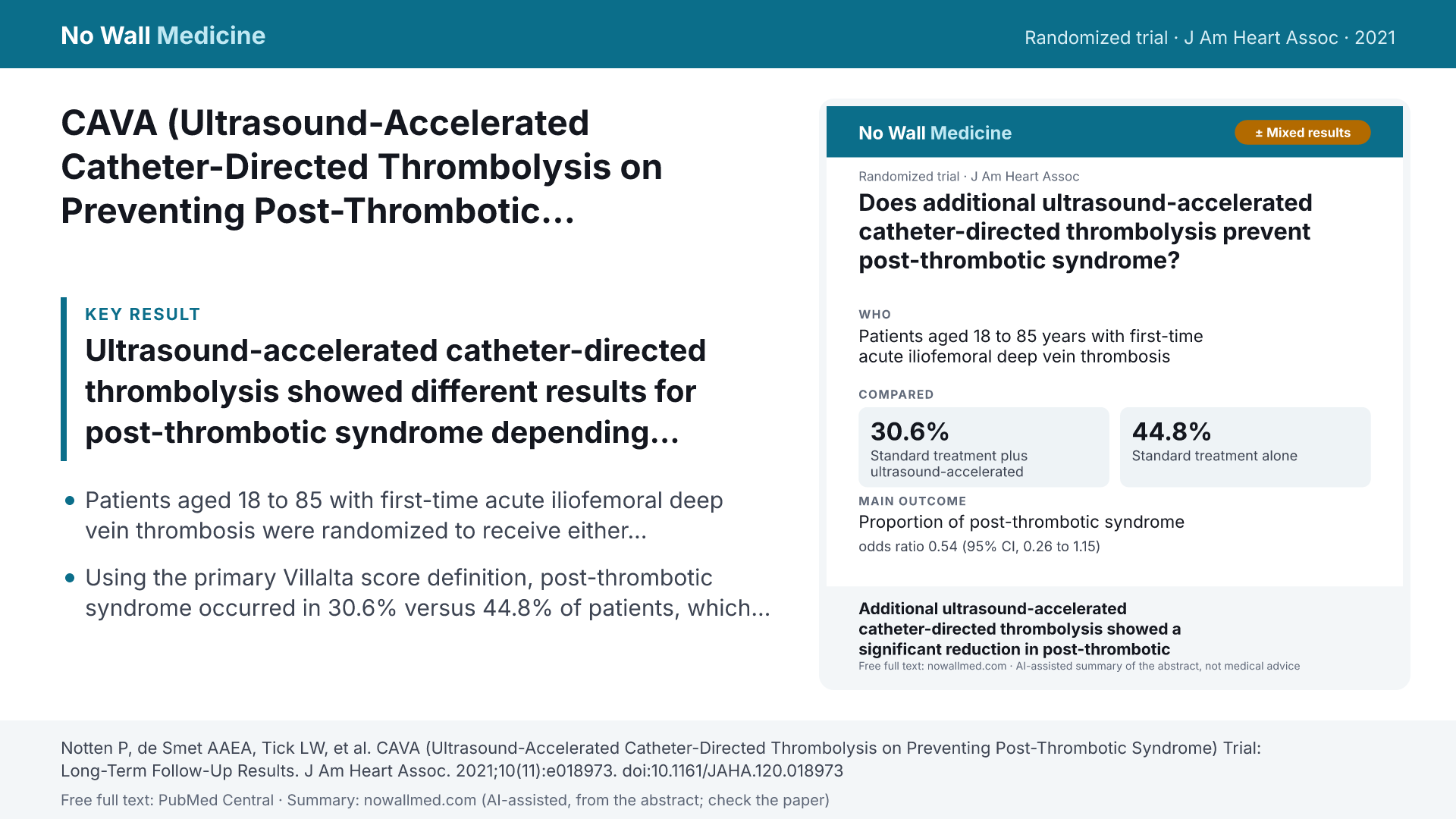
Ultrasound-accelerated catheter-directed thrombolysis showed different results for post-thrombotic syndrome depending on definition
CAVA (Ultrasound-Accelerated Catheter-Directed Thrombolysis on Preventing Post-Thrombotic Syndrome) Trial: Long-Term Follow-Up Results
Randomized trialMixed results
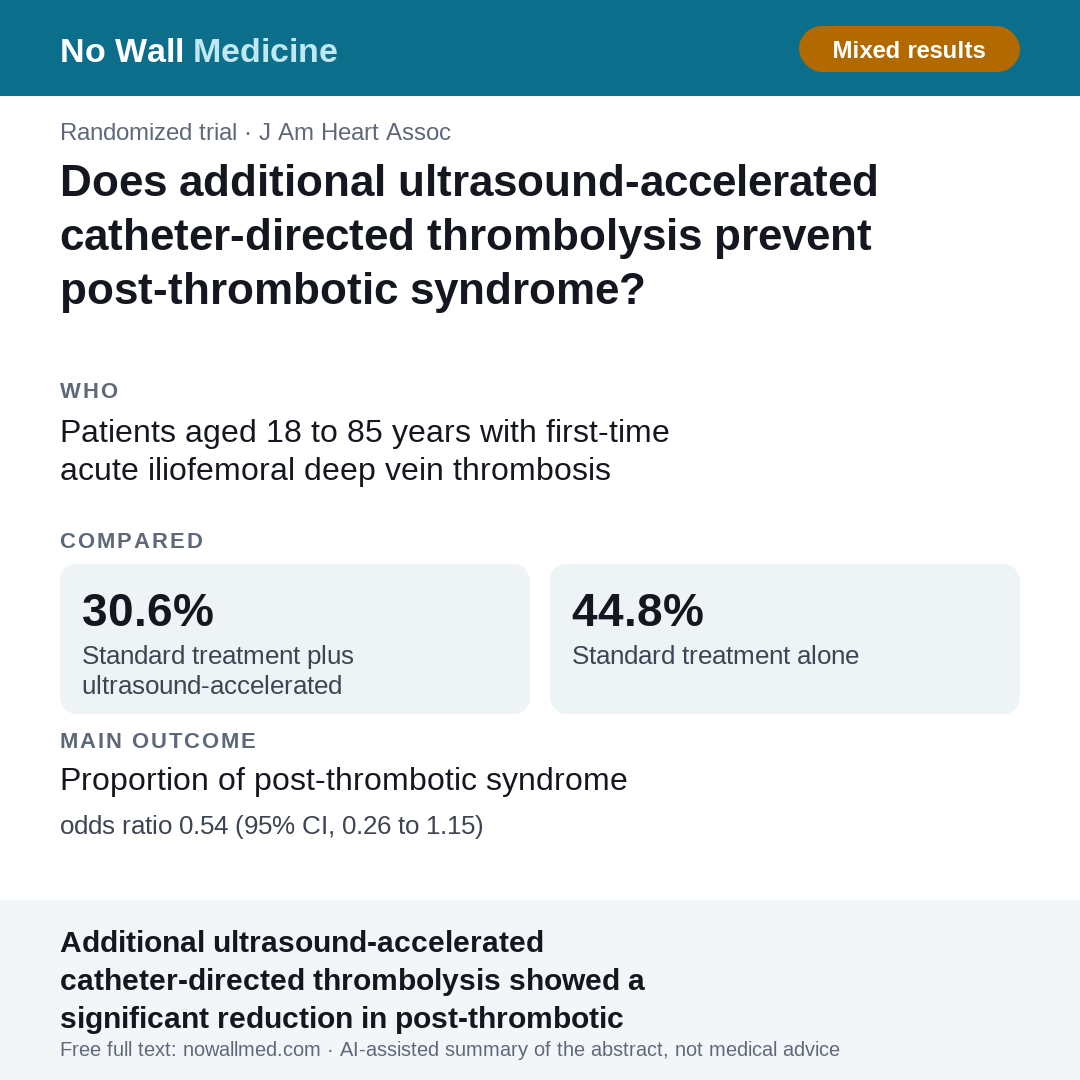
Does additional ultrasound-accelerated catheter-directed thrombolysis prevent post-thrombotic syndrome?
Who
Patients aged 18 to 85 years with first-time acute iliofemoral deep vein thrombosis
Compared
30.6%Standard treatment plus ultrasound-accelerated catheter-directed thrombolysis
44.8%Standard treatment alone
Main outcome
Proportion of post-thrombotic syndrome
Result: odds ratio 0.54 (95% CI, 0.26 to 1.15)
Bottom line: Additional ultrasound-accelerated catheter-directed thrombolysis showed a significant reduction in post-thrombotic syndrome using the International Society on Thrombosis and Haemostasis definition.
Limitation: This study was limited by its sample size
J Am Heart Assoc · 2021-05-25Download image
Clinical question: Does additional ultrasound-accelerated catheter-directed thrombolysis prevent post-thrombotic syndrome?
Why it matters: It was unknown if additional ultrasound-accelerated catheter-directed thrombolysis would impact post-thrombotic syndrome outcomes at long-term follow-up.
Key points
- Patients aged 18 to 85 with first-time acute iliofemoral deep vein thrombosis were randomized to receive either standard treatment plus ultrasound-accelerated catheter-directed thrombolysis or standard treatment alone.
- Using the primary Villalta score definition, post-thrombotic syndrome occurred in 30.6% versus 44.8% of patients, which was not statistically significant (P=0.11).
- Using the International Society on Thrombosis and Haemostasis consensus definition, post-thrombotic syndrome occurred in 46.8% versus 69.0% of patients (P=0.01).
Limitation the authors note: This study was limited by its sample size.
Headline and key points written with AI from the paper’s abstract, with every number checked against it. Read the paper before relying on them.
Was this summary helpful?
Subject terms
Cite this article
Notten P, de Smet AAEA, Tick LW, van de Poel MHW, Wikkeling ORM, Vleming LJ. CAVA (Ultrasound-Accelerated Catheter-Directed Thrombolysis on Preventing Post-Thrombotic Syndrome) Trial: Long-Term Follow-Up Results. J Am Heart Assoc. 2021. doi:10.1161/JAHA.120.018973
Spotted a mistake? Suggest a correction
Top studies every Monday
The week’s key trials and guidelines in your specialties, plus any topics you follow. By email, free.
Get the weekly digest