Liraglutide lowered ceramides and phospholipids in people with type 2 diabetes
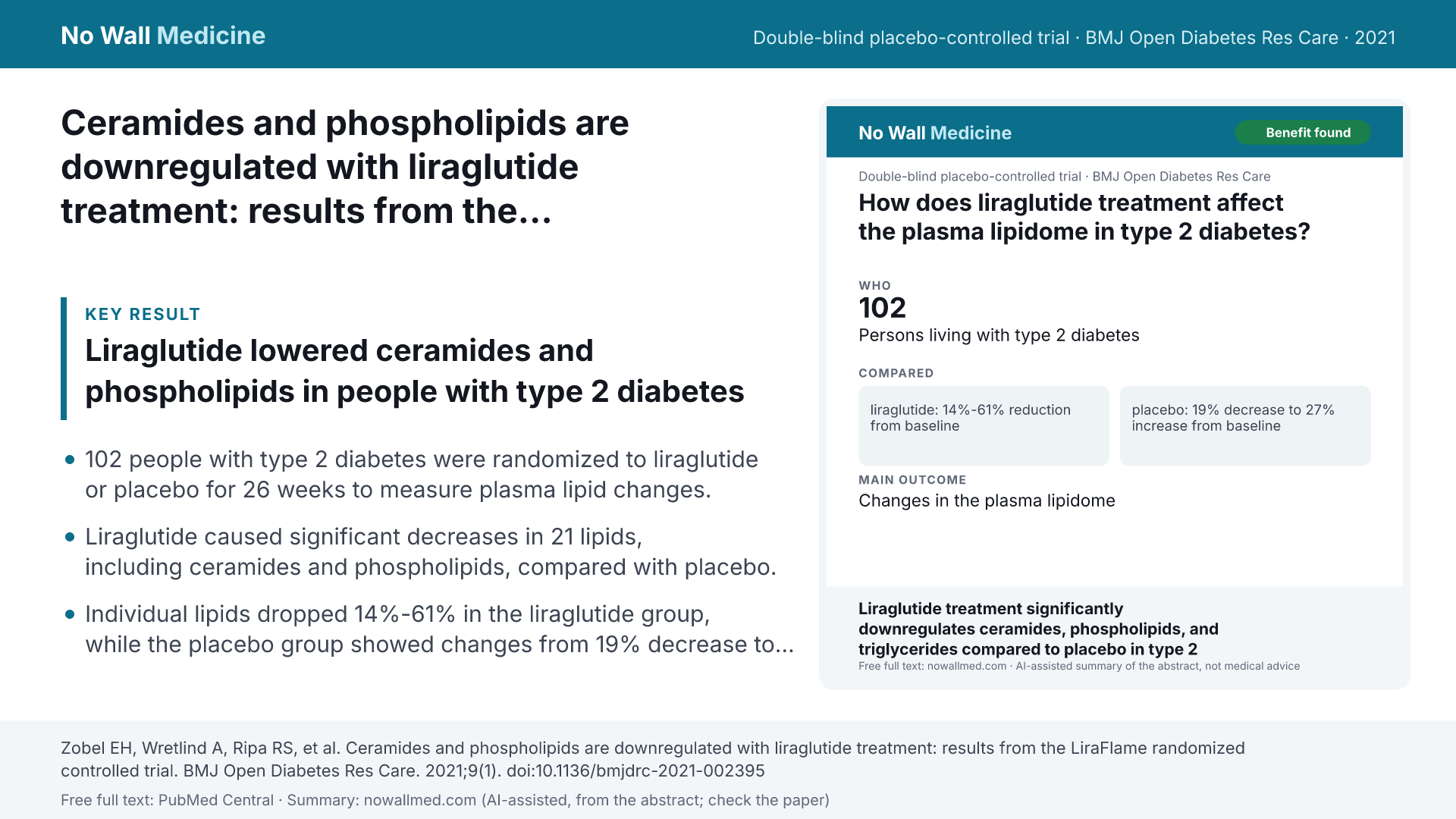
Ceramides and phospholipids are downregulated with liraglutide treatment: results from the LiraFlame randomized controlled trial
Double-blind placebo-controlled trialBenefit found
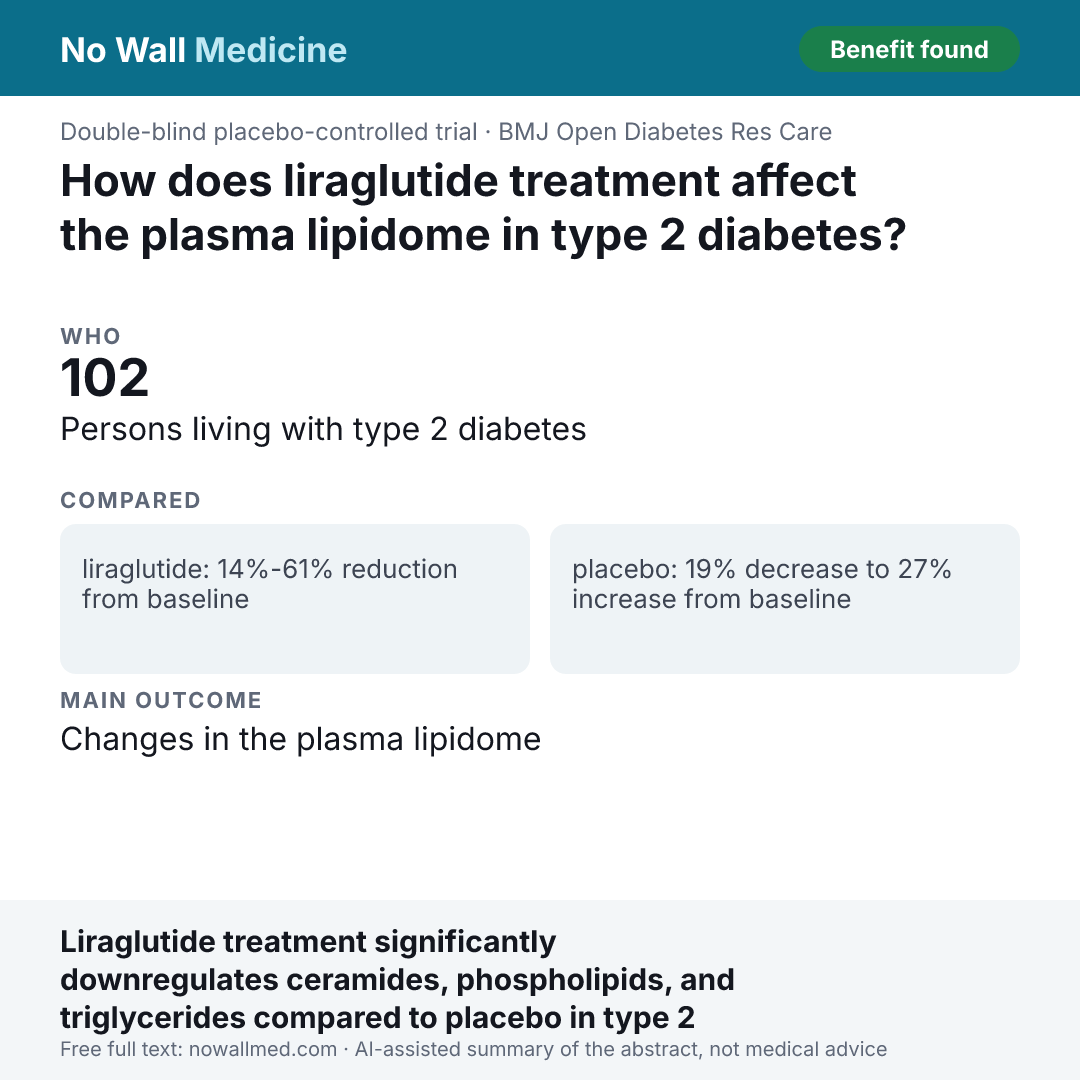
How does liraglutide treatment affect the plasma lipidome in type 2 diabetes?
Who
102
Persons living with type 2 diabetes
Compared
liraglutide: 14%-61% reduction from baseline
placebo: 19% decrease to 27% increase from baseline
Main outcome
Changes in the plasma lipidome
Bottom line: Liraglutide treatment significantly downregulates ceramides, phospholipids, and triglycerides compared to placebo in type 2 diabetes.
Limitation: These findings are hypothesis generating
BMJ Open Diabetes Res Care · 2021-09-14 · Save PNG
Clinical question: How does liraglutide treatment affect the plasma lipidome in type 2 diabetes?
Why it matters: The mechanisms explaining how glucagon-like peptide-1 receptor agonists reduce cardiovascular disease risk in type 2 diabetes are still debated.
In absolute numbers
liraglutide: 14% · placebo: 19% → a difference of 5 percentage points, so about 20 people would need the treatment for 1 more to benefit (number needed to treat) over the trial’s follow-up.
Worked out by us from the two group results above, not reported by the authors. Check the paper for the exact outcome and timing.
Key points
- 102 people with type 2 diabetes were randomized to liraglutide or placebo for 26 weeks to measure plasma lipid changes.
- Liraglutide caused significant decreases in 21 lipids, including ceramides and phospholipids, compared with placebo.
- Individual lipids dropped 14%-61% in the liraglutide group, while the placebo group showed changes from 19% decrease to 27% increase.
Headline and key points written with AI from the paper’s abstract, with every number checked against it. Read the paper before relying on them.
Was this summary helpful?
Abstract
Introduction
Treatment with glucagon-like peptide-1 receptor agonists (GLP-1 RAs) can reduce risk of cardiovascular disease (CVD) in persons living with type 2 diabetes, however the mechanisms explaining this cardiovascular benefit are still debated. We investigated changes in the plasma lipidome following treatment with the GLP-1 RA liraglutide. Research design and methods
In a double-blind placebo-controlled trial, we randomized 102 persons with type 2 diabetes to liraglutide or placebo for 26 weeks. Fasting blood plasma was collected at baseline and at end-of-treatment. The lipidome was measured using liquid-chromatography-coupled mass-spectrometry as a secondary end point in the study. Treatment response of each lipid was tested with lipid-specific linear mixed-effect models comparing liraglutide with placebo. Bonferroni p<7.1e-03 was employed. The independence of the findings from clinical covariates was evaluated with adjustment for body mass index, HbA1c, fasting status, lipid-lowering treatment and change in lipid-lowering treatment during the trial. Results
In total, 260 lipids were identified covering 11 lipid families. We observed significant decreases following liraglutide treatment compared with placebo in 21 lipids (p<7.1e-03) from the following lipid families: ceramides, hexocyl-ceramides, phosphatidylcholines, phosphatidylethanolamines and triglycerides. We confirmed these findings in adjusted models (p≤0.01). In the liraglutide-treated group, the individual lipids were reduced in the range of 14%-61% from baseline level, compared with 19% decrease to 27% increase from baseline level in the placebo group. Conclusions
Compared with placebo, liraglutide treatment led to a significant downregulation in ceramides, phospholipids and triglycerides, which all are linked to higher risk of CVD. These findings were independent of relevant clinical covariates. Our findings are hypothesis generating and shed light on the biological mechanisms underlying the cardiovascular benefits observed with GLP-1 RAs in outcome studies, and further strengthen the evidence base for recommending GLP-1 RAs to prevent CVD in type 2 diabetes. Trial registration number
NCT03449654.
Abstract reproduced under the article’s CC BY NC licence.
Subject terms
Headline, design, result, key points, caveat and citation as plain text.
Cite this article
Zobel EH, Wretlind A, Ripa RS, et al. Ceramides and phospholipids are downregulated with liraglutide treatment: results from the LiraFlame randomized controlled trial. BMJ Open Diabetes Res Care. 2021. doi:10.1136/bmjdrc-2021-002395
Spotted a mistake? Suggest a correction