Cerebral oxygen monitoring did not increase survival without brain injury in preterm infants
Cerebral regional tissue Oxygen Saturation to Guide Oxygen Delivery in preterm neonates during immediate transition after birth (COSGOD III): multicentre randomised phase 3 clinical trial
Multicentre, multinational, randomised controlled phase 3 trialNo clear difference
Does cerebral tissue oxygen saturation monitoring increase survival without cerebral injury in preterm neonates?
Who
655
Preterm neonates born to pregnant women under 32 weeks gestation · 11 tertiary neonatal intensive care units in six countries
Compared
Near infrared spectroscopy group: 252 (82.9%) out of 304
Control group: 238 (78.5%) out of 303
Main outcome
Survival without cerebral injury
Result: relative risk 1.06 (95% confidence interval 0.98 to 1.14)
Bottom line: Adding cerebral tissue oxygen saturation monitoring to standard care did not significantly increase survival without cerebral injury in preterm neonates.
BMJ · 2023-01-24Download image
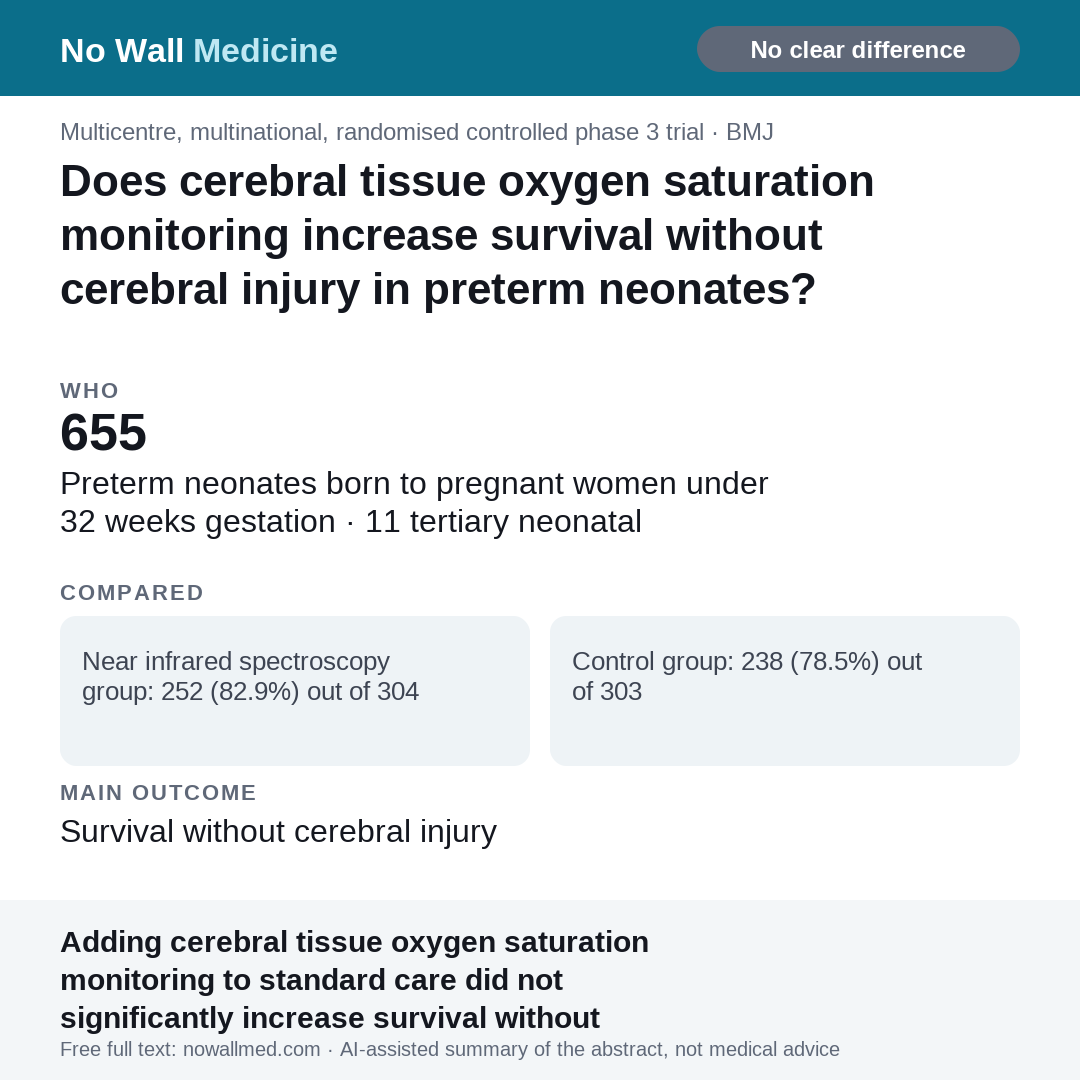
Clinical question: Does cerebral tissue oxygen saturation monitoring increase survival without cerebral injury in preterm neonates?
Why it matters: It is unclear if adding near infrared spectroscopy to monitor brain oxygen levels during the first 15 minutes after birth improves survival without brain injury in preterm infants.
Key points
- Researchers studied 655 preterm neonates across 11 intensive care units, comparing standard care to standard care plus near infrared spectroscopy, which measures oxygen levels in brain tissue.
- Survival without cerebral injury, defined as intraventricular haemorrhage or cystic periventricular leukomalacia, was 82.9% in the monitoring group compared to 78.5% in the control group.
- The difference in survival without brain injury was not statistically significant, with a relative risk of 1.06 (95% confidence interval 0.98 to 1.14).
Headline and key points written with AI from the paper’s abstract, with every number checked against it. Read the paper before relying on them.
Was this summary helpful?
Abstract
Objective
To investigate whether monitoring of cerebral tissue oxygen saturation using near infrared spectroscopy in addition to routine monitoring combined with defined treatment guidelines during immediate transition and resuscitation increases survival without cerebral injury of premature infants compared with standard care alone. Design
Multicentre, multinational, randomised controlled phase 3 trial. Setting
11 tertiary neonatal intensive care units in six countries in Europe and in Canada. Participants
1121 pregnant women (<32 weeks' gestation) were screened prenatally. The primary outcome was analysed in 607 of 655 randomised preterm neonates: 304 neonates in the near infrared spectroscopy group and 303 in the control group. Intervention
Preterm neonates were randomly assigned to either standard care (control group) or standard care plus monitoring of cerebral oxygen saturation with a dedicated treatment guideline (near infrared spectroscopy group) during immediate transition (first 15 minutes after birth) and resuscitation. Main outcome measure
The primary outcome, assessed using all cause mortality and serial cerebral ultrasonography, was a composite of survival without cerebral injury. Cerebral injury was defined as any intraventricular haemorrhage or cystic periventricular leukomalacia, or both, at term equivalent age or before discharge. Results
Cerebral tissue oxygen saturation was similar in both groups. 252 (82.9%) out of 304 neonates (median gestational age 28.9 (interquartile range 26.9-30.6) weeks) in the near infrared spectroscopy group survived without cerebral injury compared with 238 (78.5%) out of 303 neonates (28.6 (26.6-30.6) weeks) in the control group (relative risk 1.06, 95% confidence interval 0.98 to 1.14). 28 neonates died (near infrared spectroscopy group 12 (4.0%) v control group 16 (5.3%): relative risk 0.75 (0.33 to 1.70). Conclusion
Monitoring of cerebral tissue oxygen saturation in combination with dedicated interventions in preterm neonates (<32 weeks' gestation) during immediate transition and resuscitation after birth did not result in substantially higher survival without cerebral injury compared with standard care alone. Survival without cerebral injury increased by 4.3% but was not statistically significant. Trial registration
ClinicalTrials.gov NCT03166722.
Abstract reproduced under the article’s CC BY NC licence.
Subject terms
Cite this article
Pichler G, Goeral K, Hammerl M, Perme T, Dempsey EM, Springer L. Cerebral regional tissue Oxygen Saturation to Guide Oxygen Delivery in preterm neonates during immediate transition after birth (COSGOD III): multicentre randomised phase 3 clinical trial. BMJ. 2023. doi:10.1136/bmj-2022-072313
Spotted a mistake? Suggest a correction
Top studies every Monday
The week’s key trials and guidelines in your specialties, plus any topics you follow. By email, free.
Get the weekly digest