Physiologically based cord clamping resulted in similar heart rates compared to early cord clamping
Physiologically based cord clamping for infants ≥32+0 weeks gestation: A randomised clinical trial and reference percentiles for heart rate and oxygen saturation for infants ≥35+0 weeks gestation
Randomized clinical trialNo clear difference
Does physiologically based cord clamping improve heart rate in infants needing resuscitation?
Who
123
Infants born at 32+0 weeks gestation requiring resuscitation · 2 Australian perinatal centres
Compared
Physiologically based cord clamping: 154 bpm
Early cord clamping: 158 bpm
Main outcome
Mean heart rate between 60 to 120 seconds after birth
Result: adjusted mean difference -6 bpm (95% CI -17 to 5 bpm)
Bottom line: Physiologically based cord clamping resulted in similar mean heart rate compared to early cord clamping in infants needing resuscitation.
Limitation: Small number of infants requiring prolonged or advanced resuscitation.
PLOS Med · 2022-06-23Download image
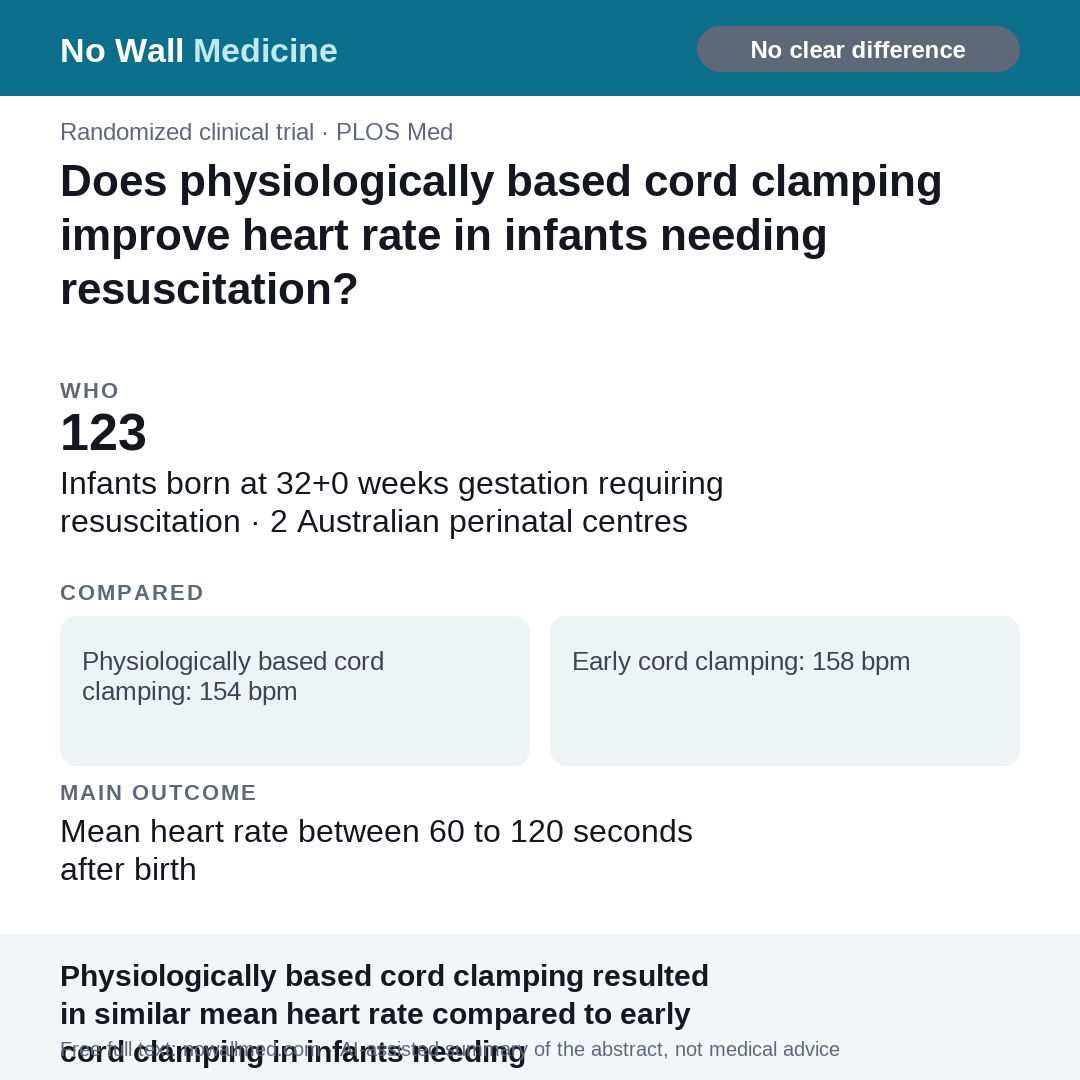
Clinical question: Does physiologically based cord clamping improve heart rate in infants needing resuscitation?
Why it matters: It was unknown if clamping the umbilical cord after establishing lung aeration would result in higher heart rates for infants needing resuscitation compared to early clamping.
Key points
- In a randomized trial of 123 infants born at ≥32+0 weeks gestation, researchers compared physiologically based cord clamping to early cord clamping.
- The mean heart rate between 60 to 120 seconds after birth was 154 bpm for the physiologically based group and 158 bpm for the early clamping group.
- Postpartum hemorrhage of ≥500 ml occurred in 34% of mothers in the physiologically based group and 32% of mothers in the early clamping group.
Limitation the authors note: The trial was limited by the small number of infants requiring prolonged or advanced resuscitation.
Headline and key points written with AI from the paper’s abstract, with every number checked against it. Read the paper before relying on them.
Was this summary helpful?
Subject terms
Cite this article
Badurdeen S, Davis PG, Hooper SB, Donath S, Santomartino GA, Heng A. Physiologically based cord clamping for infants ≥32+0 weeks gestation: A randomised clinical trial and reference percentiles for heart rate and oxygen saturation for infants ≥35+0 weeks gestation. PLOS Med. 2022. doi:10.1371/journal.pmed.1004029
Spotted a mistake? Suggest a correction
Top studies every Monday
The week’s key trials and guidelines in your specialties, plus any topics you follow. By email, free.
Get the weekly digest