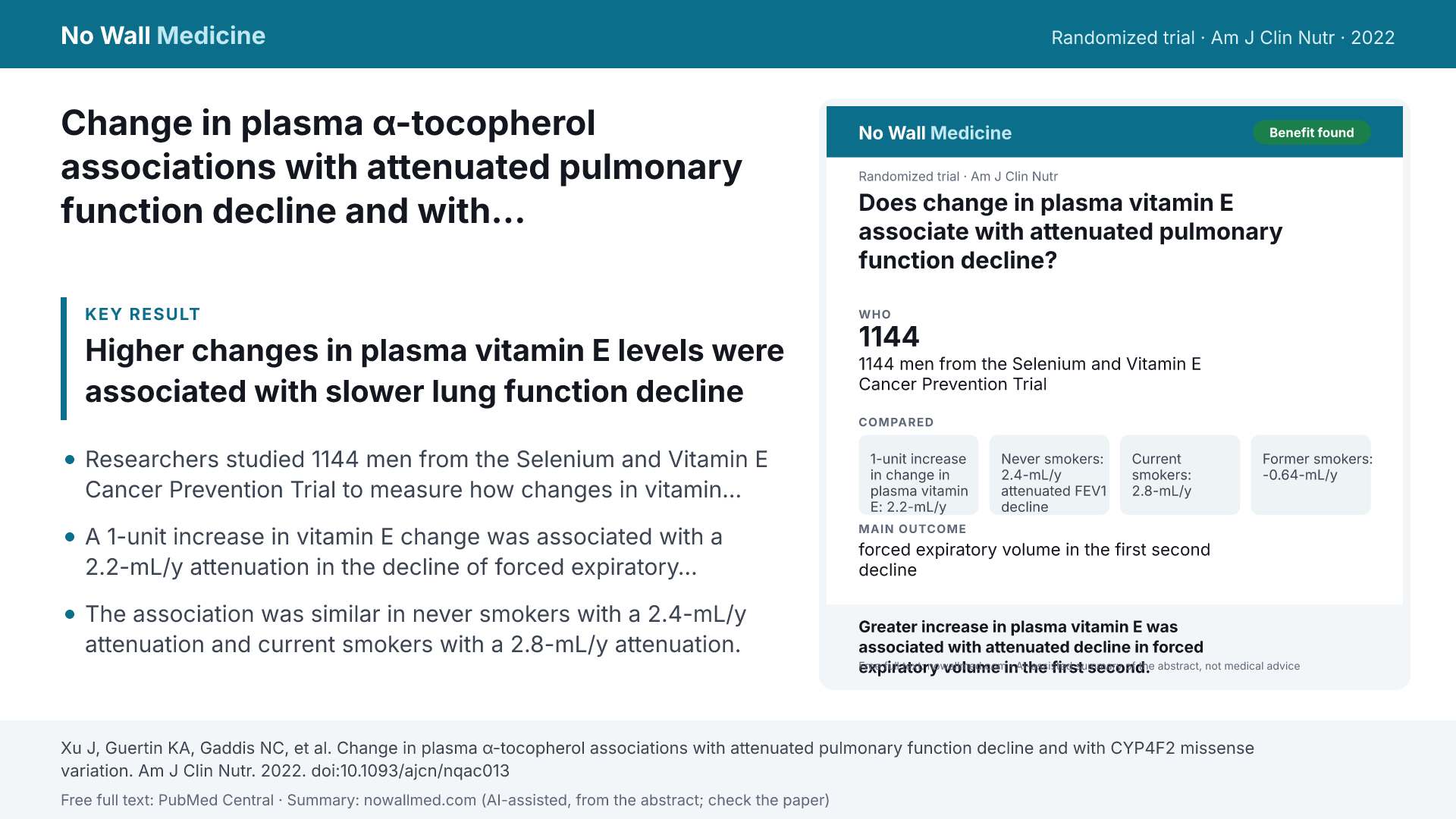
Higher changes in plasma vitamin E levels were associated with slower lung function decline
Change in plasma α-tocopherol associations with attenuated pulmonary function decline and with CYP4F2 missense variation
Randomized trialBenefit found
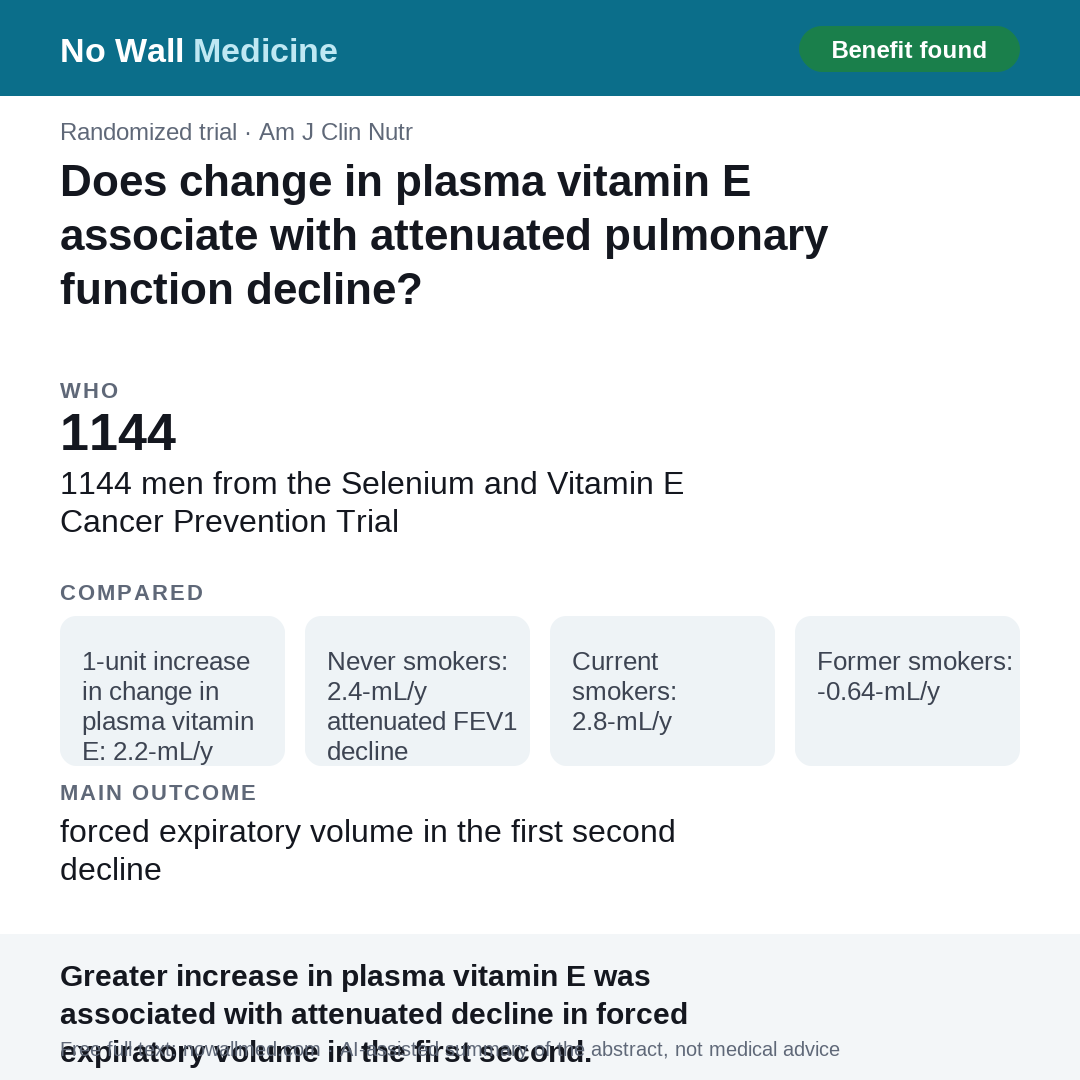
Does change in plasma vitamin E associate with attenuated pulmonary function decline?
Who
1144
1144 men from the Selenium and Vitamin E Cancer Prevention Trial
Compared
1-unit increase in change in plasma vitamin E: 2.2-mL/y attenuation in FEV1 decline
Never smokers: 2.4-mL/y attenuated FEV1 decline
Current smokers: 2.8-mL/y
Former smokers: -0.64-mL/y
Main outcome
forced expiratory volume in the first second decline
Result: 2.2-mL/y attenuation in FEV1 decline (SE: 0.9 mL/y)
Bottom line: Greater increase in plasma vitamin E was associated with attenuated decline in forced expiratory volume in the first second.
Am J Clin Nutr · 2022-01-19Download image
Clinical question: Does change in plasma vitamin E associate with attenuated pulmonary function decline?
Key points
- Researchers studied 1144 men from the Selenium and Vitamin E Cancer Prevention Trial to measure how changes in vitamin E levels related to lung function.
- A 1-unit increase in vitamin E change was associated with a 2.2-mL/y attenuation in the decline of forced expiratory volume in the first second.
- The association was similar in never smokers with a 2.4-mL/y attenuation and current smokers with a 2.8-mL/y attenuation.
Headline and key points written with AI from the paper’s abstract, with every number checked against it. Read the paper before relying on them.
Was this summary helpful?
Subject terms
Cite this article
Xu J, Guertin KA, Gaddis NC, et al. Change in plasma α-tocopherol associations with attenuated pulmonary function decline and with CYP4F2 missense variation. Am J Clin Nutr. 2022. doi:10.1093/ajcn/nqac013
Spotted a mistake? Suggest a correction