Change in plasma α-tocopherol associations with attenuated pulmonary function decline and with CYP4F2 missense variation
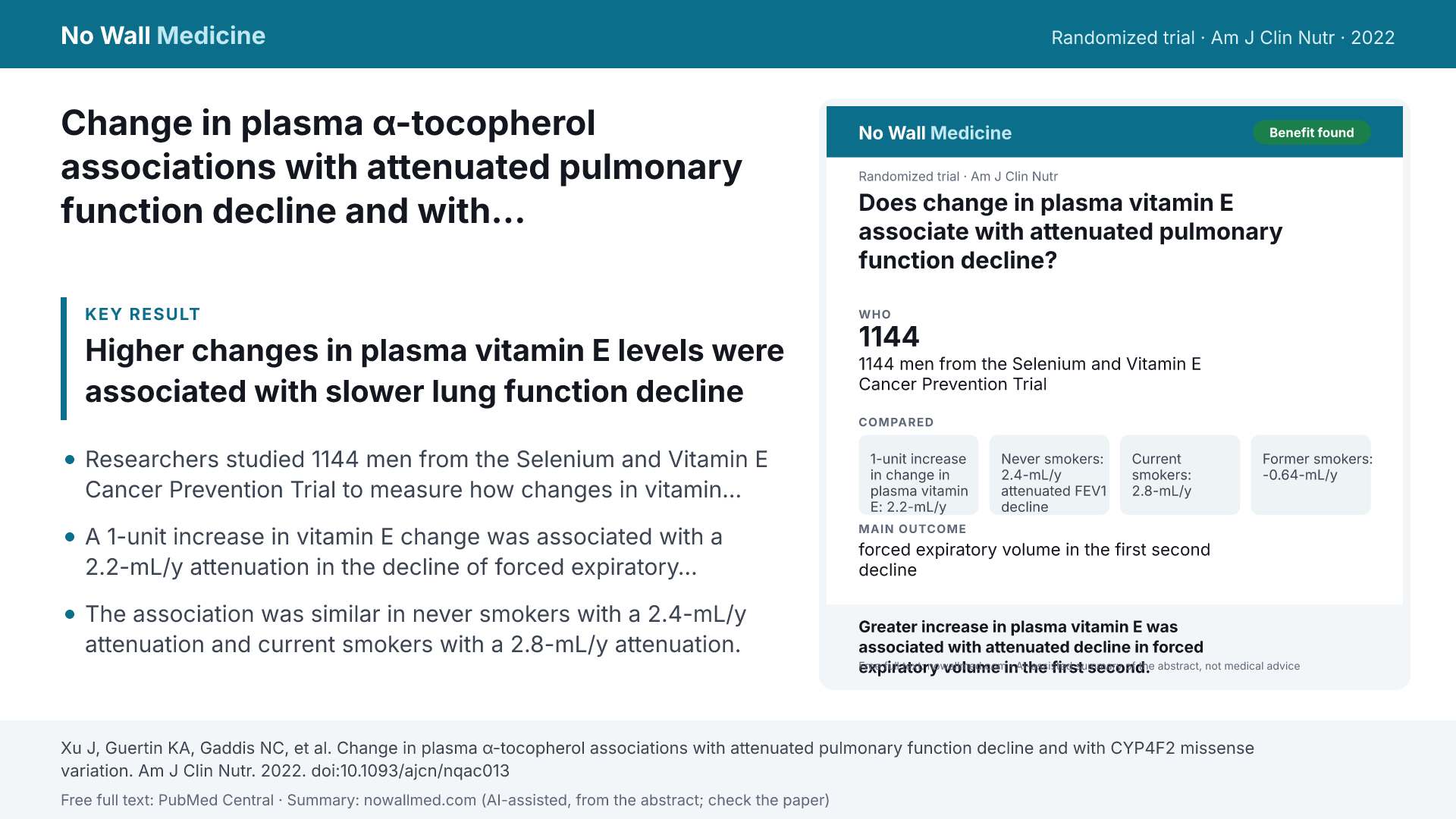
Key result: Higher changes in plasma vitamin E levels were associated with slower lung function decline
Randomized trialBenefit found
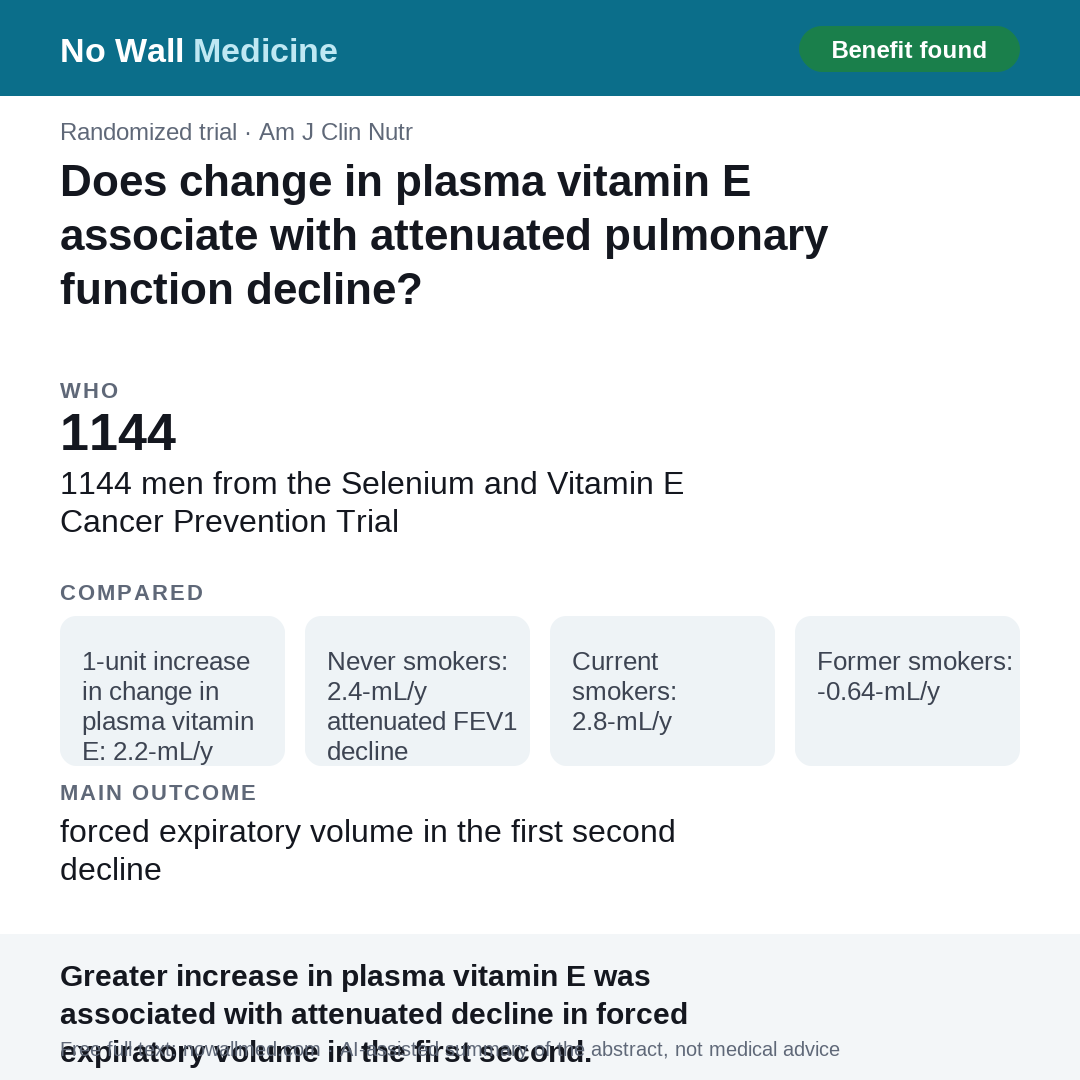
Does change in plasma vitamin E associate with attenuated pulmonary function decline?
Who
1144
1144 men from the Selenium and Vitamin E Cancer Prevention Trial
Compared
1-unit increase in change in plasma vitamin E: 2.2-mL/y attenuation in FEV1 decline
Never smokers: 2.4-mL/y attenuated FEV1 decline
Current smokers: 2.8-mL/y
Former smokers: -0.64-mL/y
Main outcome
forced expiratory volume in the first second decline
Result: 2.2-mL/y attenuation in FEV1 decline (SE: 0.9 mL/y)
Bottom line: Greater increase in plasma vitamin E was associated with attenuated decline in forced expiratory volume in the first second.
Am J Clin Nutr · 2022-01-19Download image
Key points
- Researchers studied 1144 men from the Selenium and Vitamin E Cancer Prevention Trial to measure how changes in vitamin E levels related to lung function.
- A 1-unit increase in vitamin E change was associated with a 2.2-mL/y attenuation in the decline of forced expiratory volume in the first second.
- The association was similar in never smokers with a 2.4-mL/y attenuation and current smokers with a 2.8-mL/y attenuation.
Discussion prompts
- Would these patients look like yours? Who was left out?
- Is the main outcome one that matters to patients?
- Is the difference large enough to change what you do?
Cite: Xu J, Guertin KA, Gaddis NC, et al. Change in plasma α-tocopherol associations with attenuated pulmonary function decline and with CYP4F2 missense variation. Am J Clin Nutr. 2022. doi:10.1093/ajcn/nqac013
Free full text: PubMed Central · Summary and visual abstract: nowallmed.com/a/change-in-plasma-tocopherol-associations-with-attenuated-pulmonary-2m1w32/ (AI-assisted from the abstract; check the paper before relying on it).