Changes in evening-shifted loss of control eating severity following treatment for binge-eating disorder
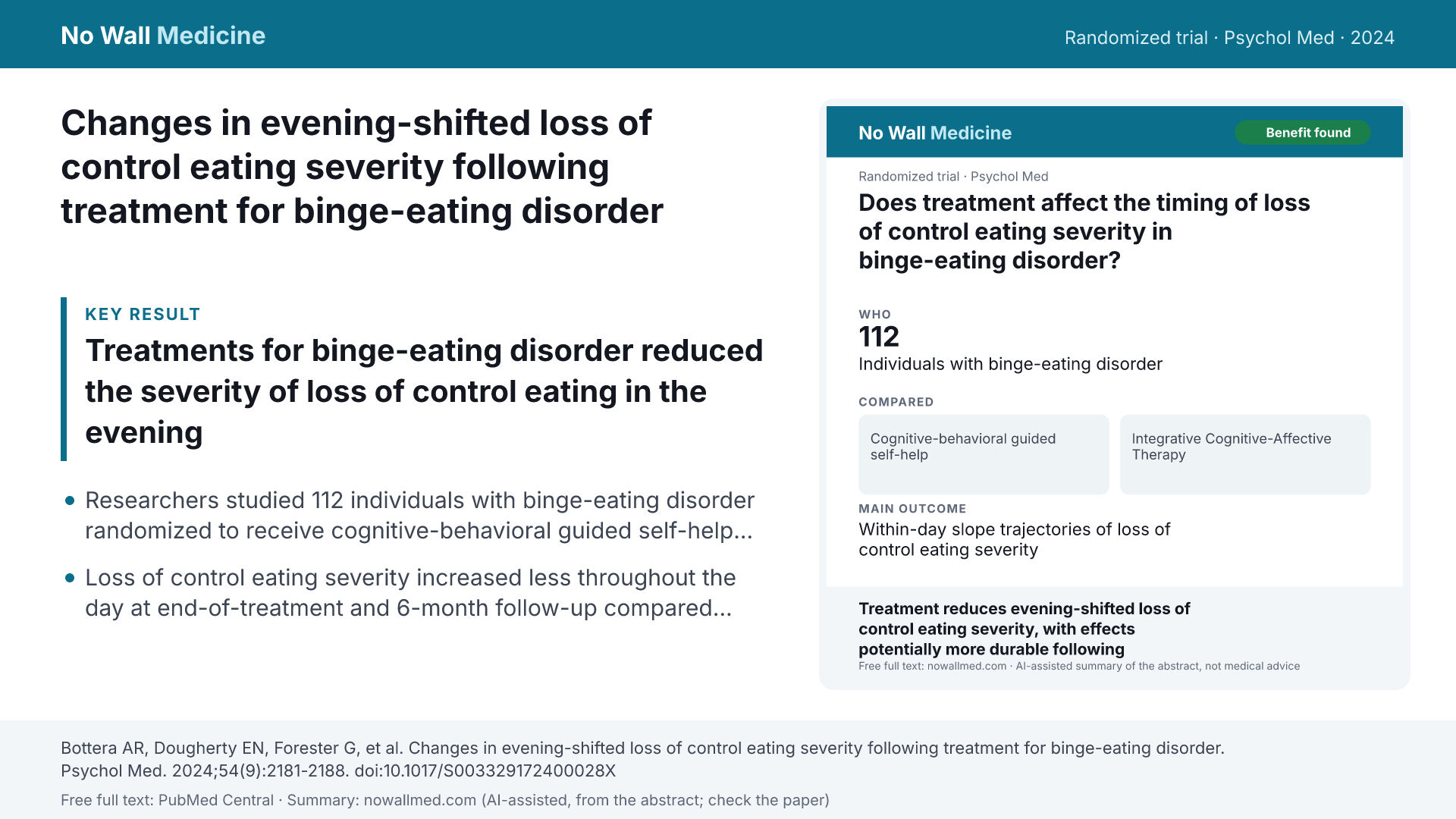
Key result: Treatments for binge-eating disorder reduced the severity of loss of control eating in the evening
Randomized trialBenefit found
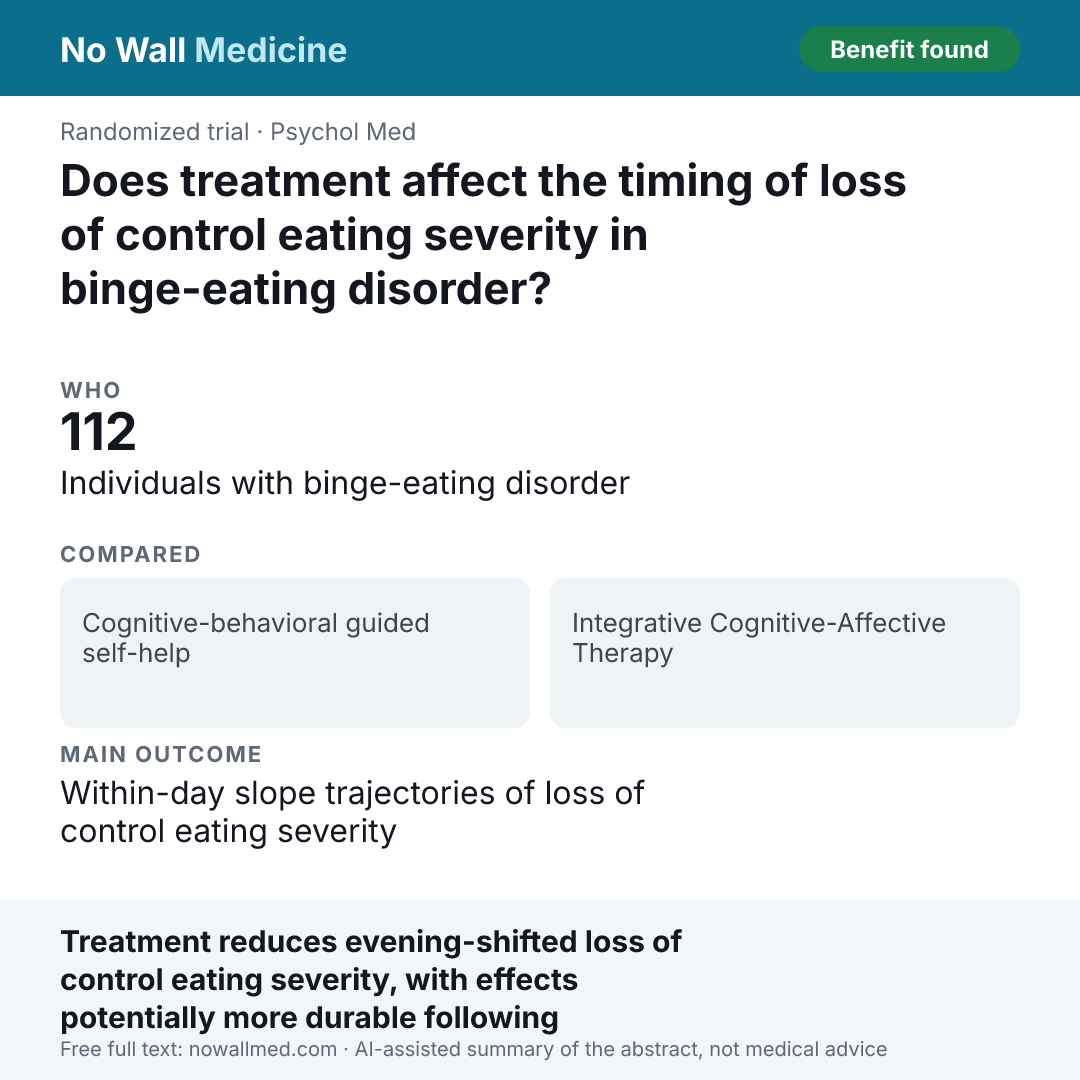
Does treatment affect the timing of loss of control eating severity in binge-eating disorder?
Who
112
Individuals with binge-eating disorder
Compared
Cognitive-behavioral guided self-help
Integrative Cognitive-Affective Therapy
Main outcome
Within-day slope trajectories of loss of control eating severity
Bottom line: Treatment reduces evening-shifted loss of control eating severity, with effects potentially more durable following Integrative Cognitive-Affective Therapy.
Psychol Med · 2024-02-28 · Save PNG
Key points
- Researchers studied 112 individuals with binge-eating disorder randomized to receive cognitive-behavioral guided self-help or integrative cognitive-affective therapy.
- Loss of control eating severity increased less throughout the day at end-of-treatment and 6-month follow-up compared to baseline.
- At 6-month follow-up, evening loss of control eating severity was more intense for those receiving cognitive-behavioral guided self-help compared to integrative cognitive-affective therapy.
Discussion prompts
- Would these patients look like yours? Who was left out?
- Is the main outcome one that matters to patients?
- Is the difference large enough to change what you do?
Cite: Bottera AR, Dougherty EN, Forester G, et al. Changes in evening-shifted loss of control eating severity following treatment for binge-eating disorder. Psychol Med. 2024;54(9):2181-2188. doi:10.1017/S003329172400028X
Free full text: PubMed Central · Summary and visual abstract: nowallmed.com/a/changes-in-evening-shifted-loss-of-control-eating-severity-following-1eabkvm/ (AI-assisted from the abstract; check the paper before relying on it).