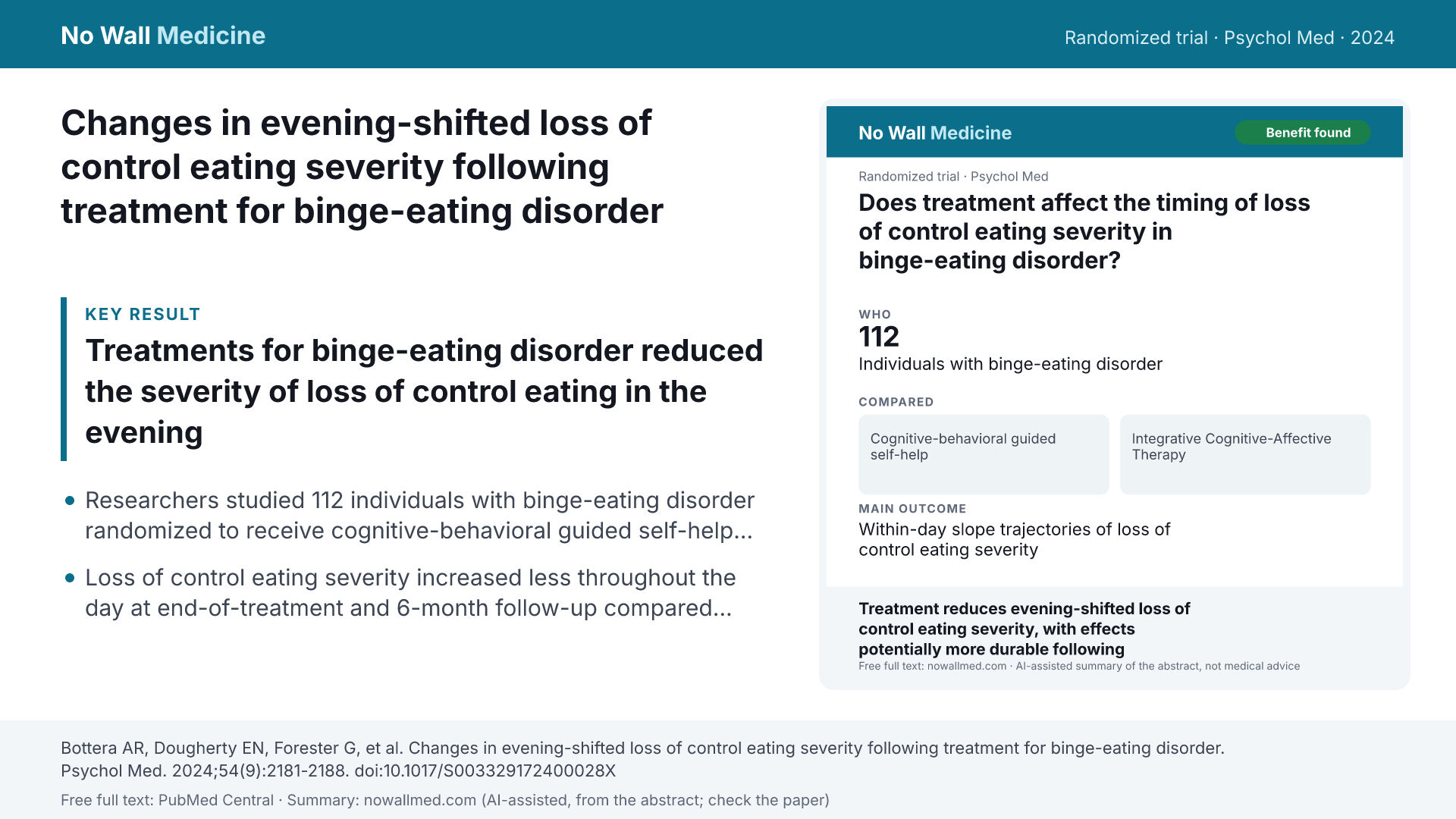
Treatments for binge-eating disorder reduced the severity of loss of control eating in the evening
Changes in evening-shifted loss of control eating severity following treatment for binge-eating disorder
Randomized trialBenefit found
Does treatment affect the timing of loss of control eating severity in binge-eating disorder?
Who
112
Individuals with binge-eating disorder
Compared
Cognitive-behavioral guided self-help
Integrative Cognitive-Affective Therapy
Main outcome
Within-day slope trajectories of loss of control eating severity
Bottom line: Treatment reduces evening-shifted loss of control eating severity, with effects potentially more durable following Integrative Cognitive-Affective Therapy.
Psychol Med · 2024-02-28Download image
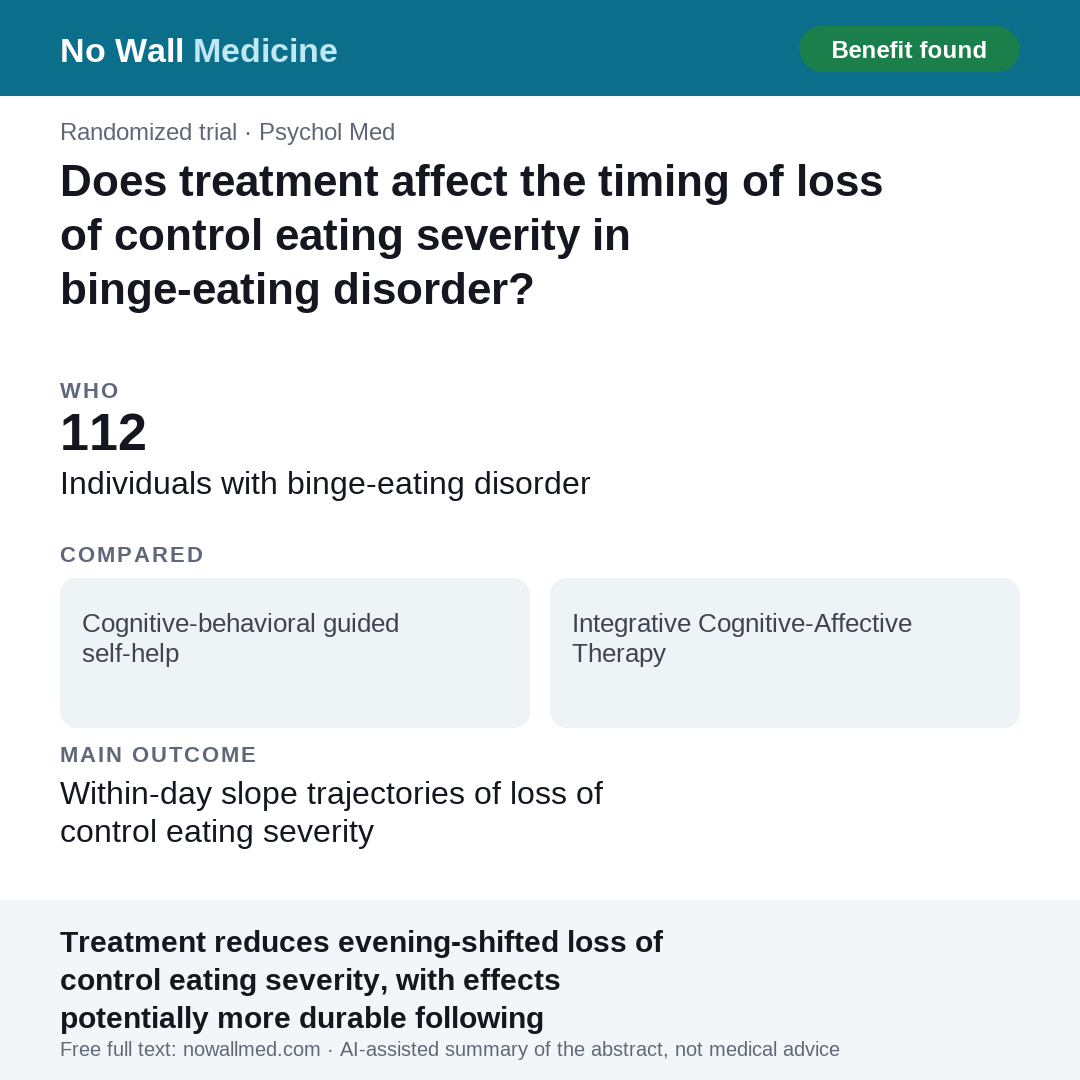
Clinical question: Does treatment affect the timing of loss of control eating severity in binge-eating disorder?
Why it matters: It was unknown if treatment for binge-eating disorder affects the specific time of day when loss of control eating is most severe.
Key points
- Researchers studied 112 individuals with binge-eating disorder randomized to receive cognitive-behavioral guided self-help or integrative cognitive-affective therapy.
- Loss of control eating severity increased less throughout the day at end-of-treatment and 6-month follow-up compared to baseline.
- At 6-month follow-up, evening loss of control eating severity was more intense for those receiving cognitive-behavioral guided self-help compared to integrative cognitive-affective therapy.
Headline and key points written with AI from the paper’s abstract, with every number checked against it. Read the paper before relying on them.
Was this summary helpful?
Subject terms
Cite this article
Bottera AR, Dougherty EN, Forester G, et al. Changes in evening-shifted loss of control eating severity following treatment for binge-eating disorder. Psychol Med. 2024. doi:10.1017/S003329172400028X
Spotted a mistake? Suggest a correction