Patiromer use did not significantly change natriuretic peptide levels compared to placebo in heart failure patients
Changes in natriuretic peptide levels following patiromer-enabled optimization of medical therapy in heart failure: A post hoc analysis of the DIAMOND study
Post hoc analysis of a randomized trialNo clear difference
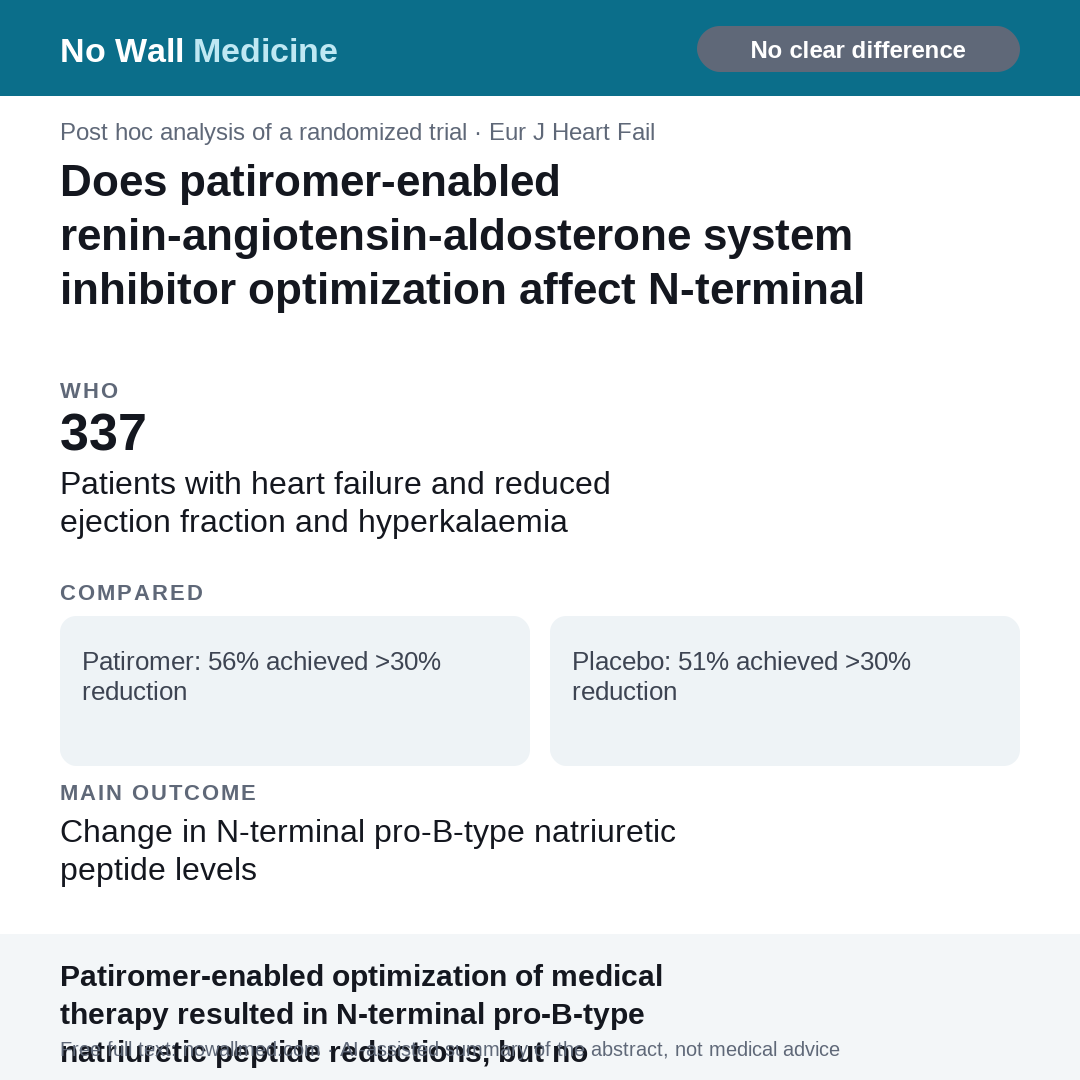
Does patiromer-enabled renin-angiotensin-aldosterone system inhibitor optimization affect N-terminal pro-B-type natriuretic peptide levels?
Who
337
Patients with heart failure and reduced ejection fraction and hyperkalaemia
Compared
Patiromer: 56% achieved >30% reduction
Placebo: 51% achieved >30% reduction
Main outcome
Change in N-terminal pro-B-type natriuretic peptide levels
Result: -53% (95% confidence interval -59% to -46%)
Bottom line: Patiromer-enabled optimization of medical therapy resulted in N-terminal pro-B-type natriuretic peptide reductions, but no significant difference between groups.
Eur J Heart Fail · 2025-07-03Download image
Clinical question: Does patiromer-enabled renin-angiotensin-aldosterone system inhibitor optimization affect N-terminal pro-B-type natriuretic peptide levels?
Why it matters: It is unclear if using the potassium binder patiromer to optimize renin-angiotensin-aldosterone system inhibitor therapy affects N-terminal pro-B-type natriuretic peptide levels in heart failure patients.
Key points
- Researchers analyzed 337 patients with heart failure and reduced ejection fraction who had N-terminal pro-B-type natriuretic peptide levels of 1000 pg/ml or higher.
- N-terminal pro-B-type natriuretic peptide levels declined by -53% in both the patiromer and placebo arms combined, but there was no significant difference between groups.
- A reduction of more than 30% occurred in 56% of the patiromer group and 51% of the placebo group, which was not a statistically significant difference.
Headline and key points written with AI from the paper’s abstract, with every number checked against it. Read the paper before relying on them.
Topics
Cite this article
Kalogeropoulos AP, Hameed I, Anker SD, Bayes-Genis A, Böhm M, Budden J. Changes in natriuretic peptide levels following patiromer-enabled optimization of medical therapy in heart failure: A post hoc analysis of the DIAMOND study. Eur J Heart Fail. 2025. doi:10.1002/ejhf.3754
Spotted a mistake? Suggest a correction