Lower natriuretic peptide levels were associated with fewer heart failure hospitalizations and deaths
Heart Failure With Preserved Ejection Fraction and Lower Natriuretic Peptide: Clinical Characteristics and Change in Natriuretic Peptide Levels
Observational study using trial dataMixed results
How do NT-proBNP levels relate to outcomes in heart failure with preserved ejection fraction?
Who
602
Patients with heart failure and preserved ejection fraction · SUPPORT trial
Compared
NT-proBNP <300 pg/mL: lower risks of heart failure hospitalization or all-cause death
NT-proBNP ≥300 pg/mL: higher risks of heart failure hospitalization or all-cause death
Main outcome
heart failure hospitalization or all-cause death
Result: adjusted hazard ratio 1.08 (95% CI 0.69-1.69)
Bottom line: Patients with low NT-proBNP may progress to higher levels and adverse outcomes over time.
J Am Heart Assoc · 2025-10-23Download image
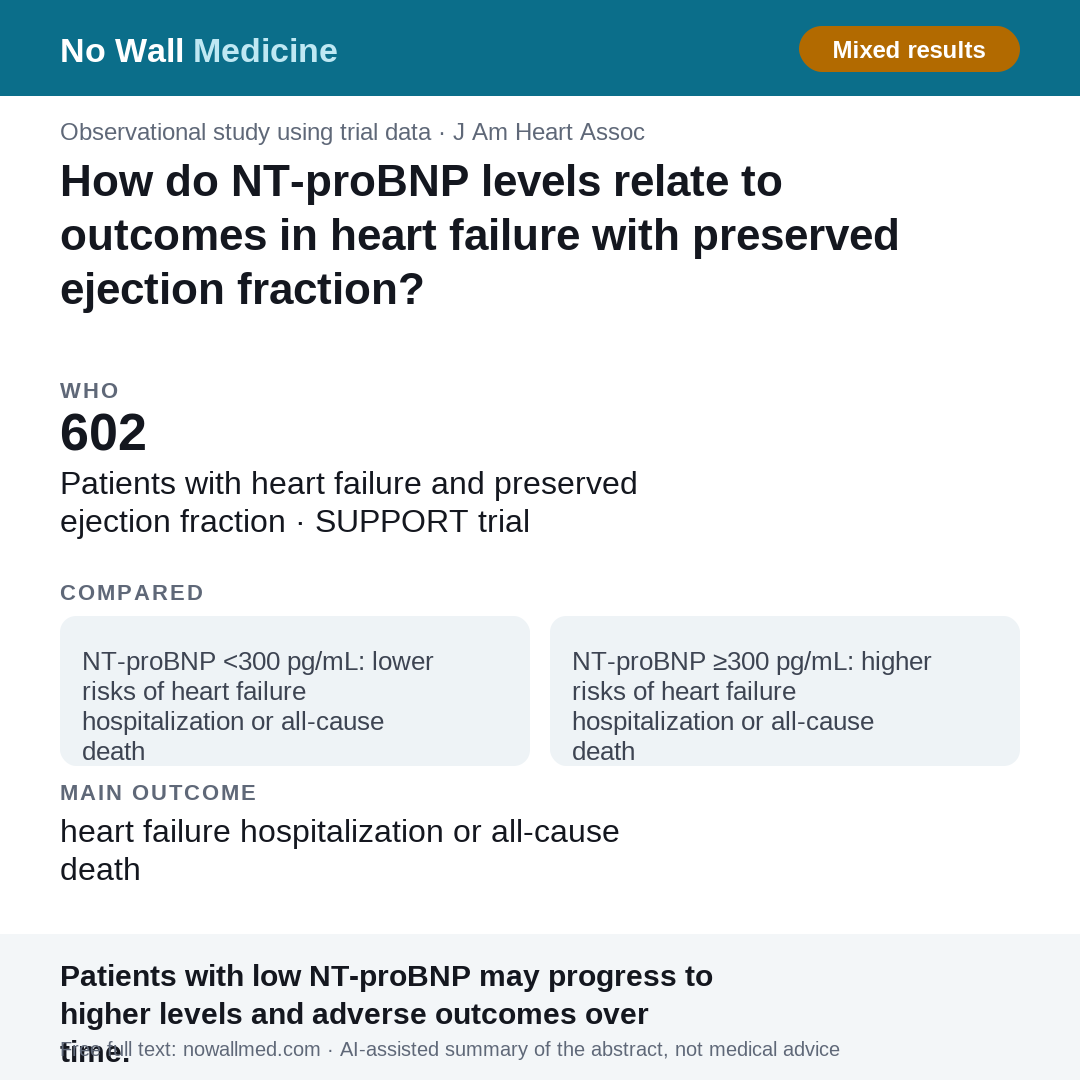
Clinical question: How do NT-proBNP levels relate to outcomes in heart failure with preserved ejection fraction?
Why it matters: Current guidelines emphasize recognizing mild elevations in N-terminal pro-B-type natriuretic peptide, but levels in heart failure with preserved ejection fraction are often lower than expected.
Key points
- Researchers studied 602 patients with heart failure and preserved ejection fraction, which is a condition where the heart pumps normally but is stiff.
- Patients with N-terminal pro-B-type natriuretic peptide levels below 300 pg/mL were associated with lower risks of heart failure hospitalization or all-cause death.
- Over 3 years, 15.5% of patients with levels below 300 pg/mL saw their levels rise to 300 pg/mL or higher alongside cardiac deterioration.
Headline and key points written with AI from the paper’s abstract, with every number checked against it. Read the paper before relying on them.
Topics
Cite this article
Teramoto K, Nochioka K, Sakata Y, Nishimura K, Shimokawa H, Yasuda S. Heart Failure With Preserved Ejection Fraction and Lower Natriuretic Peptide: Clinical Characteristics and Change in Natriuretic Peptide Levels. J Am Heart Assoc. 2025. doi:10.1161/JAHA.125.041208
Spotted a mistake? Suggest a correction