Reporting completeness and data sharing in systematic reviews showed little improvement between 2014 and 2020
Changing patterns in reporting and sharing of review data in systematic reviews with meta-analysis of the effects of interventions: cross sectional meta-research study
Cross sectional meta-researchMixed results
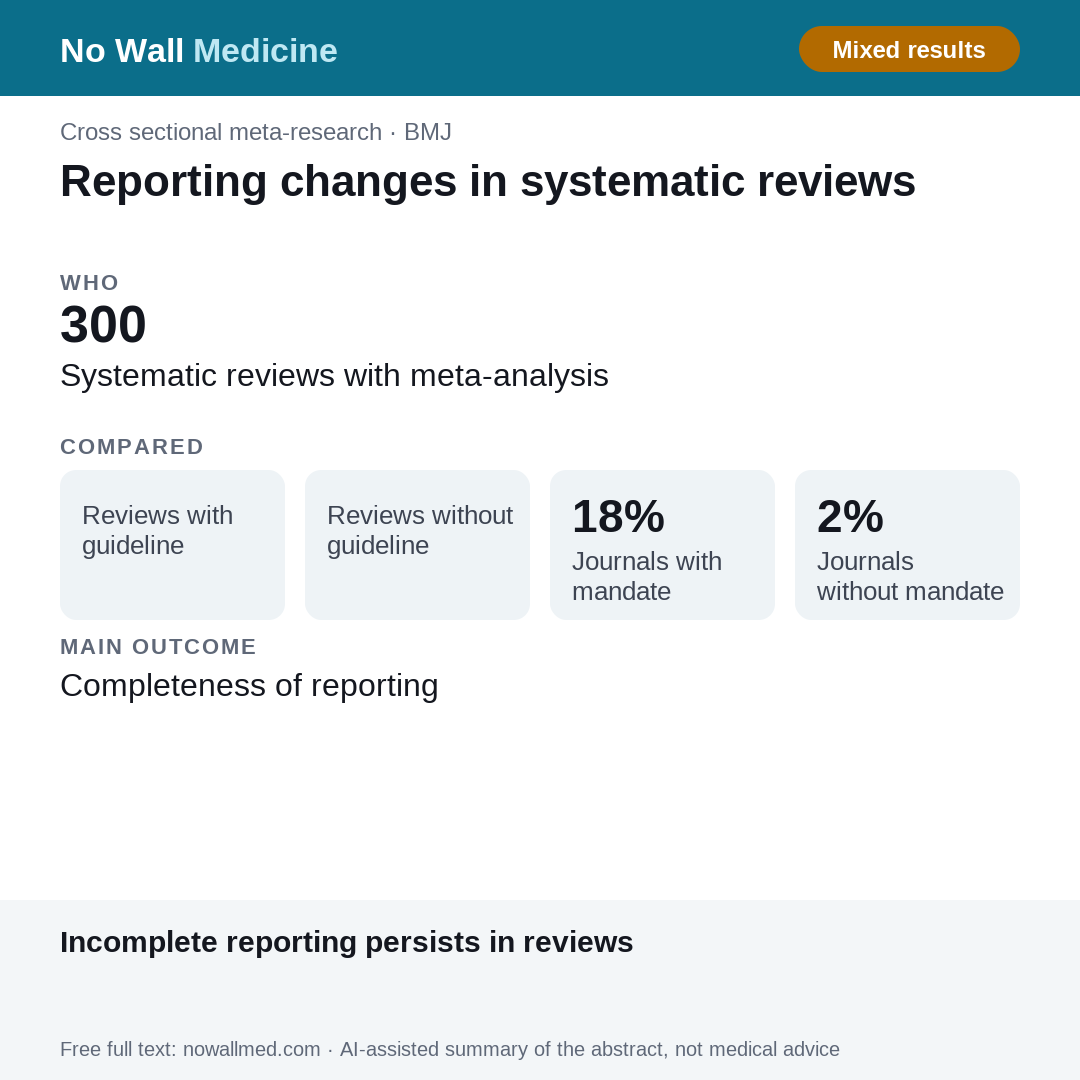
Reporting changes in systematic reviews
Who
300
Systematic reviews with meta-analysis
Compared
Reviews with guideline
Reviews without guideline
18%Journals with mandate
2%Journals without mandate
Main outcome
Completeness of reporting
Bottom line: Incomplete reporting persists in reviews
BMJ · 2022-11-22Download image
Why it matters: It is unknown if the completeness of reporting and the frequency of sharing data and code in systematic reviews have changed over time.
Key points
- Researchers analyzed 300 systematic reviews from 2020 and compared them to 110 reviews from 2014 to assess reporting completeness and material sharing.
- In 2020, 38% reported a registration record, 71% provided a full search strategy, 62% described risk of bias assessment methods, and 72% stated funding sources.
- Reviews in journals mandating data sharing or availability statements were associated with higher sharing rates of 18% compared to 2% in other journals.
Headline and key points written with AI from the paper’s abstract, with every number checked against it. Read the paper before relying on them.
Was this summary helpful?
Abstract
Objectives
To examine changes in completeness of reporting and frequency of sharing data, analytical code, and other review materials in systematic reviews over time; and factors associated with these changes. Design
Cross sectional meta-research study. Population
Random sample of 300 systematic reviews with meta-analysis of aggregate data on the effects of a health, social, behavioural, or educational intervention. Reviews were indexed in PubMed, Science Citation Index, Social Sciences Citation Index, Scopus, and Education Collection in November 2020. Main outcome measures
The extent of complete reporting and the frequency of sharing review materials in the systematic reviews indexed in 2020 were compared with 110 systematic reviews indexed in February 2014. Associations between completeness of reporting and various factors (eg, self-reported use of reporting guidelines, journal policies on data sharing) were examined by calculating risk ratios and 95% confidence intervals. Results
Several items were reported suboptimally among 300 systematic reviews from 2020, such as a registration record for the review (n=113; 38%), a full search strategy for at least one database (n=214; 71%), methods used to assess risk of bias (n=185; 62%), methods used to prepare data for meta-analysis (n=101; 34%), and source of funding for the review (n=215; 72%). Only a few items not already reported at a high frequency in 2014 were reported more frequently in 2020. No evidence indicated that reviews using a reporting guideline were more completely reported than reviews not using a guideline. Reviews published in 2020 in journals that mandated either data sharing or inclusion of data availability statements were more likely to share their review materials (eg, data, code files) than reviews in journals without such mandates (16/87 (18%) v 4/213 (2%)). Conclusion
Incomplete reporting of several recommended items for systematic reviews persists, even in reviews that claim to have followed a reporting guideline. Journal policies on data sharing might encourage sharing of review materials.
Abstract reproduced under the article’s CC BY licence.
Subject terms
Cite this article
Nguyen PY, Kanukula R, McKenzie JE, Alqaidoom Z, Brennan SE, Haddaway NR. Changing patterns in reporting and sharing of review data in systematic reviews with meta-analysis of the effects of interventions: cross sectional meta-research study. BMJ. 2022. doi:10.1136/bmj-2022-072428
Spotted a mistake? Suggest a correction
Top studies every Monday
The week’s key trials and guidelines in your specialties, plus any topics you follow. By email, free.
Get the weekly digest