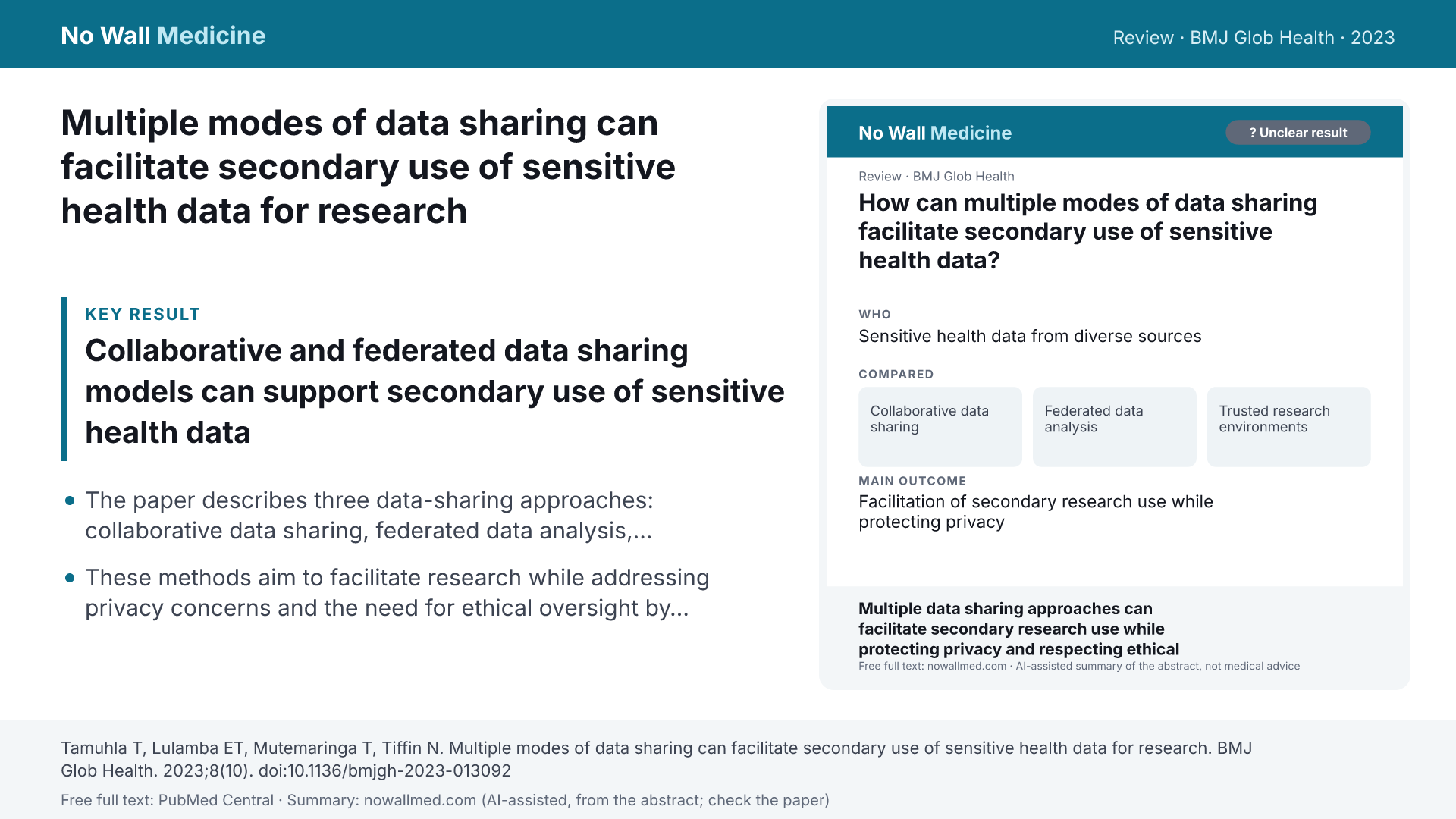
Collaborative and federated data sharing models can support secondary use of sensitive health data
Multiple modes of data sharing can facilitate secondary use of sensitive health data for research
ReviewUnclear result
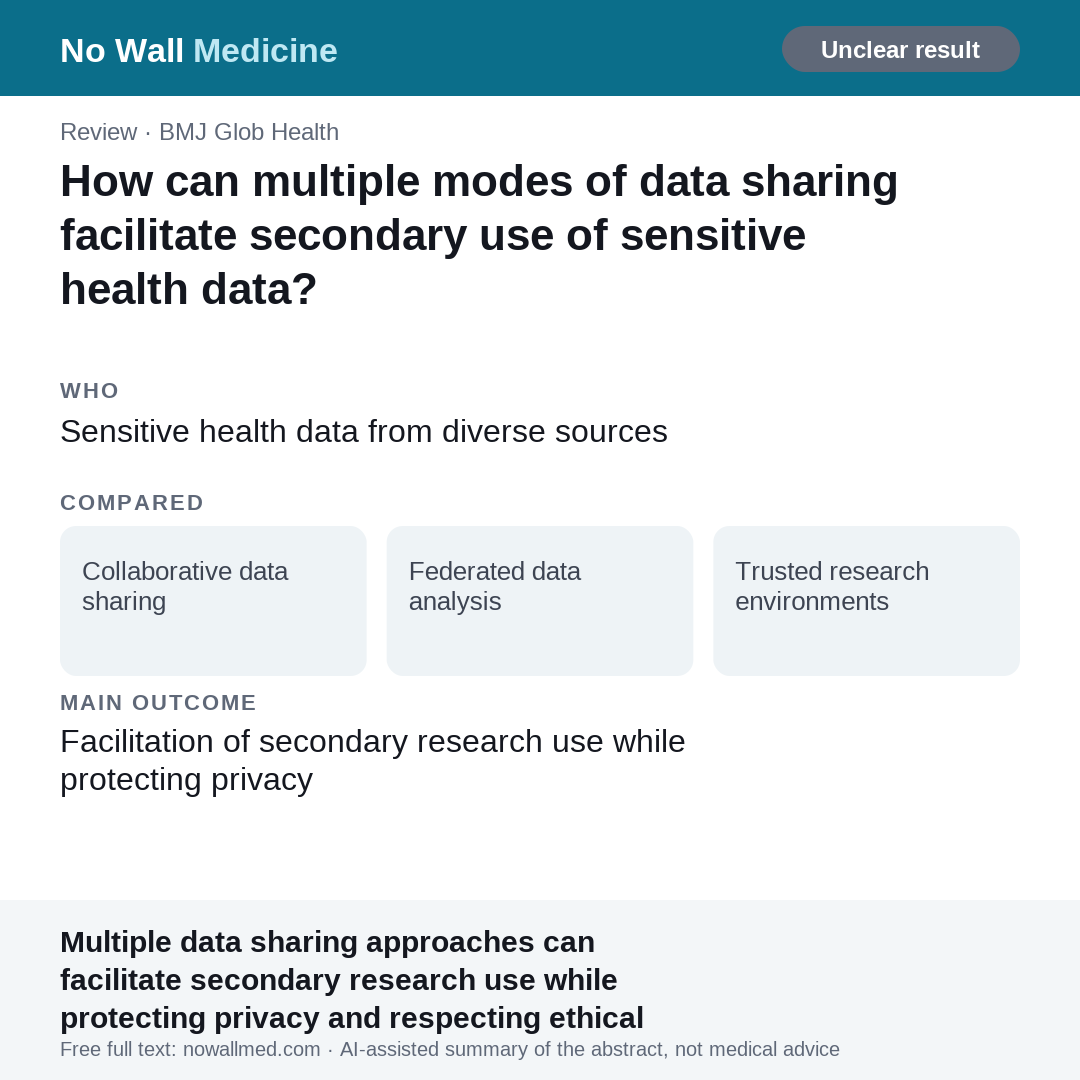
How can multiple modes of data sharing facilitate secondary use of sensitive health data?
Who
Sensitive health data from diverse sources
Compared
Collaborative data sharing
Federated data analysis
Trusted research environments
Main outcome
Facilitation of secondary research use while protecting privacy
Bottom line: Multiple data sharing approaches can facilitate secondary research use while protecting privacy and respecting ethical constraints.
BMJ Glob Health · 2023-10-07Download image
Clinical question: How can multiple modes of data sharing facilitate secondary use of sensitive health data?
Why it matters: Traditional open access models of unidirectional data transfer may create privacy issues and fail to address the needs of researchers in under-resourced environments.
Key points
- The paper describes three data-sharing approaches: collaborative data sharing, federated data analysis, and trusted research environments.
- These methods aim to facilitate research while addressing privacy concerns and the need for ethical oversight by data generators.
- The authors present a modular approach to data sharing agreements and a framework to protect privacy through deidentification and anonymisation.
Headline and key points written with AI from the paper’s abstract, with every number checked against it. Read the paper before relying on them.
Was this summary helpful?
Abstract
Evidence-based healthcare relies on health data from diverse sources to inform decision-making across different domains, including disease prevention, aetiology, diagnostics, therapeutics and prognosis. Increasing volumes of highly granular data provide opportunities to leverage the evidence base, with growing recognition that health data are highly sensitive and onward research use may create privacy issues for individuals providing data. Concerns are heightened for data without explicit informed consent for secondary research use. Additionally, researchers-especially from under-resourced environments and the global South-may wish to participate in onward analysis of resources they collected or retain oversight of onward use to ensure ethical constraints are respected. Different data-sharing approaches may be adopted according to data sensitivity and secondary use restrictions, moving beyond the traditional Open Access model of unidirectional data transfer from generator to secondary user. We describe collaborative data sharing, facilitating research by combining datasets and undertaking meta-analysis involving collaborating partners; federated data analysis, where partners undertake synchronous, harmonised analyses on their independent datasets and then combine their results in a coauthored report, and trusted research environments where data are analysed in a controlled environment and only aggregate results are exported. We review how deidentification and anonymisation methods, including data perturbation, can reduce risks specifically associated with health data secondary use. In addition, we present an innovative modularised approach for building data sharing agreements incorporating a more nuanced approach to data sharing to protect privacy, and provide a framework for building the agreements for each of these data-sharing scenarios.
Abstract reproduced under the article’s CC BY NC licence.
Subject terms
Cite this article
Tamuhla T, Lulamba ET, Mutemaringa T, Tiffin N. Multiple modes of data sharing can facilitate secondary use of sensitive health data for research. BMJ Glob Health. 2023. doi:10.1136/bmjgh-2023-013092
Spotted a mistake? Suggest a correction