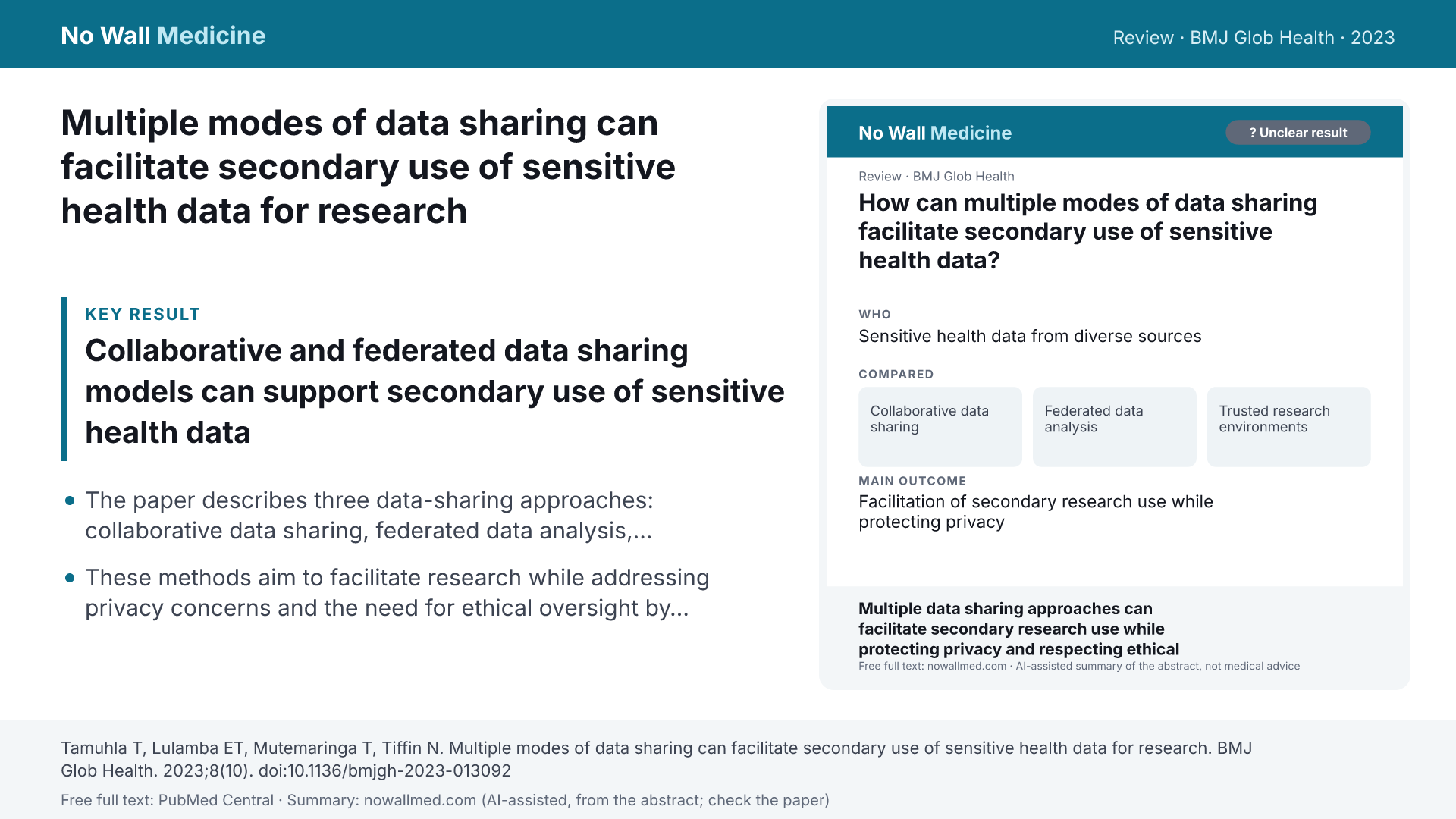
Multiple modes of data sharing can facilitate secondary use of sensitive health data for research
Key result: Collaborative and federated data sharing models can support secondary use of sensitive health data
ReviewUnclear result
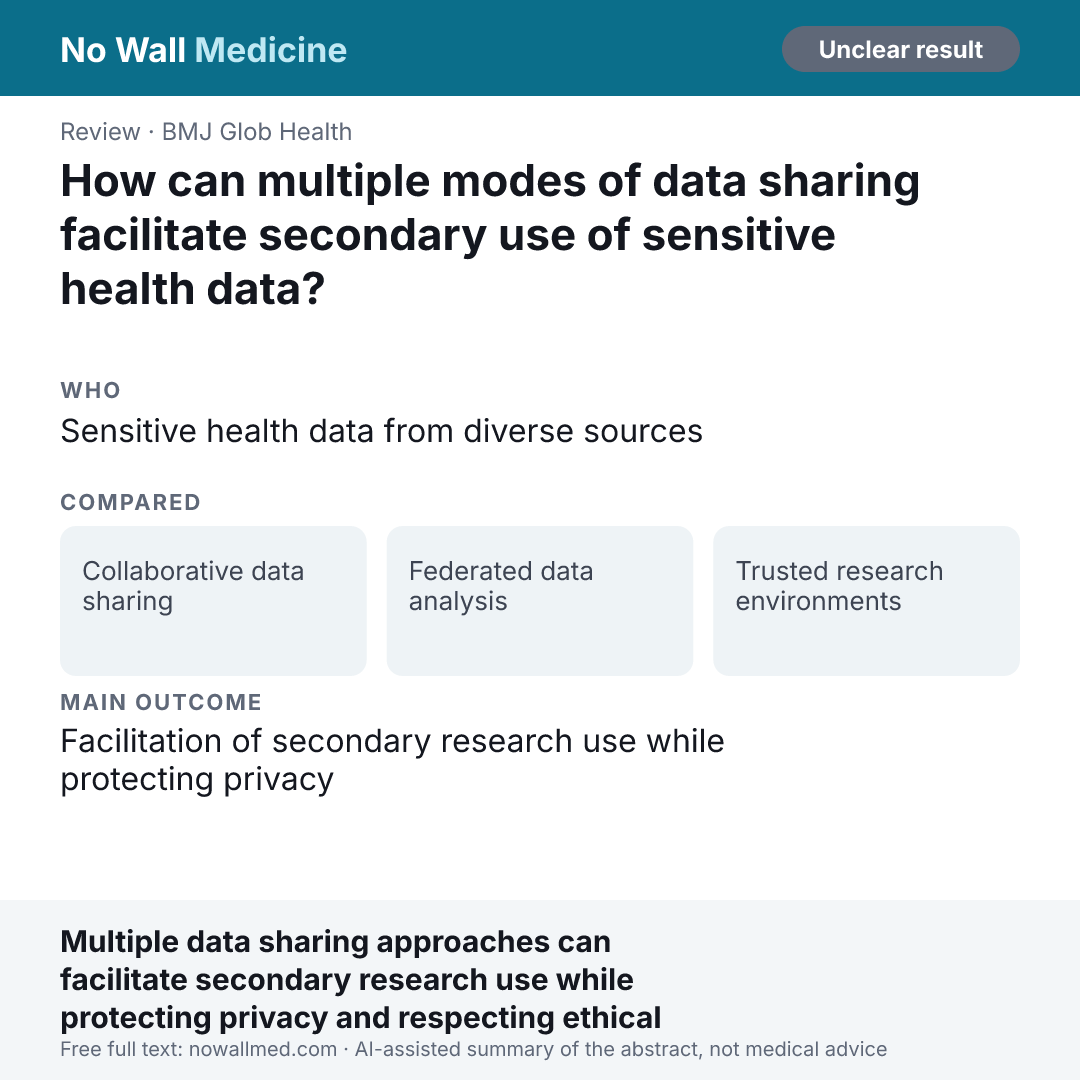
How can multiple modes of data sharing facilitate secondary use of sensitive health data?
Who
Sensitive health data from diverse sources
Compared
Collaborative data sharing
Federated data analysis
Trusted research environments
Main outcome
Facilitation of secondary research use while protecting privacy
Bottom line: Multiple data sharing approaches can facilitate secondary research use while protecting privacy and respecting ethical constraints.
BMJ Glob Health · 2023-10-07 · Save PNG
Key points
- The paper describes three data-sharing approaches: collaborative data sharing, federated data analysis, and trusted research environments.
- These methods aim to facilitate research while addressing privacy concerns and the need for ethical oversight by data generators.
- The authors present a modular approach to data sharing agreements and a framework to protect privacy through deidentification and anonymisation.
Why it matters: Traditional open access models of unidirectional data transfer may create privacy issues and fail to address the needs of researchers in under-resourced environments.
Discussion prompts
- Would these patients look like yours? Who was left out?
- Is the main outcome one that matters to patients?
- Is the difference large enough to change what you do?
Cite: Tamuhla T, Lulamba ET, Mutemaringa T, Tiffin N. Multiple modes of data sharing can facilitate secondary use of sensitive health data for research. BMJ Glob Health. 2023;8(10). doi:10.1136/bmjgh-2023-013092
Free full text: PubMed Central · Summary and visual abstract: nowallmed.com/a/multiple-modes-of-data-sharing-can-facilitate-secondary-use-of-j0u3va/ (AI-assisted from the abstract; check the paper before relying on it).