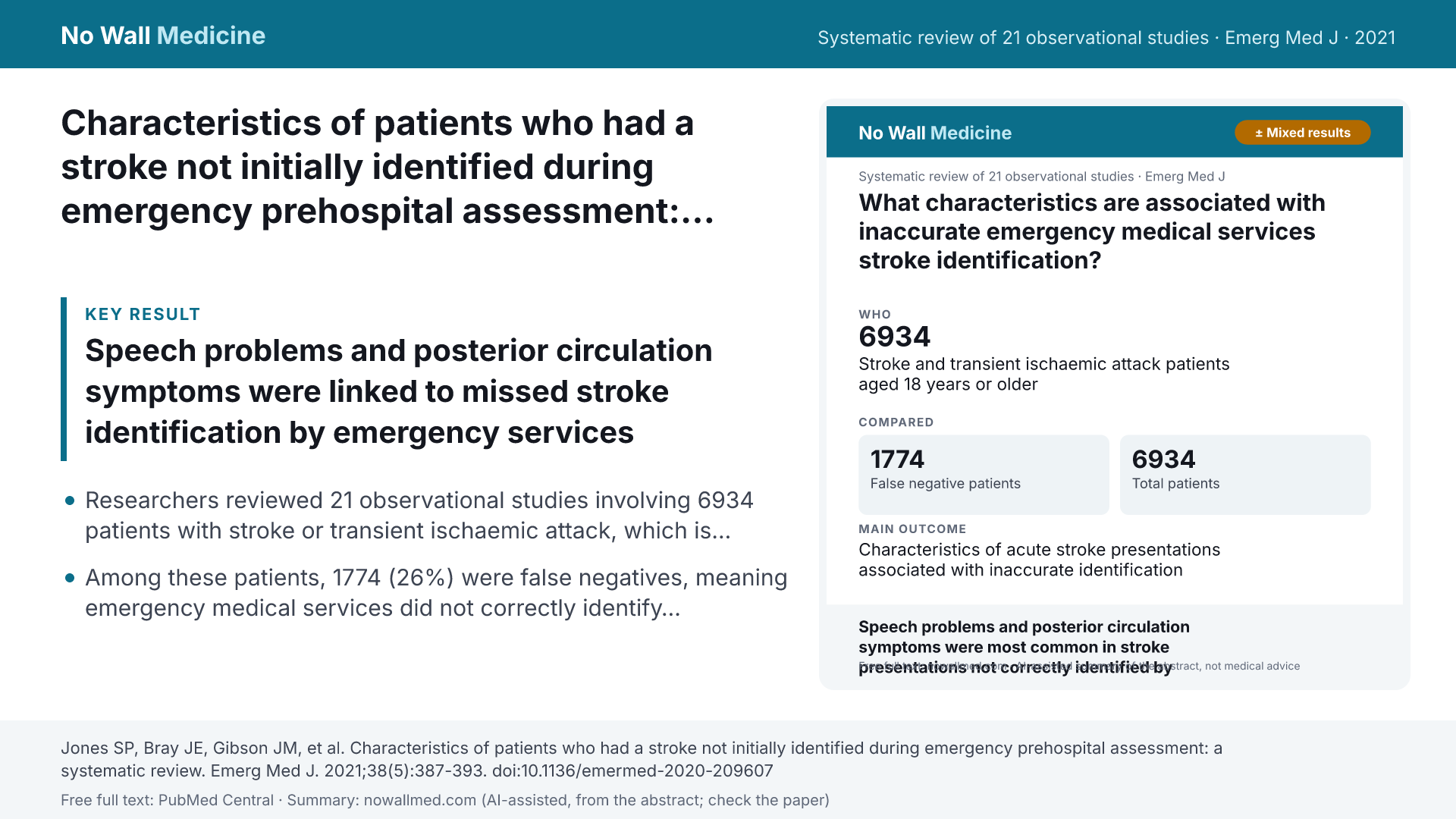
Speech problems and posterior circulation symptoms were linked to missed stroke identification by emergency services
Characteristics of patients who had a stroke not initially identified during emergency prehospital assessment: a systematic review
Systematic review of 21 observational studiesMixed results
What characteristics are associated with inaccurate emergency medical services stroke identification?
Who
6934
Stroke and transient ischaemic attack patients aged 18 years or older
Compared
1774False negative patients (26%)
6934Total patients
Main outcome
Characteristics of acute stroke presentations associated with inaccurate identification
Bottom line: Speech problems and posterior circulation symptoms were most common in stroke presentations not correctly identified by emergency medical services.
Limitation: Adding symptoms to screening tools requires valuation of sensitivity, specificity, training, and resource overuse.
Emerg Med J · 2021-02-19 · Save PNG
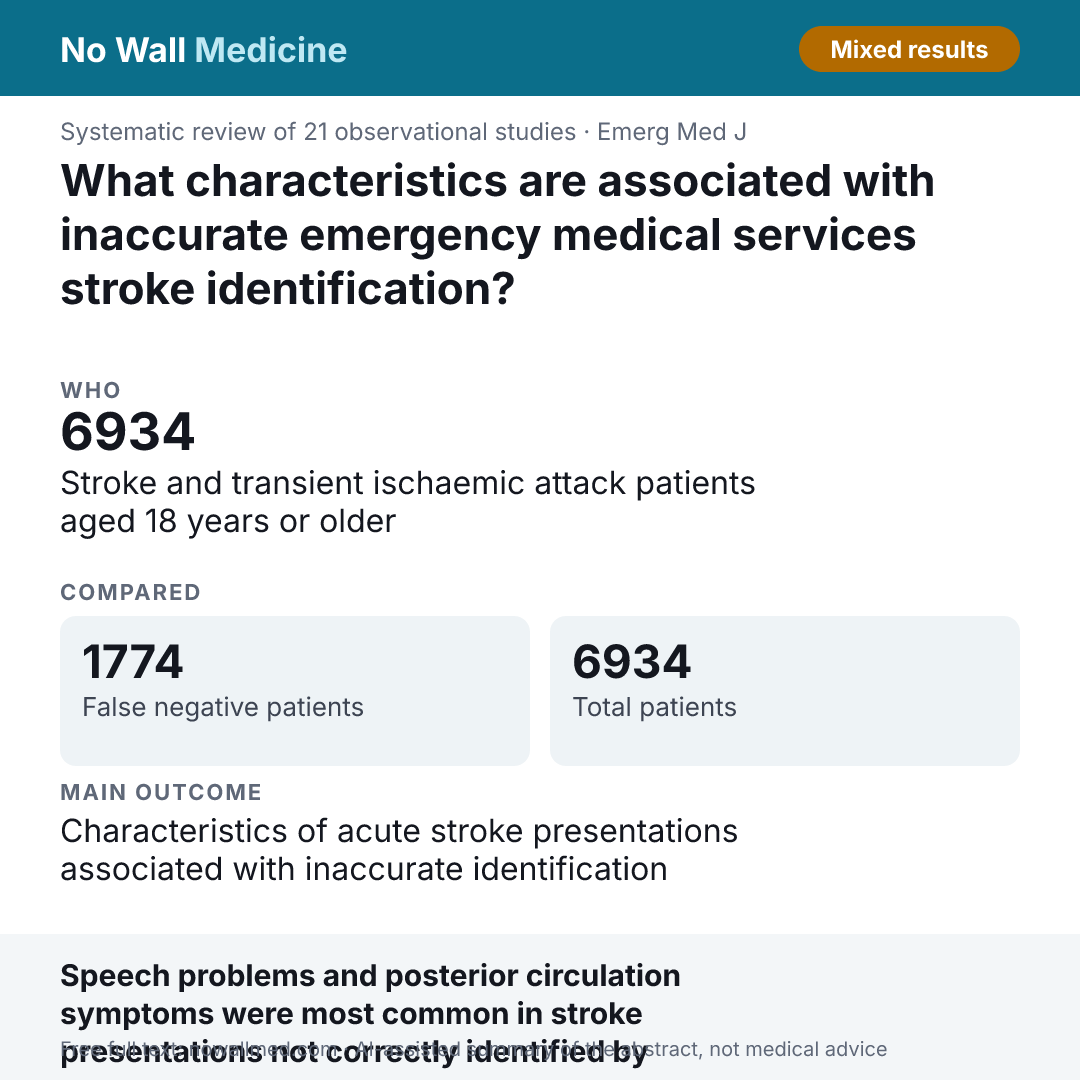
Clinical question: What characteristics are associated with inaccurate emergency medical services stroke identification?
Key points
- Researchers reviewed 21 observational studies involving 6934 patients with stroke or transient ischaemic attack, which is a temporary period of stroke-like symptoms.
- Among these patients, 1774 (26%) were false negatives, meaning emergency medical services did not correctly identify the stroke during prehospital assessment.
- Common symptoms in missed cases included speech problems (13%-28%), nausea or vomiting (8%-38%), dizziness (23%-27%), changes in mental status (8%-25%), and visual disturbances (13%-28%).
Headline and key points written with AI from the paper’s abstract, with every number checked against it. Read the paper before relying on them.
Was this summary helpful?
Abstract
Background
Around 25% of patients who had a stroke do not present with typical 'face, arm, speech' symptoms at onset, and are challenging for emergency medical services (EMS) to identify. The aim of this systematic review was to identify the characteristics of acute stroke presentations associated with inaccurate EMS identification (false negatives). Method
We performed a systematic search of MEDLINE, EMBASE, CINAHL and PubMed from 1995 to August 2020 using key terms: stroke, EMS, paramedics, identification and assessment. Studies included: patients who had a stroke or patient records; ≥18 years; any stroke type; prehospital assessment undertaken by health professionals including paramedics or technicians; data reported on prehospital diagnostic accuracy and/or presenting symptoms. Data were extracted and study quality assessed by two researchers using the Quality Assessment of Diagnostic Accuracy Studies V.2 tool. Results
Of 845 studies initially identified, 21 observational studies met the inclusion criteria. Of the 6934 stroke and Transient Ischaemic Attack patients included, there were 1774 (26%) false negative patients (range from 4 (2%) to 247 (52%)). Commonly documented symptoms in false negative cases were speech problems (n=107; 13%-28%), nausea/vomiting (n=94; 8%-38%), dizziness (n=86; 23%-27%), changes in mental status (n=51; 8%-25%) and visual disturbance/impairment (n=43; 13%-28%). Conclusion
Speech problems and posterior circulation symptoms were the most commonly documented symptoms among stroke presentations that were not correctly identified by EMS (false negatives). However, the addition of further symptoms to stroke screening tools requires valuation of subsequent sensitivity and specificity, training needs and possible overuse of high priority resources.
Abstract reproduced under the article’s CC BY NC licence.
Subject terms
Headline, design, result, key points, caveat and citation as plain text.
Cite this article
Jones SP, Bray JE, Gibson JM, et al. Characteristics of patients who had a stroke not initially identified during emergency prehospital assessment: a systematic review. Emerg Med J. 2021;38(5):387-393. doi:10.1136/emermed-2020-209607
Spotted a mistake? Suggest a correction