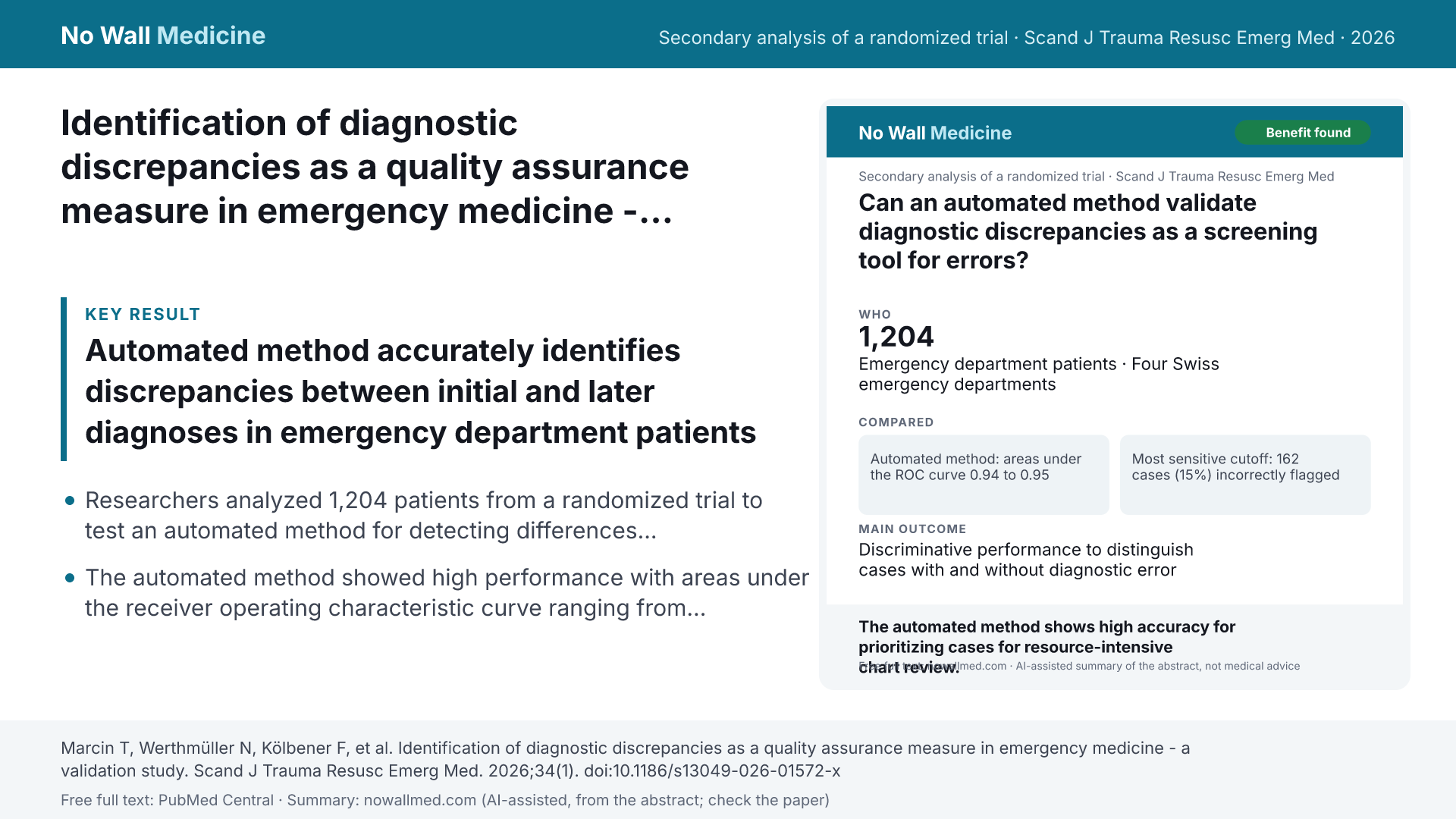
Automated method accurately identifies discrepancies between initial and later diagnoses in emergency department patients
Identification of diagnostic discrepancies as a quality assurance measure in emergency medicine - a validation study
Secondary analysis of a randomized trialBenefit found
Can an automated method validate diagnostic discrepancies as a screening tool for errors?
Who
1,204
Emergency department patients · Four Swiss emergency departments
Compared
Automated method: areas under the ROC curve 0.94 to 0.95
Most sensitive cutoff: 162 cases (15%) incorrectly flagged
Main outcome
Discriminative performance to distinguish cases with and without diagnostic error
Result: areas under the ROC curve 0.94 to 0.95
Bottom line: The automated method shows high accuracy for prioritizing cases for resource-intensive chart review.
Scand J Trauma Resusc Emerg Med · 2026-02-11Download image
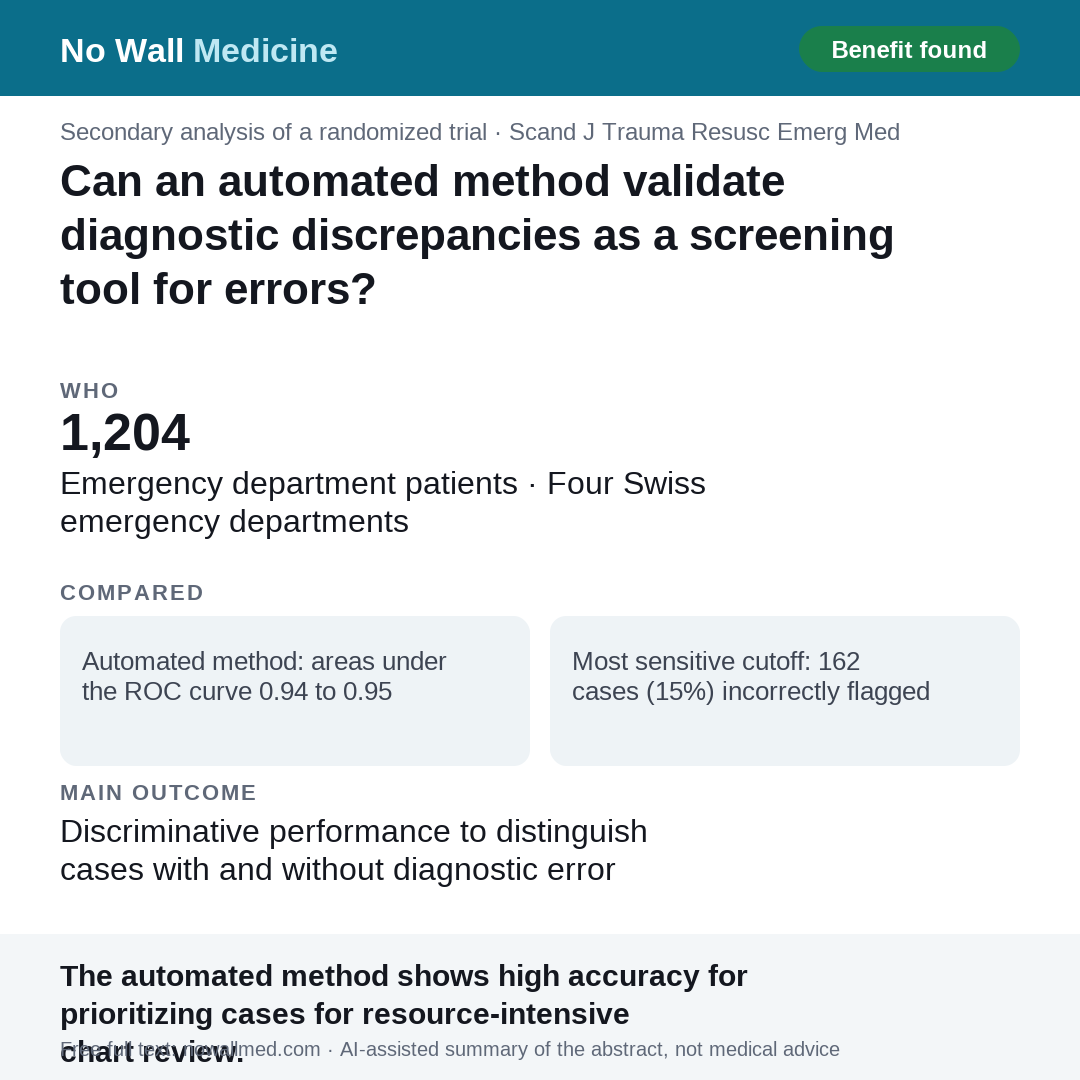
Clinical question: Can an automated method validate diagnostic discrepancies as a screening tool for errors?
Why it matters: Identifying diagnostic errors is difficult because finding them often requires resource-intensive manual reviews of patient charts.
Key points
- Researchers analyzed 1,204 patients from a randomized trial to test an automated method for detecting differences between emergency department diagnoses and follow-up diagnoses.
- The automated method showed high performance with areas under the receiver operating characteristic curve ranging from 0.94 to 0.95.
- Using the most sensitive cutoff, the method detected all true discrepancies but incorrectly flagged 162 cases, which was 15%, as discrepant.
Headline and key points written with AI from the paper’s abstract, with every number checked against it. Read the paper before relying on them.
Was this summary helpful?
Subject terms
Cite this article
Marcin T, Werthmüller N, Kölbener F, et al. Identification of diagnostic discrepancies as a quality assurance measure in emergency medicine - a validation study. Scand J Trauma Resusc Emerg Med. 2026. doi:10.1186/s13049-026-01572-x
Spotted a mistake? Suggest a correction