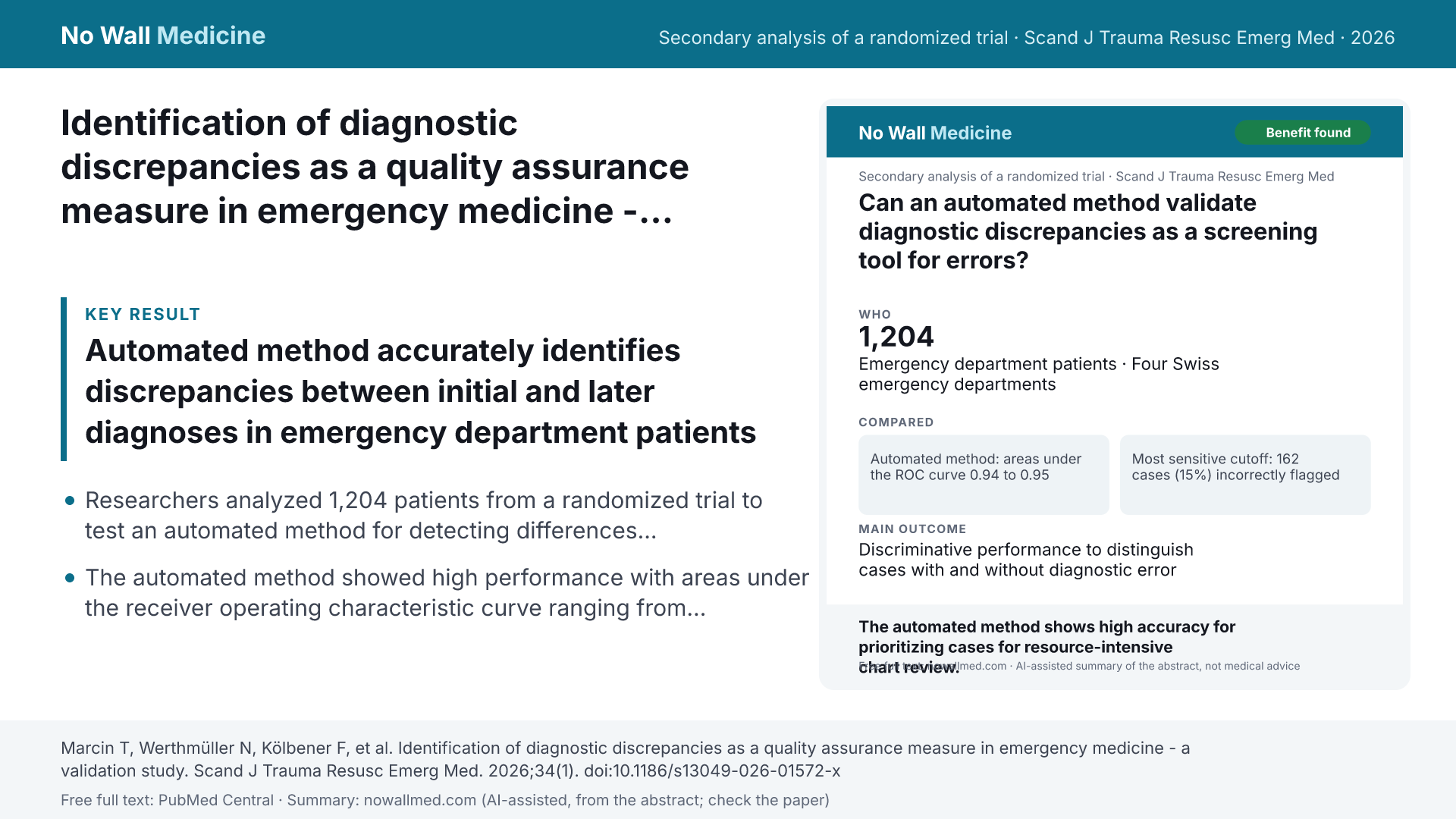
Identification of diagnostic discrepancies as a quality assurance measure in emergency medicine - a validation study
Key result: Automated method accurately identifies discrepancies between initial and later diagnoses in emergency department patients
Secondary analysis of a randomized trialBenefit found
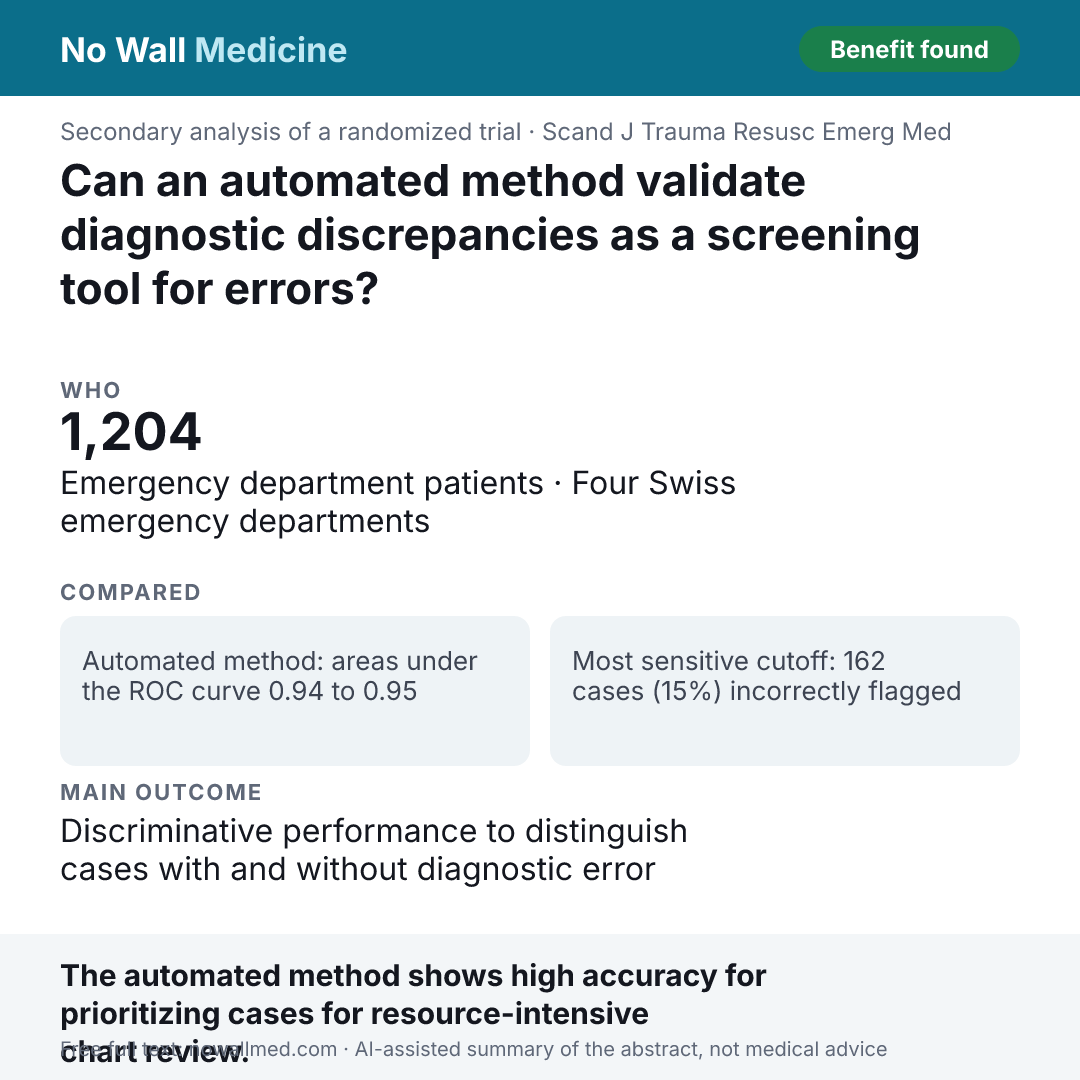
Can an automated method validate diagnostic discrepancies as a screening tool for errors?
Who
1,204
Emergency department patients · Four Swiss emergency departments
Compared
Automated method: areas under the ROC curve 0.94 to 0.95
Most sensitive cutoff: 162 cases (15%) incorrectly flagged
Main outcome
Discriminative performance to distinguish cases with and without diagnostic error
Result: areas under the ROC curve 0.94 to 0.95
Bottom line: The automated method shows high accuracy for prioritizing cases for resource-intensive chart review.
Scand J Trauma Resusc Emerg Med · 2026-02-11 · Save PNG
Key points
- Researchers analyzed 1,204 patients from a randomized trial to test an automated method for detecting differences between emergency department diagnoses and follow-up diagnoses.
- The automated method showed high performance with areas under the receiver operating characteristic curve ranging from 0.94 to 0.95.
- Using the most sensitive cutoff, the method detected all true discrepancies but incorrectly flagged 162 cases, which was 15%, as discrepant.
Why it matters: Identifying diagnostic errors is difficult because finding them often requires resource-intensive manual reviews of patient charts.
Discussion prompts
- Would these patients look like yours? Who was left out?
- Is the main outcome one that matters to patients?
- Is the difference large enough to change what you do?
Cite: Marcin T, Werthmüller N, Kölbener F, et al. Identification of diagnostic discrepancies as a quality assurance measure in emergency medicine - a validation study. Scand J Trauma Resusc Emerg Med. 2026;34(1). doi:10.1186/s13049-026-01572-x
Free full text: PubMed Central · Summary and visual abstract: nowallmed.com/a/identification-of-diagnostic-discrepancies-as-a-quality-assurance-1rzoe49/ (AI-assisted from the abstract; check the paper before relying on it).