Slow oxygen uptake recovery after exercise was associated with higher risk of heart failure or death
Characterization and Application of Novel Exercise Recovery Patterns That Reflect Cardiac Performance: A Substudy of the SEQUOIA-HCM Trial
Randomized controlled trial substudyBenefit found
Does VO2T12.5% reflect cardiac performance and improve with aficamten treatment?
Who
263
Participants with symptomatic obstructive hypertrophic cardiomyopathy · Not specified
Compared
Aficamten: improved 8 seconds (95% CI, -12 to -5 seconds)
Placebo
Main outcome
Time for oxygen uptake to decline by 12.5% (VO2T12.5%)
Result: odds ratio 3.7 (95% CI, 1.9-6.9)
Bottom line: Aficamten treatment improved VO2T12.5% compared to placebo in patients with obstructive hypertrophic cardiomyopathy.
Circulation · 2025-09-05Download image
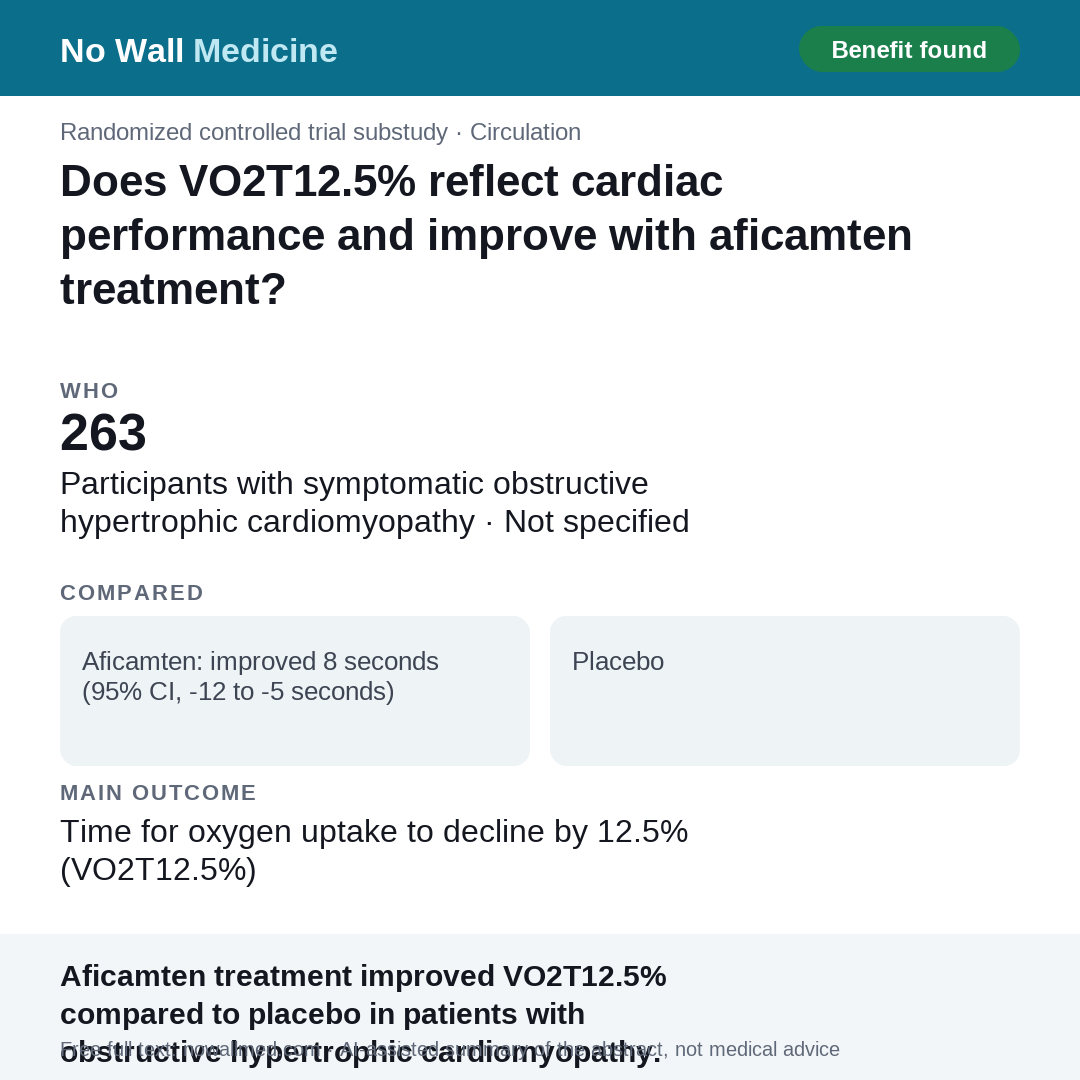
Clinical question: Does VO2T12.5% reflect cardiac performance and improve with aficamten treatment?
Why it matters: Researchers sought to establish simple measures of oxygen uptake recovery that reflect cardiac performance and predict outcomes in patients with dyspnea on exertion.
Key points
- In a cohort of 814 patients, a longer time for oxygen uptake to decline by 12.5% was associated with an elevated pulmonary capillary wedge pressure to cardiac output slope.
- For every 15-second increase in the time for oxygen uptake to decline by 12.5%, the hazard ratio for heart failure hospitalization or death was 1.54.
- In the SEQUOIA-HCM trial of 263 participants, aficamten treatment was associated with an 8 second improvement in oxygen uptake recovery compared to placebo at 24 weeks.
Headline and key points written with AI from the paper’s abstract, with every number checked against it. Read the paper before relying on them.
Topics
Cite this article
Campain J, Griskowitz C, Newlands C, Claggett BL, Kulac IJ, McGinnis S. Characterization and Application of Novel Exercise Recovery Patterns That Reflect Cardiac Performance: A Substudy of the SEQUOIA-HCM Trial. Circulation. 2025. doi:10.1161/CIRCULATIONAHA.124.073585
Spotted a mistake? Suggest a correction