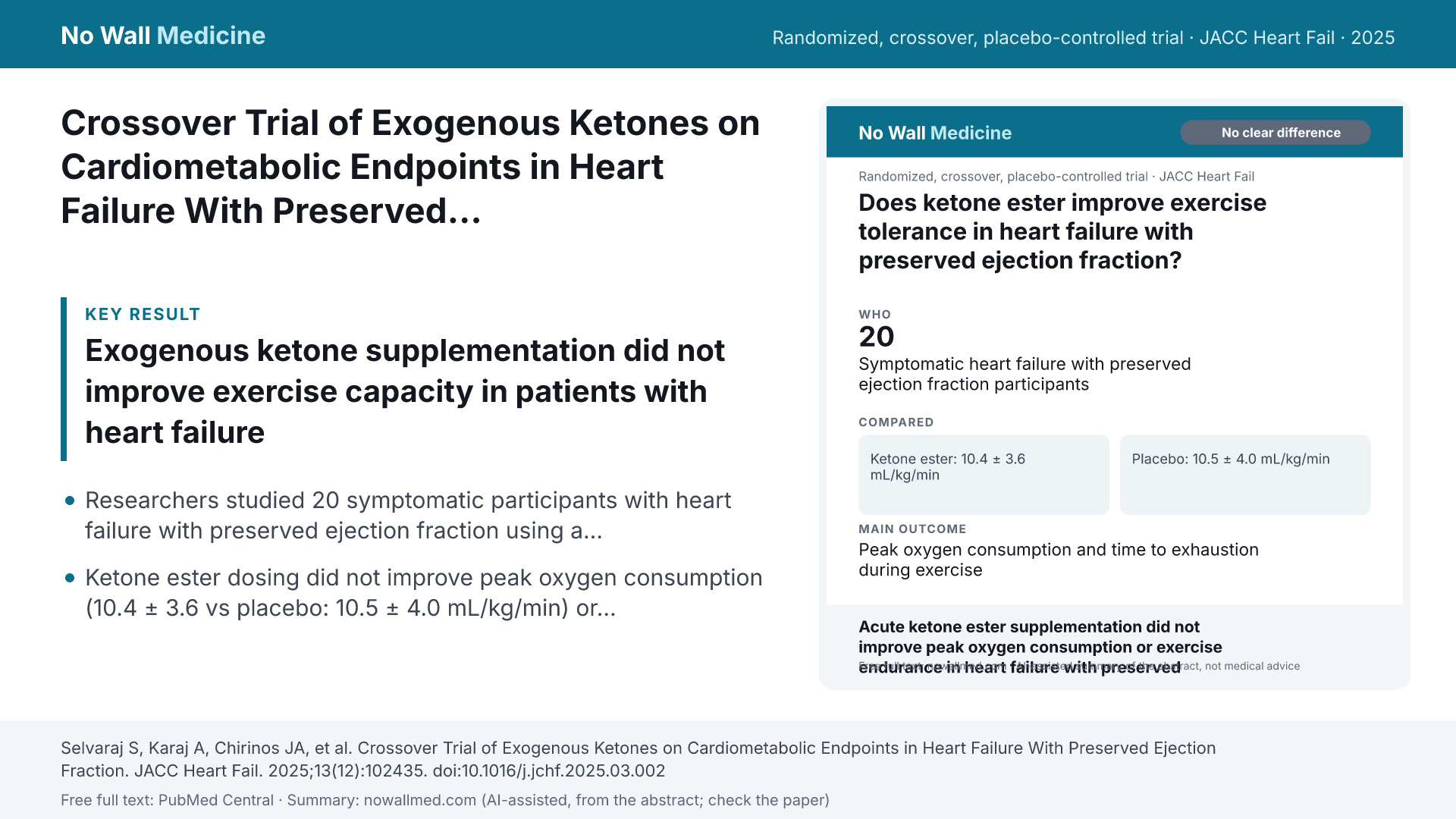
Exogenous ketone supplementation did not improve exercise capacity in patients with heart failure
Crossover Trial of Exogenous Ketones on Cardiometabolic Endpoints in Heart Failure With Preserved Ejection Fraction
Randomized, crossover, placebo-controlled trialNo clear difference
Does ketone ester improve exercise tolerance in heart failure with preserved ejection fraction?
Who
20
Symptomatic heart failure with preserved ejection fraction participants
Compared
Ketone ester: 10.4 ± 3.6 mL/kg/min
Placebo: 10.5 ± 4.0 mL/kg/min
Main outcome
Peak oxygen consumption and time to exhaustion during exercise
Bottom line: Acute ketone ester supplementation did not improve peak oxygen consumption or exercise endurance in heart failure with preserved ejection fraction.
JACC Heart Fail · 2025-03-29 · Save PNG
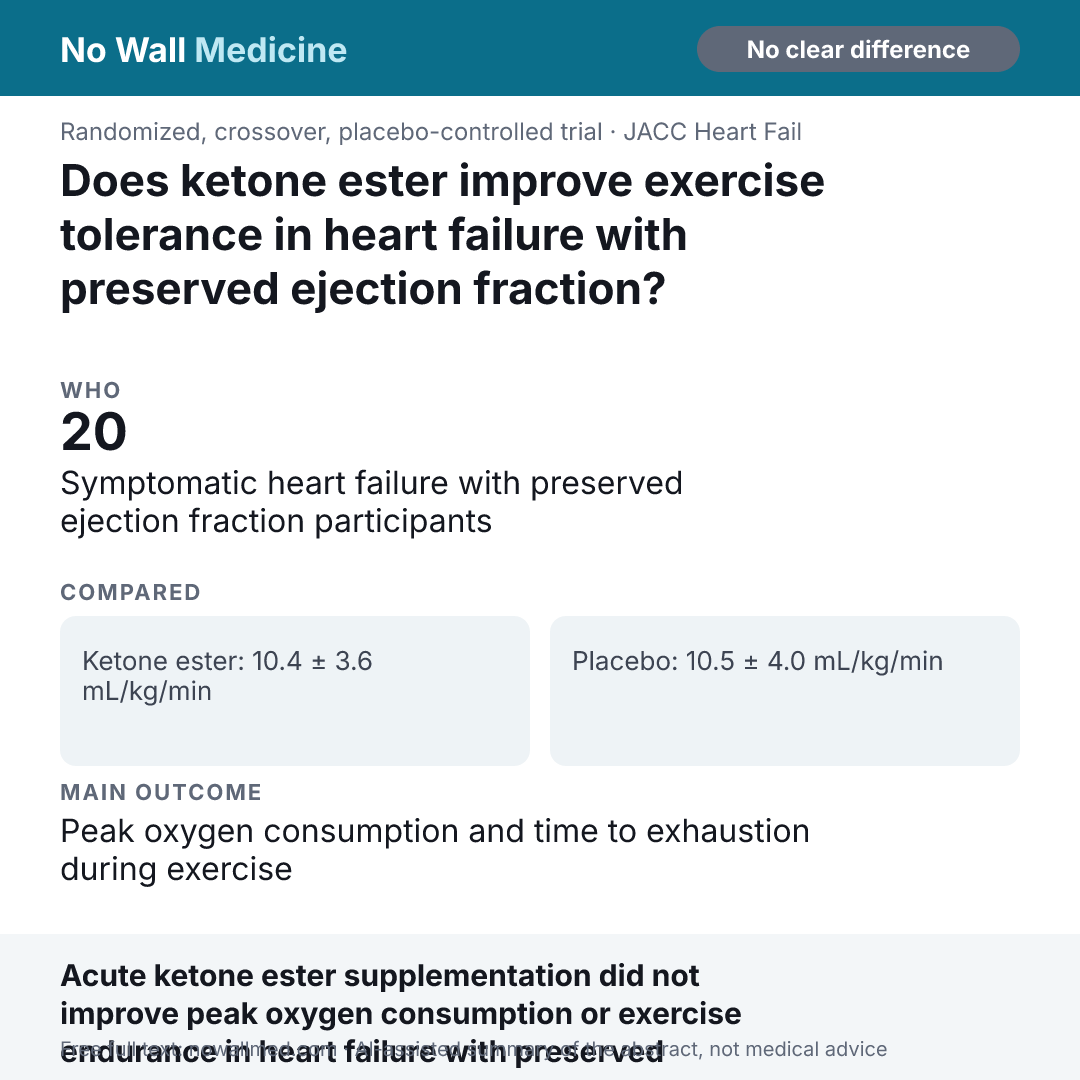
Clinical question: Does ketone ester improve exercise tolerance in heart failure with preserved ejection fraction?
Key points
- Researchers studied 20 symptomatic participants with heart failure with preserved ejection fraction using a randomized, crossover, placebo-controlled trial.
- Ketone ester dosing did not improve peak oxygen consumption (10.4 ± 3.6 vs placebo: 10.5 ± 4.0 mL/kg/min) or exercise endurance (9.7 ± 7.3 minutes vs 8.7 ± 4.4 minutes).
- Ketone ester use was associated with lower respiratory exchange ratios, lower glucose, and lower estimated left ventricular filling pressures.
Headline and key points written with AI from the paper’s abstract, with every number checked against it. Read the paper before relying on them.
Was this summary helpful?
Subject terms
Headline, design, result, key points, caveat and citation as plain text.
Cite this article
Selvaraj S, Karaj A, Chirinos JA, et al. Crossover Trial of Exogenous Ketones on Cardiometabolic Endpoints in Heart Failure With Preserved Ejection Fraction. JACC Heart Fail. 2025;13(12):102435. doi:10.1016/j.jchf.2025.03.002
Spotted a mistake? Suggest a correction