Inorganic nitrite improves oxygen transport in the muscles and lungs during exercise in heart failure
Peripheral and pulmonary effects of inorganic nitrite during exercise in heart failure with preserved ejection fraction
Meta-analysis of two randomized, double-blind, placebo-controlled trialsBenefit found
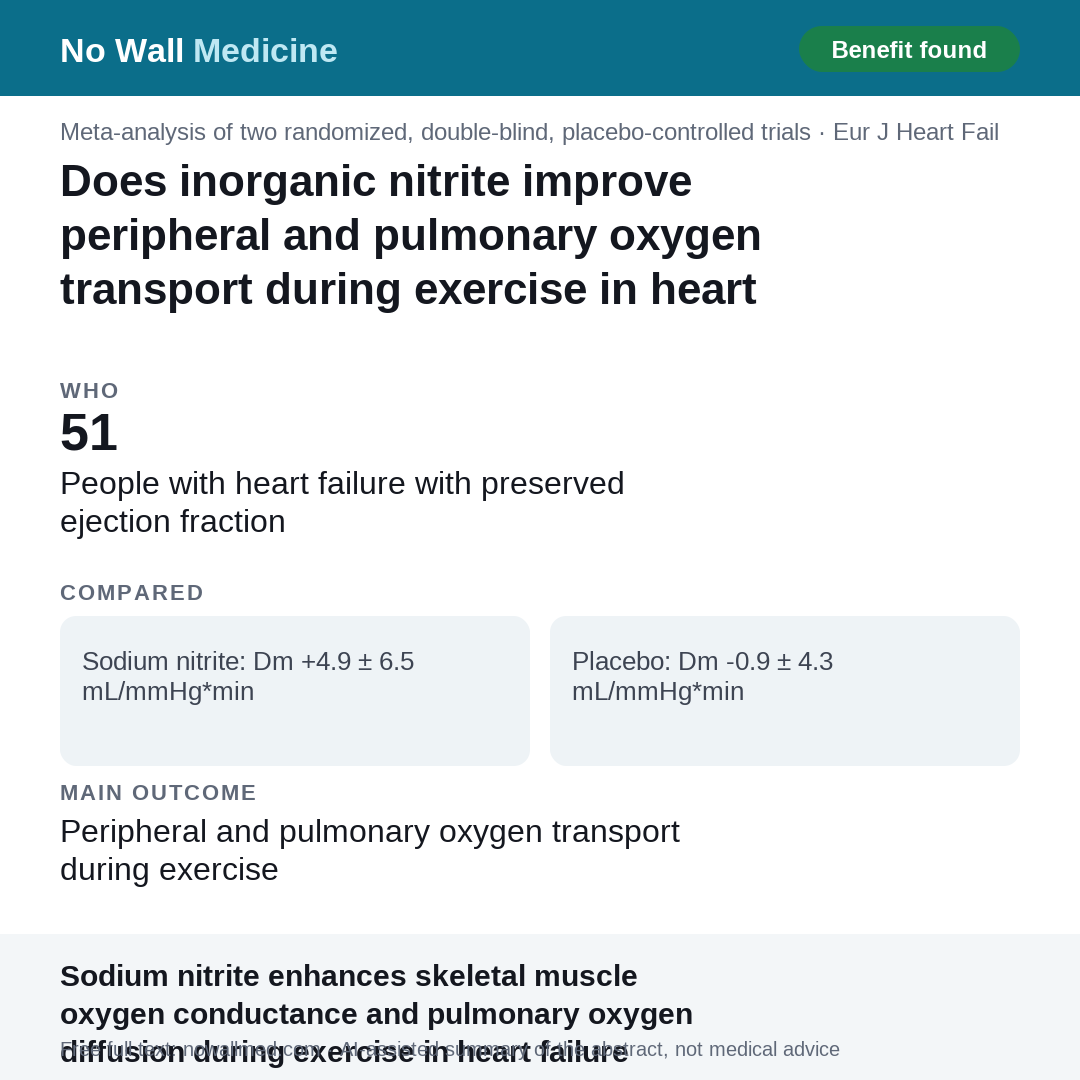
Does inorganic nitrite improve peripheral and pulmonary oxygen transport during exercise in heart failure?
Who
51
People with heart failure with preserved ejection fraction
Compared
Sodium nitrite: Dm +4.9 ± 6.5 mL/mmHg*min
Placebo: Dm -0.9 ± 4.3 mL/mmHg*min
Main outcome
Peripheral and pulmonary oxygen transport during exercise
Bottom line: Sodium nitrite enhances skeletal muscle oxygen conductance and pulmonary oxygen diffusion during exercise in heart failure patients.
Eur J Heart Fail · 2021-02-01Download image
Clinical question: Does inorganic nitrite improve peripheral and pulmonary oxygen transport during exercise in heart failure?
Why it matters: It was unknown whether inorganic nitrite improves how oxygen is transported to the muscles and through the lungs during exercise in patients with heart failure with preserved ejection fraction.
Key points
- Researchers pooled data from 51 participants in two randomized, double-blind, placebo-controlled trials to measure oxygen transport in people with heart failure with preserved ejection fraction.
- Nitrite treatment was associated with an increase in skeletal muscle oxygen conductance of 4.9 ± 6.5 vs. -0.9 ± 4.3 mL/mmHg*min and improved pulmonary oxygen diffusion of 2.5 ± 6.3 vs. -2.0 ± 9.0 mL/mmHg*min.
- Nitrite was associated with faster oxygen consumption response times of -5.0 ± 6.9 vs. -0.6 ± 6.0 s and increased oxygen delivery through cardiac output of 0.4 ± 0.7 vs. -0.3 ± 0.9 L/min.
Headline and key points written with AI from the paper’s abstract, with every number checked against it. Read the paper before relying on them.
Was this summary helpful?
Subject terms
Cite this article
Reddy YNV, Stewart GM, Obokata M, Koepp KE, Borlaug BA. Peripheral and pulmonary effects of inorganic nitrite during exercise in heart failure with preserved ejection fraction. Eur J Heart Fail. 2021. doi:10.1002/ejhf.2093
Spotted a mistake? Suggest a correction
Top studies every Monday
The week’s key trials and guidelines in your specialties, plus any topics you follow. By email, free.
Get the weekly digest