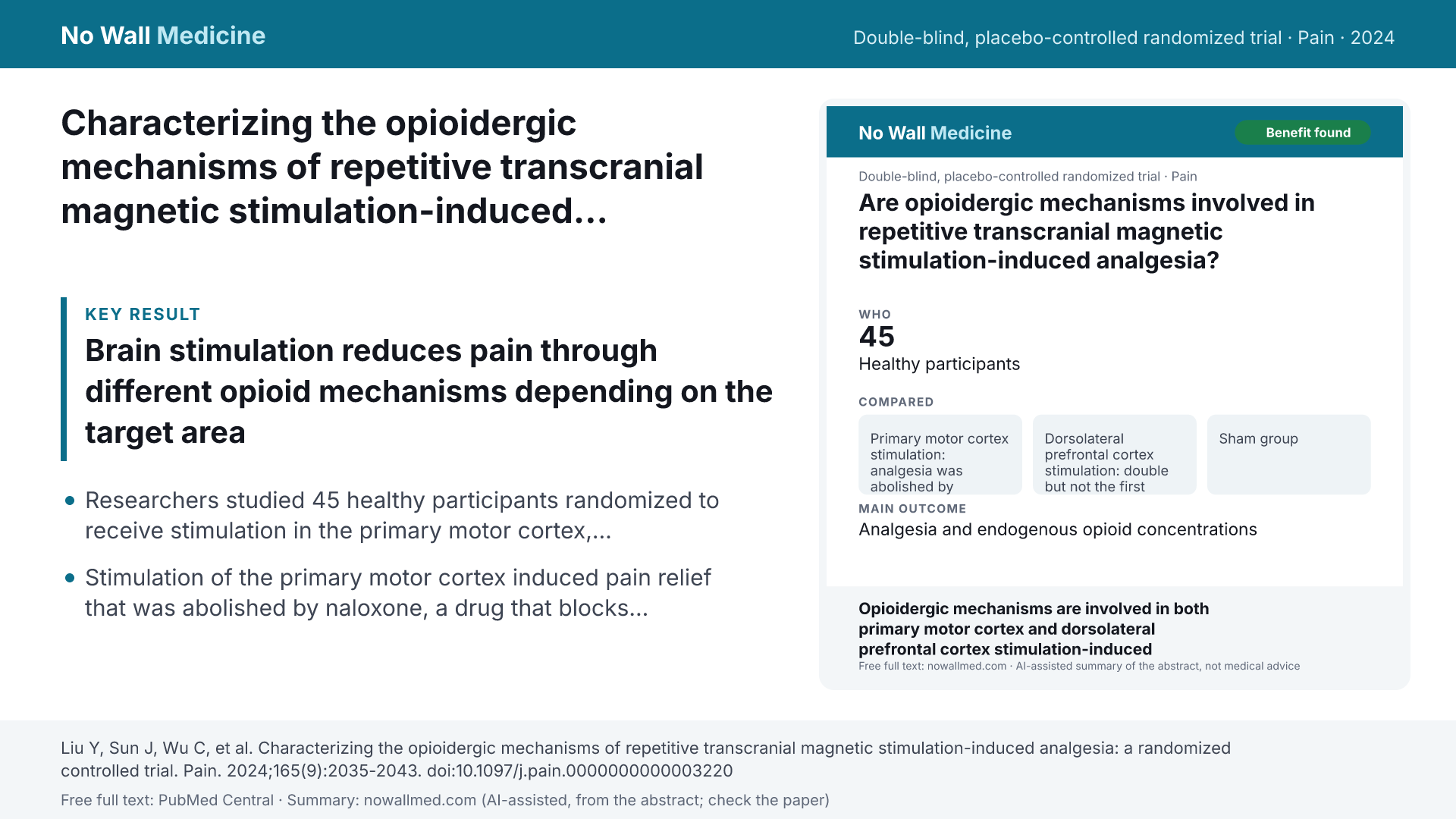
Brain stimulation reduces pain through different opioid mechanisms depending on the target area
Characterizing the opioidergic mechanisms of repetitive transcranial magnetic stimulation-induced analgesia: a randomized controlled trial
Double-blind, placebo-controlled randomized trialBenefit found
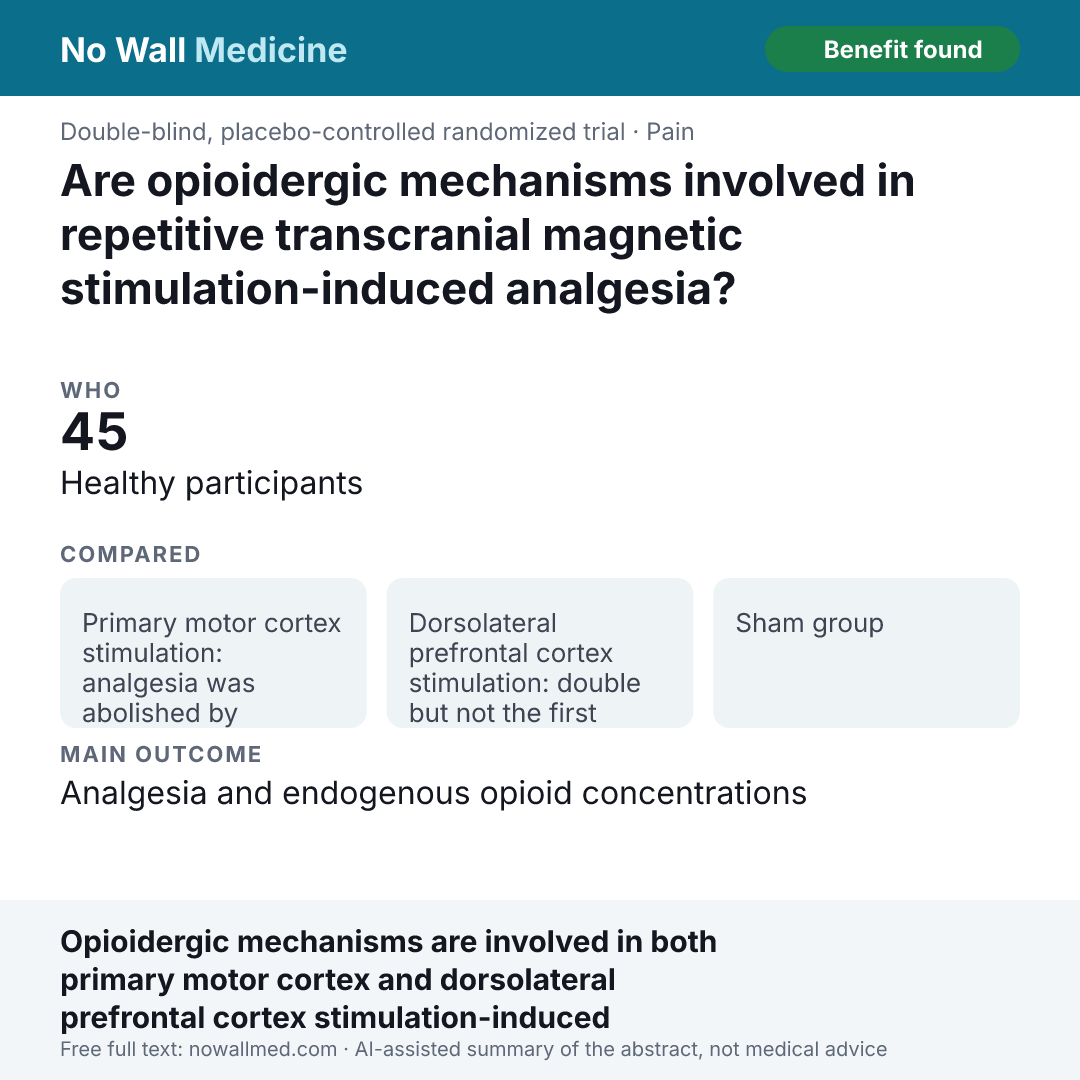
Are opioidergic mechanisms involved in repetitive transcranial magnetic stimulation-induced analgesia?
Who
45
Healthy participants
Compared
Primary motor cortex stimulation: analgesia was abolished by naloxone
Dorsolateral prefrontal cortex stimulation: double but not the first session induced significant pain reduction
Sham group
Main outcome
Analgesia and endogenous opioid concentrations
Bottom line: Opioidergic mechanisms are involved in both primary motor cortex and dorsolateral prefrontal cortex stimulation-induced analgesia.
Pain · 2024-03-26 · Save PNG
Clinical question: Are opioidergic mechanisms involved in repetitive transcranial magnetic stimulation-induced analgesia?
Key points
- Researchers studied 45 healthy participants randomized to receive stimulation in the primary motor cortex, the dorsolateral prefrontal cortex, or a sham treatment.
- Stimulation of the primary motor cortex induced pain relief that was abolished by naloxone, a drug that blocks opioid receptors.
- Stimulation of the dorsolateral prefrontal cortex caused pain reduction after a second session, which was associated with increased plasma concentrations of encephalin.
Headline and key points written with AI from the paper’s abstract, with every number checked against it. Read the paper before relying on them.
Was this summary helpful?
Subject terms
Headline, design, result, key points, caveat and citation as plain text.
Cite this article
Liu Y, Sun J, Wu C, et al. Characterizing the opioidergic mechanisms of repetitive transcranial magnetic stimulation-induced analgesia: a randomized controlled trial. Pain. 2024;165(9):2035-2043. doi:10.1097/j.pain.0000000000003220
Spotted a mistake? Suggest a correction