Repetitive transcranial magnetic stimulation reduced pain in women with fibromyalgia for up to 8 weeks
Motor cortex repetitive transcranial magnetic stimulation in fibromyalgia: a multicentre randomised controlled trial
International randomized, double-blind, sham-controlled trialBenefit found
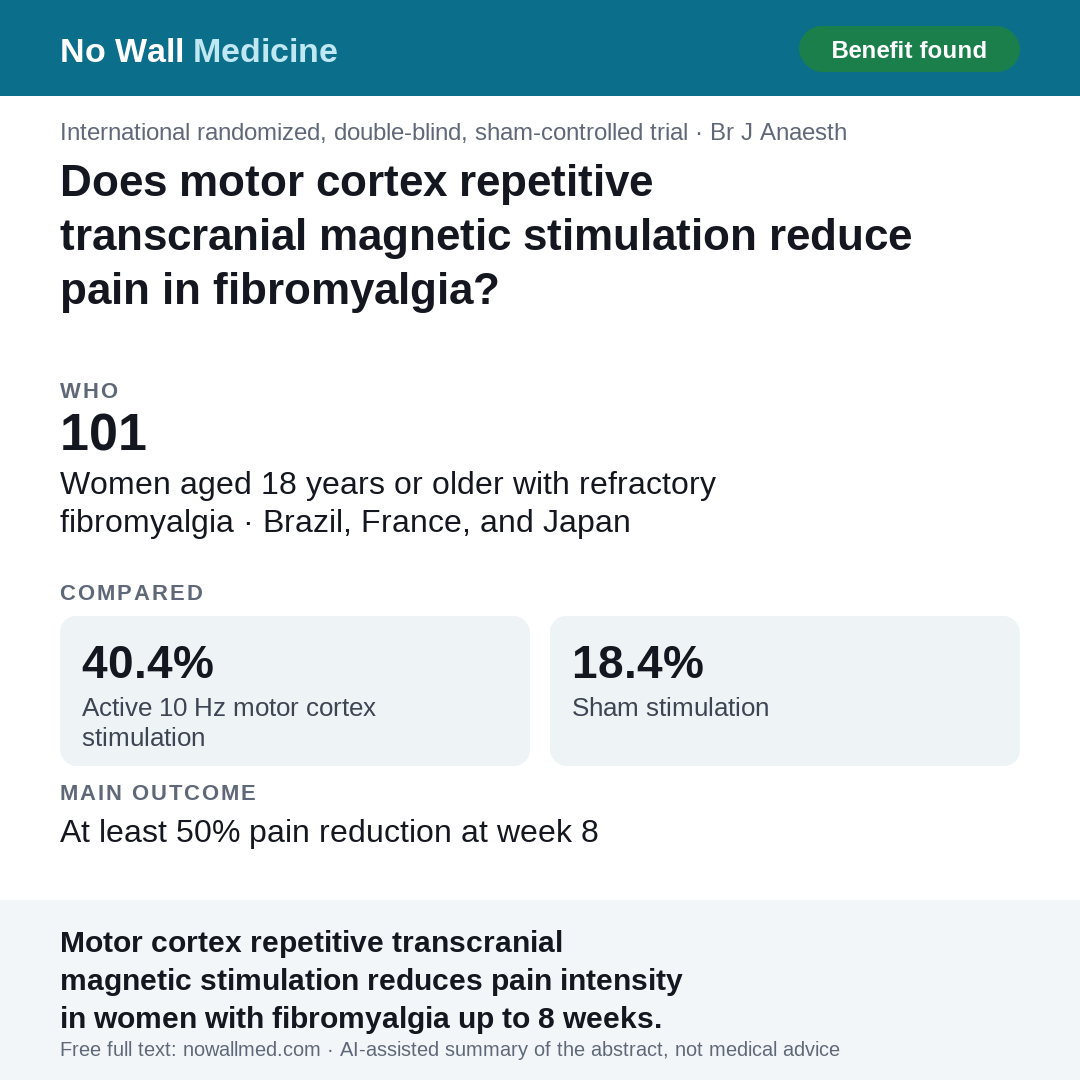
Does motor cortex repetitive transcranial magnetic stimulation reduce pain in fibromyalgia?
Who
101
Women aged 18 years or older with refractory fibromyalgia · Brazil, France, and Japan
Compared
40.4%Active 10 Hz motor cortex stimulation
18.4%Sham stimulation
Main outcome
At least 50% pain reduction at week 8
Result: odds ratio 3.04 (95% credible interval 1.26-8.06)
Bottom line: Motor cortex repetitive transcranial magnetic stimulation reduces pain intensity in women with fibromyalgia up to 8 weeks.
Br J Anaesth · 2025-03-13Download image
Clinical question: Does motor cortex repetitive transcranial magnetic stimulation reduce pain in fibromyalgia?
Why it matters: Fibromyalgia often remains refractory to treatment, and the efficacy of repetitive transcranial magnetic stimulation as an add-on therapy was unknown.
In absolute numbers
Active 10 Hz motor cortex stimulation: 40.4% · Sham stimulation: 18.4% → a difference of 22 percentage points, so about 5 people would need the treatment for 1 more to benefit (number needed to treat) over the trial’s follow-up.
Worked out by us from the two group results above, not reported by the authors. Check the paper for the exact outcome and timing.
Key points
- Researchers studied 101 women with fibromyalgia who did not respond to standard treatments, comparing 10 Hz motor cortex repetitive transcranial magnetic stimulation to a sham stimulation.
- At week 8, the active group had a 40.4% relative pain reduction compared to 18.4% in the sham group.
- By week 16, the probability of pain reduction decreased to 34.2%, though the likelihood of a reduction in Fibromyalgia Impact Questionnaire scores was 79.1%.
Headline and key points written with AI from the paper’s abstract, with every number checked against it. Read the paper before relying on them.
Topics
Cite this article
Silva VA, Baptista AF, Fonseca AS, Carneiro AM, Brunoni AR, Carrilho PEM. Motor cortex repetitive transcranial magnetic stimulation in fibromyalgia: a multicentre randomised controlled trial. Br J Anaesth. 2025. doi:10.1016/j.bja.2024.12.045
Spotted a mistake? Suggest a correction
Top studies every Monday
The week’s key trials and guidelines in your specialties, by email. Free.
Get the weekly digest