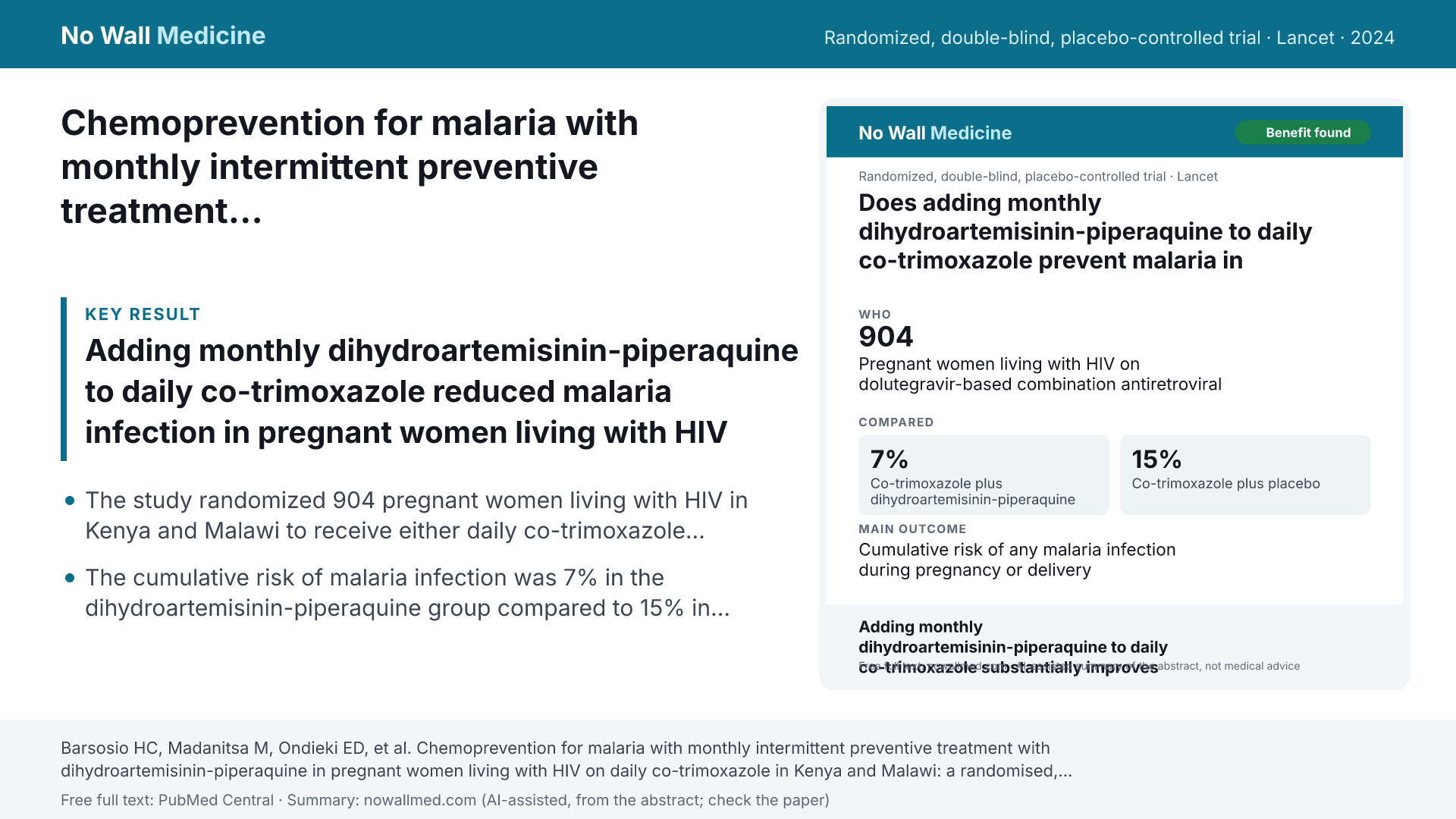
Adding monthly dihydroartemisinin-piperaquine to daily co-trimoxazole reduced malaria infection in pregnant women living with HIV
Chemoprevention for malaria with monthly intermittent preventive treatment with dihydroartemisinin-piperaquine in pregnant women living with HIV on daily co-trimoxazole in Kenya and Malawi: a randomised, double-blind, placebo-controlled trial
Randomized, double-blind, placebo-controlled trialBenefit found
Does adding monthly dihydroartemisinin-piperaquine to daily co-trimoxazole prevent malaria in pregnant women living with HIV?
Who
904
Pregnant women living with HIV on dolutegravir-based combination antiretroviral therapy · Kenya and Malawi
Compared
7%Co-trimoxazole plus dihydroartemisinin-piperaquine (31/443)
15%Co-trimoxazole plus placebo (70/452)
Main outcome
Cumulative risk of any malaria infection during pregnancy or delivery
Result: risk ratio 0·45 (95% CI 0·30-0·67)
Bottom line: Adding monthly dihydroartemisinin-piperaquine to daily co-trimoxazole substantially improves malaria prevention in pregnant women living with HIV.
Lancet · 2024-01-12 · Save PNG
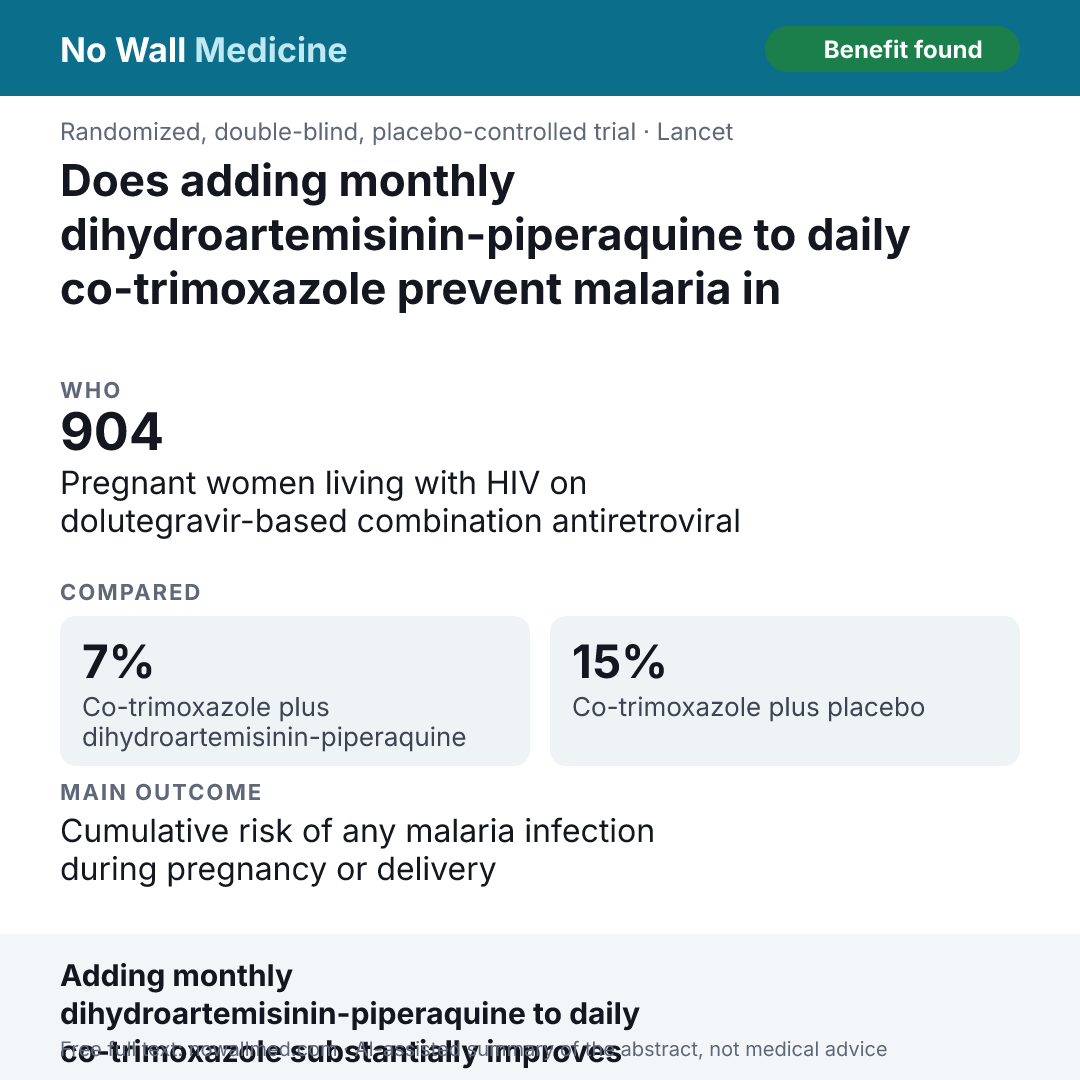
Clinical question: Does adding monthly dihydroartemisinin-piperaquine to daily co-trimoxazole prevent malaria in pregnant women living with HIV?
Why it matters: Resistance to sulfadoxine-pyrimethamine threatens the effectiveness of daily co-trimoxazole, which is used to prevent malaria in pregnant women living with HIV.
In absolute numbers
Co-trimoxazole plus dihydroartemisinin-piperaquine: 7% · Co-trimoxazole plus placebo: 15% → a difference of 8 percentage points, so about 13 people would need the treatment for 1 more to benefit (number needed to treat) over the trial’s follow-up.
Worked out by us from the two group results above, not reported by the authors. Check the paper for the exact outcome and timing.
Key points
- The study randomized 904 pregnant women living with HIV in Kenya and Malawi to receive either daily co-trimoxazole plus monthly dihydroartemisinin-piperaquine or daily co-trimoxazole plus a placebo.
- The cumulative risk of malaria infection was 7% in the dihydroartemisinin-piperaquine group compared to 15% in the placebo group.
- The incidence of malaria infection was 25.4 per 100 person-years in the dihydroartemisinin-piperaquine group versus 77.3 per 100 person-years in the placebo group.
Headline and key points written with AI from the paper’s abstract, with every number checked against it. Read the paper before relying on them.
Was this summary helpful?
Abstract
Background
The efficacy of daily co-trimoxazole, an antifolate used for malaria chemoprevention in pregnant women living with HIV, is threatened by cross-resistance of Plasmodium falciparum to the antifolate sulfadoxine-pyrimethamine. We assessed whether addition of monthly dihydroartemisinin-piperaquine to daily co-trimoxazole is more effective at preventing malaria infection than monthly placebo plus daily co-trimoxazole in pregnant women living with HIV. Methods
We did an individually randomised, two-arm, placebo-controlled trial in areas with high-grade sulfadoxine-pyrimethamine resistance in Kenya and Malawi. Pregnant women living with HIV on dolutegravir-based combination antiretroviral therapy (cART) who had singleton pregnancies between 16 weeks' and 28 weeks' gestation were randomly assigned (1:1) by computer-generated block randomisation, stratified by site and HIV status (known positive vs newly diagnosed), to daily co-trimoxazole plus monthly dihydroartemisinin-piperaquine (three tablets of 40 mg dihydroartemisinin and 320 mg piperaquine given daily for 3 days) or daily co-trimoxazole plus monthly placebo. Daily co-trimoxazole consisted of one tablet of 160 mg sulfamethoxazole and 800 mg trimethoprim. The primary endpoint was the incidence of Plasmodium infection detected in the peripheral (maternal) or placental (maternal) blood or tissue by PCR, microscopy, rapid diagnostic test, or placental histology (active infection) from 2 weeks after the first dose of dihydroartemisinin-piperaquine or placebo to delivery. Log-binomial regression was used for binary outcomes, and Poisson regression for count outcomes. The primary analysis was by modified intention to treat, consisting of all randomised eligible participants with primary endpoint data. The safety analysis included all women who received at least one dose of study drug. All investigators, laboratory staff, data analysts, and participants were masked to treatment assignment. This trial is registered with ClinicalTrials.gov, NCT04158713. Findings
From Nov 11, 2019, to Aug 3, 2021, 904 women were enrolled and randomly assigned to co-trimoxazole plus dihydroartemisinin-piperaquine (n=448) or co-trimoxazole plus placebo (n=456), of whom 895 (99%) contributed to the primary analysis (co-trimoxazole plus dihydroartemisinin-piperaquine, n=443; co-trimoxazole plus placebo, n=452). The cumulative risk of any malaria infection during pregnancy or delivery was lower in the co-trimoxazole plus dihydroartemisinin-piperaquine group than in the co-trimoxazole plus placebo group (31 [7%] of 443 women vs 70 [15%] of 452 women, risk ratio 0·45, 95% CI 0·30-0·67; p=0·0001). The incidence of any malaria infection during pregnancy or delivery was 25·4 per 100 person-years in the co-trimoxazole plus dihydroartemisinin-piperaquine group versus 77·3 per 100 person-years in the co-trimoxazole plus placebo group (incidence rate ratio 0·32, 95% CI 0·22-0·47, p<0·0001). The number needed to treat to avert one malaria infection per pregnancy was 7 (95% CI 5-10). The incidence of serious adverse events was similar between groups in mothers (17·7 per 100 person-years in the co-trimoxazole plus dihydroartemisinin-piperaquine group [23 events] vs 17·8 per 100 person-years in the co-trimoxazole group [25 events]) and infants (45·4 per 100 person-years [23 events] vs 40·2 per 100 person-years [21 events]). Nausea within the first 4 days after the start of treatment was reported by 29 (7%) of 446 women in the co-trimoxazole plus dihydroartemisinin-piperaquine group versus 12 (3%) of 445 women in the co-trimoxazole plus placebo group. The risk of adverse pregnancy outcomes did not differ between groups. Interpretation
Addition of monthly intermittent preventive treatment with dihydroartemisinin-piperaquine to the standard of care with daily unsupervised co-trimoxazole in areas of high antifolate resistance substantially improves malaria chemoprevention in pregnant women living with HIV on dolutegravir-based cART and should be considered for policy. Funding
European and Developing Countries Clinical Trials Partnership 2; UK Joint Global Health Trials Scheme (UK Foreign, Commonwealth and Development Office; Medical Research Council; National Institute for Health Research; Wellcome); and Swedish International Development Cooperation Agency.
Abstract reproduced under the article’s CC BY licence.
Subject terms
Headline, design, result, key points, caveat and citation as plain text.
Cite this article
Barsosio HC, Madanitsa M, Ondieki ED, et al. Chemoprevention for malaria with monthly intermittent preventive treatment with dihydroartemisinin-piperaquine in pregnant women living with HIV on daily co-trimoxazole in Kenya and Malawi: a randomised, double-blind, placebo-controlled trial. Lancet. 2024;403(10424):365-378. doi:10.1016/S0140-6736(23)02631-4
Spotted a mistake? Suggest a correction