Randomized trialThe Lancet Oncology · Aug 23, 2026
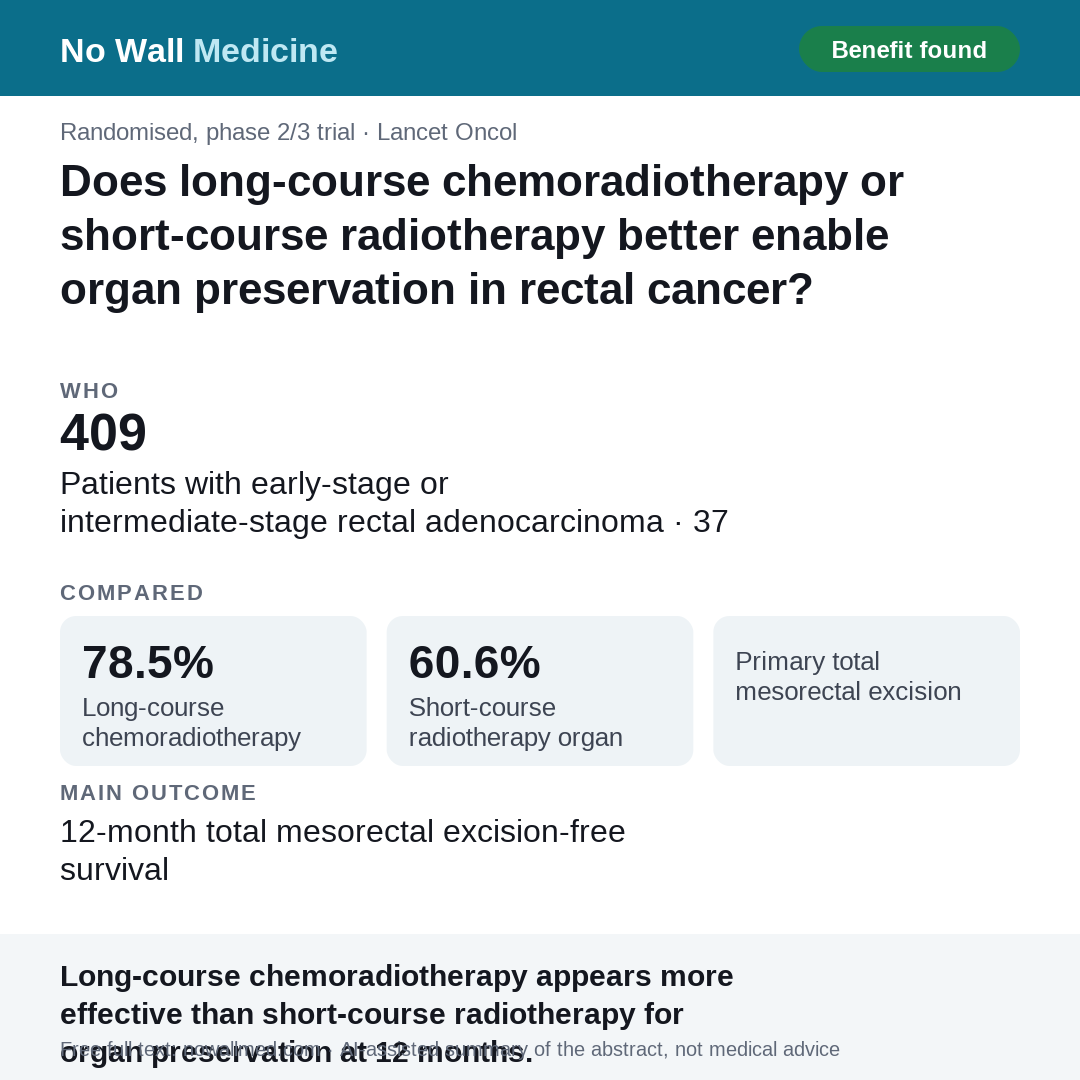
Long-course chemoradiotherapy showed higher 12-month organ preservation rates than short-course radiotherapy in rectal cancer
Chemoradiotherapy versus short-course radiotherapy for response-adapted organ preservation in early-stage and intermediate-stage rectal cancer (STAR-TREC): 12-month results of an international, multicentre, open-label, parallel-group, randomised, phase 2/3 trial
Bach SP, Sebag-Montefiore D, Homer V, Gilbert A, Appelt A, Geh I, et al
Clinical question: Does long-course chemoradiotherapy or short-course radiotherapy better enable organ preservation in rectal cancer?
Why it matters: Standard surgery for rectal cancer can cause significant physical impairment and reduced quality of life, creating a need for organ preservation methods.
Key points
Researchers studied 409 participants with early or intermediate-stage rectal cancer, comparing long-course chemoradiotherapy, short-course radiotherapy, and standard surgery.
Among those choosing organ preservation, 12-month survival without surgery was 78.5% for long-course chemoradiotherapy compared to 60.6% for short-course radiotherapy.
The most common serious side effects were gastrointestinal disorders and procedural complications across all treatment groups.
Headline and key points written with AI from the paper’s abstract, with every number checked against it. Read the paper before relying on them.
Background
Total mesorectal excision (TME) is the standard treatment for most early-stage and intermediate-stage rectal cancer but can cause substantial perioperative morbidity, functional impairment, and reduced quality of life. We assessed whether long-course chemoradiotherapy (LCCRT) or short-course radiotherapy (SCRT) could increase organ preservation and reduce surgery, toxicity, and quality-of-life harms without compromising oncological outcomes. Methods
STAR-TREC is an international, multicentre, open-label, parallel-group, randomised, phase 2/3 trial in five European countries. Eligible patients were aged 16 years or older in the UK or aged 18 years or older elsewhere, had an Eastern Cooperative Oncology Group (ECOG) performance status of 0-1, and rectal adenocarcinoma (≤40 mm staged as mrT1-T3bN0). In phase 2, participants were randomly assigned (1:1:1) to LCCRT-based organ preservation (LCCRT-OP; 50 Gy in 25 fractions plus oral capecitabine 825 mg/m2 twice daily), SCRT-based organ preservation (SCRT-OP; 25 Gy in five fractions), or primary TME. Phase 2 assessed feasibility, with recruitment at months 12 and 24 as the primary endpoint and feasibility thresholds of four or more and six or more randomisations per month, respectively. Phase 3 adopted a partially randomised patient-preference design, allowing participants to choose either organ preservation or TME. Participants that chose organ preservation were randomly assigned (1:1) to receive LCCRT-OP or SCRT-OP using centralised, computer-generated assignment, with stratification by country and MRI T category (≤T3a vs T3b) using minimisation. The phase 3 primary endpoint was organ-preservation 30 months after treatment initiation, defined as absence of TME, stoma, or local recurrence, which was assessed in the modified intention-to-treat population, which included participants in phase 2 and phase 3. After a planned interim analysis of unmasked phase 2 data, the trial steering committee and independent data monitoring committee recommended reporting a 12-month, modified intention-to-treat analysis of implementation outcomes for participants recruited before Aug 8, 2023. This study is registered with ISRCTN (14240288) and is closed. Findings
Between June 14, 2017, and April 8, 2024, 503 participants were enrolled at 37 sites. Phase 2 enrolled 120 participants, with recruitment rates of three and six participants per month at months 12 and 24, respectively. Overall, 12-month TME-free survival was 60% (47 of 78 participants). After phase 3 recruitment ended, interim analysis of unmasked phase 2 data showed an early TME-free survival benefit with LCCRT versus SCRT (12-month median TME-free survival not reached [95% CI not reached-not reached] vs 7·6 months [95% CI 6·4-not reached]; hazard ratio [HR] 3·7 [95% CI 1·7-8·0]; posterior probability of superiority >99·5%). The trial steering committee and independent data monitoring committee therefore recommended expanded analysis of 426 participants recruited before Aug 8, 2023: 120 from phase 2 and 306 from phase 3. 17 participants withdrew before treatment, leaving 409 in the modified intention-to-treat population: 163 allocated to LCCRT, 168 to SCRT, and 78 to primary TME. 116 (28%) participants were female and 293 (72%) were male. Among participants who opted for organ preservation, 12-month TME-free survival was 78·5% (95% CI 72·4-85·1) with LCCRT and 60·6% (53·6-68·4) with SCRT (HR 1·90 [95% CI 1·29-2·81]). The most common grade 3-4 serious adverse events were gastrointestinal disorders (four [2%] with LCCRT vs six [4%] with SCRT vs six [8%] with TME) and procedural complications (three [2%] with LCCRT vs five [3%] with SCRT vs five [6%] with TME). One participant allocated to primary TME died after an anastomotic leak. Interpretation
These early results support a response-adapted organ-preservation approach, with LCCRT appearing more effective than SCRT at 12 months. Organ-preservation might also reduce treatment-related toxicity compared with primary TME. Longer follow-up is needed for the prespecified 30-month endpoint and definitive functional and oncological outcomes. Funding
Cancer Research UK, Stand Up to Cancer, Dutch Cancer Society, Danish Cancer Society, Kom Op Tegen Kanker, Cancerfonden, ALF Region Stockholm, RCC Region Stockholm.
Abstract reproduced under the article’s CC BY licence.
Topics
Humans; Rectal Neoplasms; Male; Female; Middle Aged; Neoplasm Staging; Aged; Adenocarcinoma; Organ Sparing Treatments; Quality of Life; Chemoradiotherapy; Europe
Prostate and pelvic nodal stereotactic body radiotherapy (SBRT) versus prostate-only SBRT for high-risk, localised prostate cancer (PACE-NODES): early adverse event results from an international, open-label, phase 3, randomised controlled trial