Six months of remote ischemic conditioning improved blood flow and symptoms in stable angina patients
Chronic remote ischemic conditioning treatment in patients with chronic stable angina (EARLY-MYO-CSA): a randomized, controlled proof-of-concept trial
Randomized, controlled proof-of-concept trialBenefit found
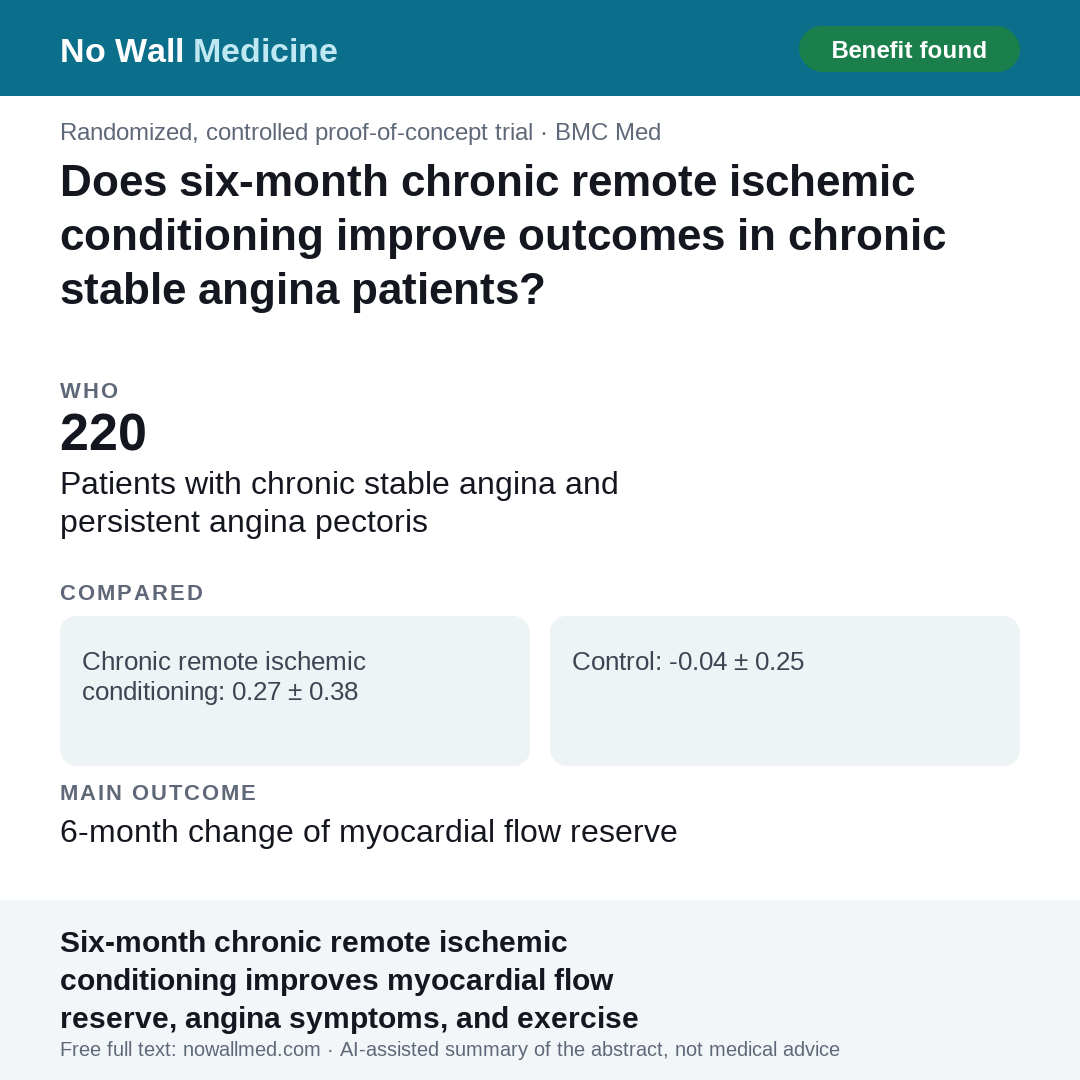
Does six-month chronic remote ischemic conditioning improve outcomes in chronic stable angina patients?
Who
220
Patients with chronic stable angina and persistent angina pectoris
Compared
Chronic remote ischemic conditioning: 0.27 ± 0.38
Control: -0.04 ± 0.25
Main outcome
6-month change of myocardial flow reserve
Bottom line: Six-month chronic remote ischemic conditioning improves myocardial flow reserve, angina symptoms, and exercise performance in stable angina patients.
BMC Med · 2023-08-25Download image
Clinical question: Does six-month chronic remote ischemic conditioning improve outcomes in chronic stable angina patients?
Why it matters: It was unknown if chronic remote ischemic conditioning is effective for patients with chronic stable angina who still have symptoms despite optimal medical therapy.
Key points
- The study randomized 220 patients with chronic stable angina to receive either chronic remote ischemic conditioning or a sham treatment for 6 months.
- The treatment group showed a mean change in myocardial flow reserve of 0.27 ± 0.38 compared to -0.04 ± 0.25 in the control group.
- Patients receiving the treatment had higher rates of improved angina symptoms at 60.0% compared to 14.6% in the control group.
Headline and key points written with AI from the paper’s abstract, with every number checked against it. Read the paper before relying on them.
Was this summary helpful?
Subject terms
Cite this article
Guo Q, Zhao Z, Yang F, Zhang Z, Rao X, Cui J. Chronic remote ischemic conditioning treatment in patients with chronic stable angina (EARLY-MYO-CSA): a randomized, controlled proof-of-concept trial. BMC Med. 2023. doi:10.1186/s12916-023-03041-z
Spotted a mistake? Suggest a correction
Top studies every Monday
The week’s key trials and guidelines in your specialties, plus any topics you follow. By email, free.
Get the weekly digest