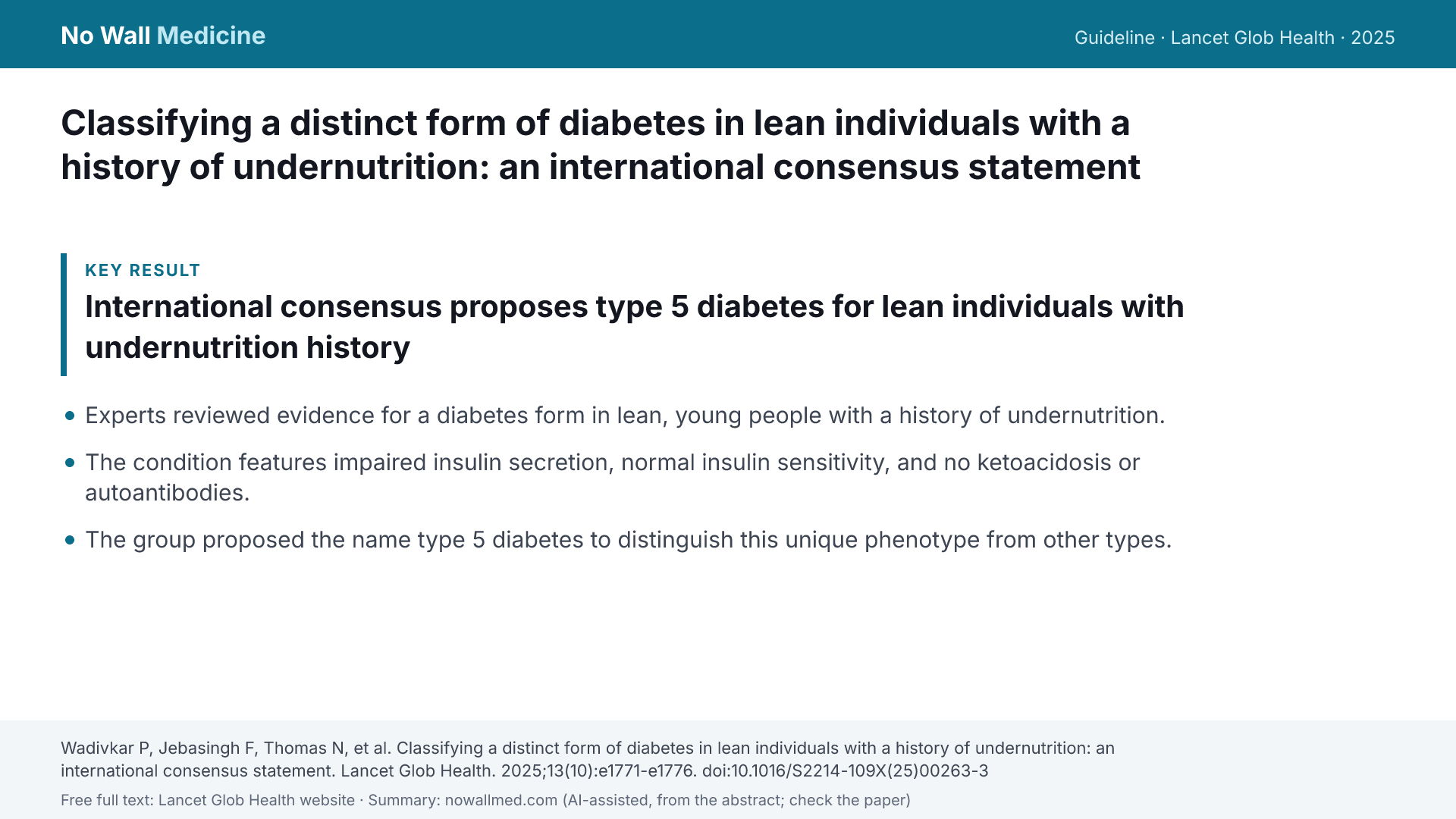
International experts propose type 5 diabetes for lean individuals with a history of undernutrition
Classifying a distinct form of diabetes in lean individuals with a history of undernutrition: an international consensus statement
Status not yet checked. We have not confirmed that this is still the issuing body's current recommendation. Check the issuing body before using it in practice.
Why it matters: The classification of malnutrition-related diabetes was removed in 1999 due to disagreements regarding whether undernutrition was a sufficient risk factor.
Key points
- An international consensus meeting synthesized evidence regarding a unique diabetes phenotype in lean, young people with early life undernutrition.
- This form of diabetes is characterized by impaired pancreatic insulin secretion, normal insulin sensitivity in the liver and body, no ketoacidosis, and no islet cell autoantibodies.
- The term type 5 diabetes was proposed to classify these individuals who have a body mass index (BMI) <18.5 kg/m2 and are under 30 years of age.
Headline and key points written with AI from the paper’s abstract, with every number checked against it. Read the paper before relying on them.
Was this summary helpful?
Abstract
Since 1955, a form of diabetes in lean, young (BMI <18·5 kg/m2, age <30 years) individuals with a history suggestive of undernutrition from before birth and throughout childhood has been described in the literature. In 1985, WHO formally classified it as malnutrition-related diabetes, but subsequently removed the classification in 1999 over a disagreement as to whether undernutrition was a sufficient risk factor to cause this type of diabetes. Emerging evidence now strongly supports the distinct classification of this unique diabetes phenotype, which is characterised by substantial impairment of pancreatic insulin secretion, with normal hepatic and peripheral insulin sensitivity, an absence of ketoacidosis, and no islet cell autoantibodies. In this consensus statement, we synthesise this evidence to produce a set of common features of the disease, proposed pathogenetic mechanisms, and suggested management and prevention strategies. During a consensus meeting in Vellore, India, in January, 2025, type 5 diabetes was proposed as the nomenclature for this distinct form of diabetes, subsequently formalised at the International Diabetes Federation (IDF) World Diabetes Congress in April, 2025. We call upon the international diabetes community to recognise this distinct form of the disease, and to support the IDF's Type 5 Diabetes Working Group and its goals to promote more research into its phenotype, pathophysiology, and treatment, which will benefit millions of patients worldwide, particularly in low-income and middle-income countries.
Abstract reproduced under the article’s CC BY NC ND licence.
Subject terms
Cite this article
Wadivkar P, Jebasingh F, Thomas N, Yajnik CS, Vaag AA, Kibirige D. Classifying a distinct form of diabetes in lean individuals with a history of undernutrition: an international consensus statement. Lancet Glob Health. 2025. doi:10.1016/S2214-109X(25)00263-3
Spotted a mistake? Suggest a correction