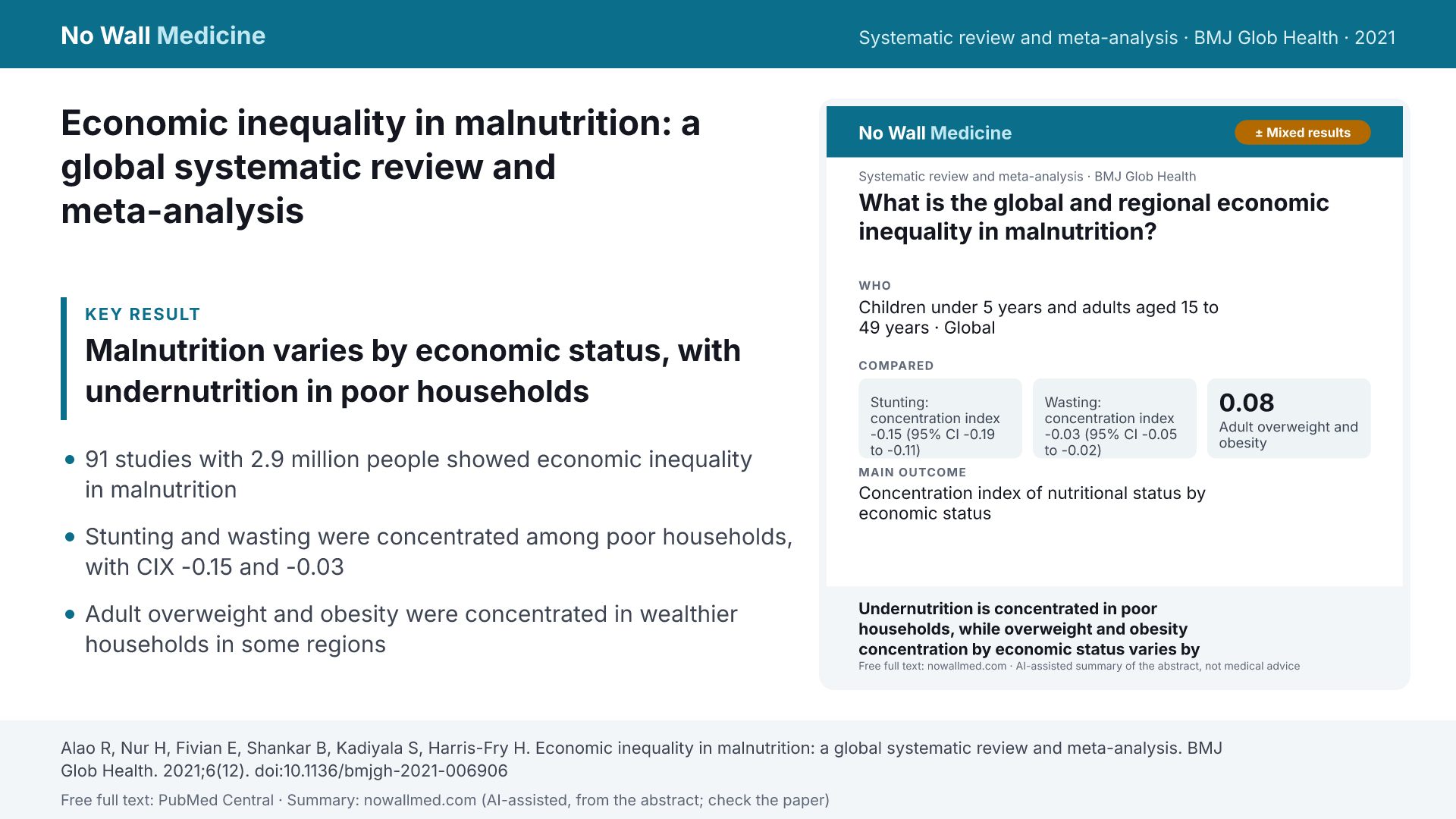
Malnutrition varies by economic status, with undernutrition in poor households
Economic inequality in malnutrition: a global systematic review and meta-analysis
Systematic review and meta-analysisMixed results
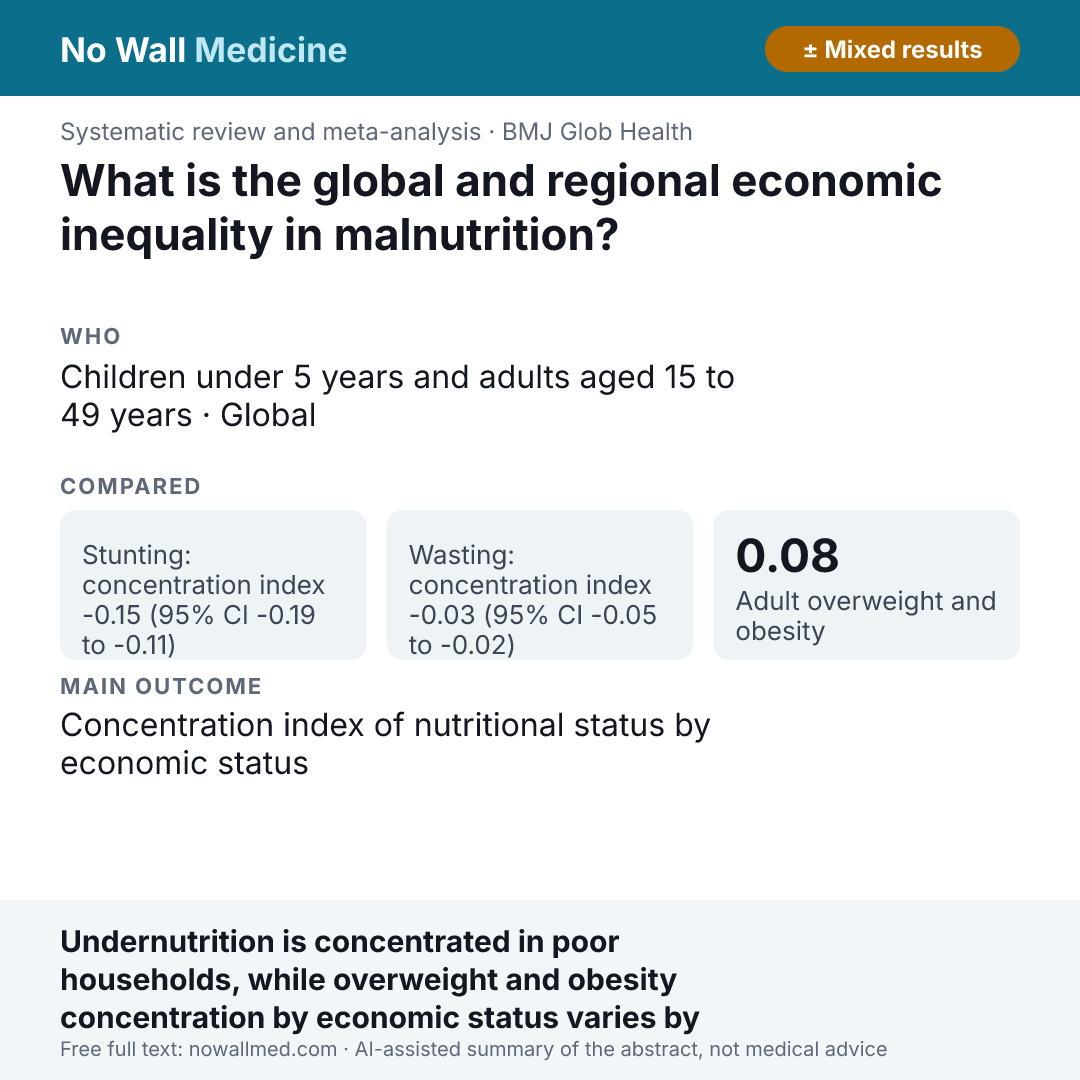
What is the global and regional economic inequality in malnutrition?
Who
Children under 5 years and adults aged 15 to 49 years · Global
Compared
Stunting: concentration index -0.15 (95% CI -0.19 to -0.11)
Wasting: concentration index -0.03 (95% CI -0.05 to -0.02)
0.08Adult overweight and obesity (95% CI -0.00 to 0.17)
Main outcome
Concentration index of nutritional status by economic status
Bottom line: Undernutrition is concentrated in poor households, while overweight and obesity concentration by economic status varies by region.
BMJ Glob Health · 2021-12-10 · Save PNG
Clinical question: What is the global and regional economic inequality in malnutrition?
Key points
- 91 studies with 2.9 million people showed economic inequality in malnutrition.
- Stunting and wasting were concentrated among poor households, with CIX -0.15 and -0.03.
- Adult overweight and obesity were concentrated in wealthier households in some regions.
Headline and key points written with AI from the paper’s abstract, with every number checked against it. Read the paper before relying on them.
Was this summary helpful?
Abstract
Objective
To describe the evidence on global and regional economic inequality in malnutrition, and the associations between economic inequality and malnutrition. Methods
We conducted a systematic review and meta-analysis. Between 1 November 2020 and 22 January 2021, we searched Medline, Embase, Global Health, Eldis, Web of Science and EBSCO Discovery Service. We contacted 39 experts and tracked citations. We included any study reporting a concentration index (CIX) relating economic status and nutritional status and any multilevel study reporting an association between economic inequality and nutritional status. Nutritional status was measured as stunting, wasting, anaemia, or overweight in children (<5 years), or underweight, overweight or obesity, or anaemia in adults (15-49 years). We had no study date or language restriction. Quality was assessed using the Appraisal Tool for Cross-Sectional Studies (AXIS tool). We mapped estimates and pooled them using multilevel random-effects meta-analyses. Results
From 6185 results, 91 studies provided 426 CIX (>2.9 million people) and 47 associations (~3.9 million people). Stunting (CIX -0.15 (95% CI -0.19 to -0.11)) and wasting (-0.03 (95% CI -0.05 to -0.02)) are concentrated among poor households. Adult overweight and obesity is concentrated in wealthier households (0.08 (95% CI -0.00 to 0.17)), particularly in South Asia (0.26 (95% CI 0.19 to 0.34)), but not in Europe and Central Asia (-0.02 (95% CI -0.08 to 0.05)) or North America (-0.04 (95% CI -0.10 to 0.03)). We found no association between 0.1 increase in Gini coefficient and adult underweight (OR 1.03 (95% CI 0.94 to 1.12)) or overweight and obesity (0.92 (95% CI 0.80 to 1.05)). Conclusions
There is good evidence that the prevalence of malnutrition varies by levels of absolute economic status. Undernutrition is concentrated in poor households, whereas concentration of overweight and obesity by economic status depends on region, and we lack information on economic inequalities in anaemia and child overweight. In contrast, links between malnutrition and relative economic status are less clear and should not be assumed; robust evidence on causal pathways is needed. Prospero registration number
CRD42020201572.
Abstract reproduced under the article’s CC BY licence.
Subject terms
Headline, design, result, key points, caveat and citation as plain text.
Cite this article
Alao R, Nur H, Fivian E, Shankar B, Kadiyala S, Harris-Fry H. Economic inequality in malnutrition: a global systematic review and meta-analysis. BMJ Glob Health. 2021;6(12). doi:10.1136/bmjgh-2021-006906
Spotted a mistake? Suggest a correction