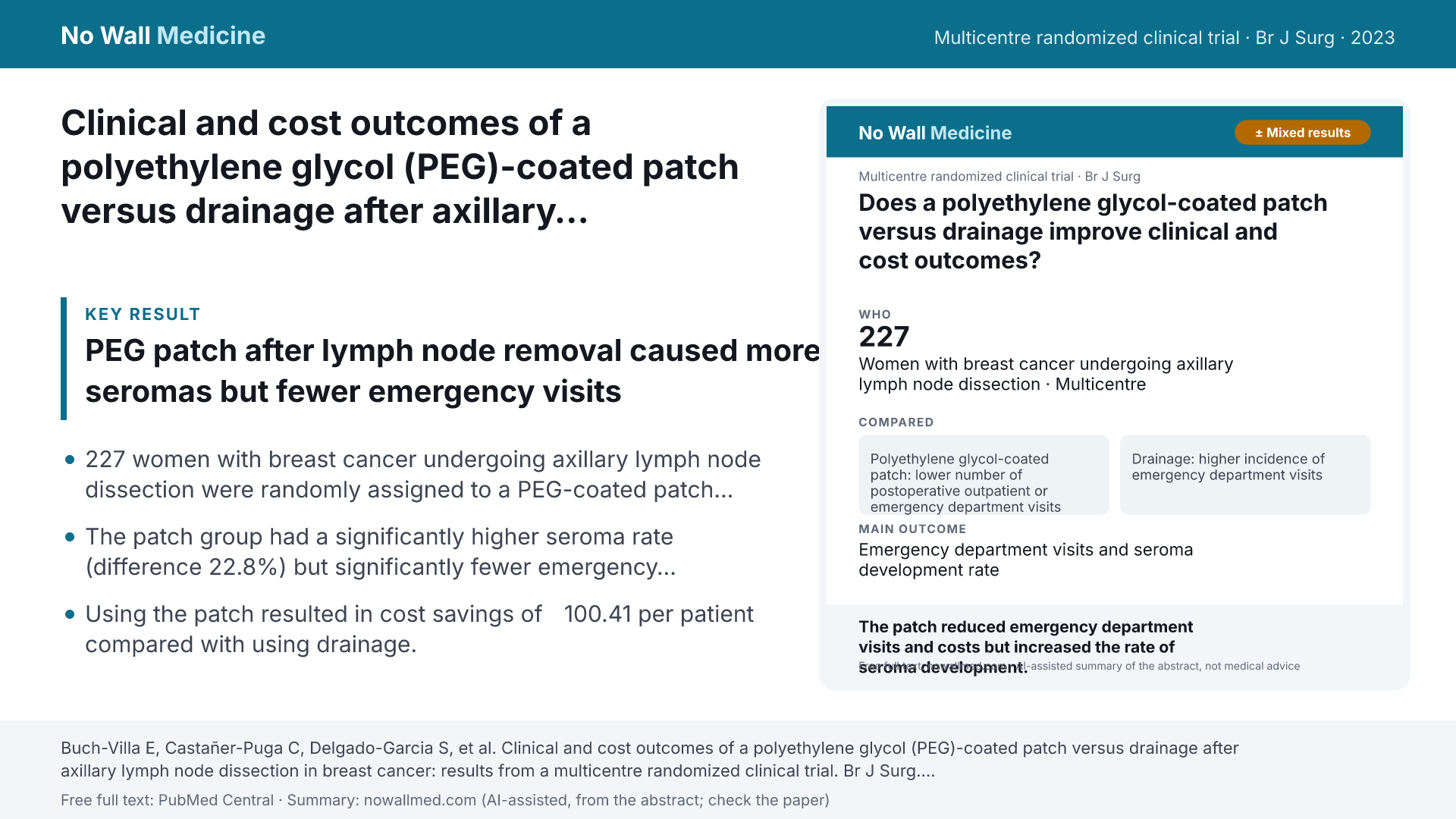
PEG patch after lymph node removal caused more seromas but fewer emergency visits
Clinical and cost outcomes of a polyethylene glycol (PEG)-coated patch versus drainage after axillary lymph node dissection in breast cancer: results from a multicentre randomized clinical trial
Multicentre randomized clinical trialMixed results
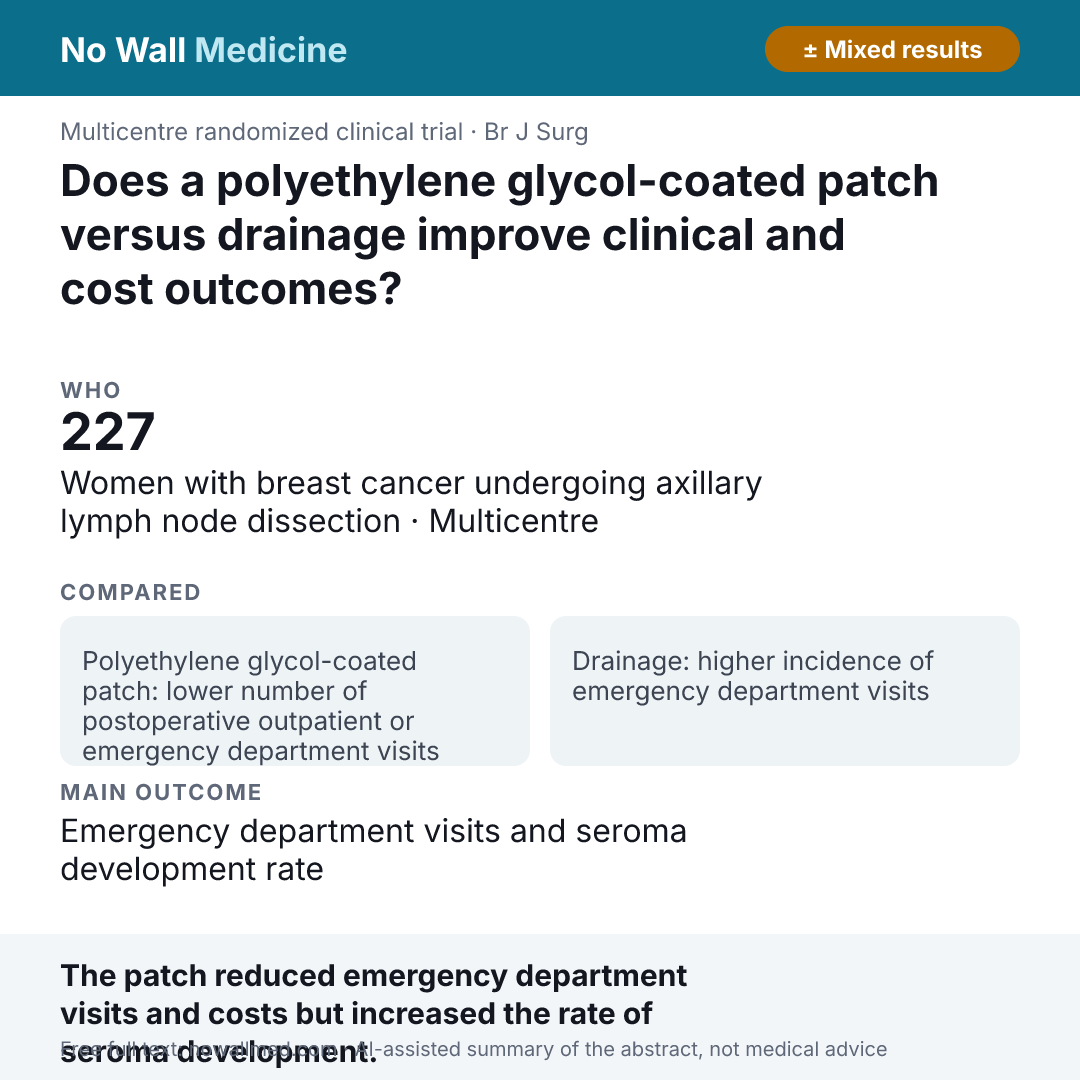
Does a polyethylene glycol-coated patch versus drainage improve clinical and cost outcomes?
Who
227
Women with breast cancer undergoing axillary lymph node dissection · Multicentre
Compared
Polyethylene glycol-coated patch: lower number of postoperative outpatient or emergency department visits
Drainage: higher incidence of emergency department visits
Main outcome
Emergency department visits and seroma development rate
Result: incidence rate difference 26.1 per cent (95% CI 14.5 to 37.7 per cent)
Bottom line: The patch reduced emergency department visits and costs but increased the rate of seroma development.
Br J Surg · 2023-06-14 · Save PNG
Clinical question: Does a polyethylene glycol-coated patch versus drainage improve clinical and cost outcomes?
Key points
- 227 women with breast cancer undergoing axillary lymph node dissection were randomly assigned to a PEG-coated patch or drainage.
- The patch group had a significantly higher seroma rate (difference 22.8%) but significantly fewer emergency department visits (difference 26.1%).
- Using the patch resulted in cost savings of €100.41 per patient compared with using drainage.
Headline and key points written with AI from the paper’s abstract, with every number checked against it. Read the paper before relying on them.
Was this summary helpful?
Subject terms
Headline, design, result, key points, caveat and citation as plain text.
Cite this article
Buch-Villa E, Castañer-Puga C, Delgado-Garcia S, et al. Clinical and cost outcomes of a polyethylene glycol (PEG)-coated patch versus drainage after axillary lymph node dissection in breast cancer: results from a multicentre randomized clinical trial. Br J Surg. 2023;110(9):1180-1188. doi:10.1093/bjs/znad150
Spotted a mistake? Suggest a correction