Clinical and Ecological Impact of an Educational Program to Optimize Antibiotic Treatments in Nursing Homes (PROA-SENIOR): A Cluster, Randomized, Controlled Trial and Interrupted Time-Series Analysis
Cluster, randomized, controlled trial and interrupted time-series analysisBenefit found
What is the clinical and ecological impact of an antimicrobial stewardship program in nursing homes?
Who
Residents in 14 nursing homes · Andalusia, Spain
Compared
General antimicrobial stewardship program
Experimental antimicrobial stewardship program
Main outcome
Overall use of antimicrobials defined daily doses per 1000 resident days
Bottom line: An antimicrobial stewardship program decreased total antimicrobial consumption and multidrug-resistant organism prevalence in nursing homes.
Limitation: Two unexpected coronavirus disease 2019 waves affected the centers.
Clin Infect Dis · 2022-10-22Download image
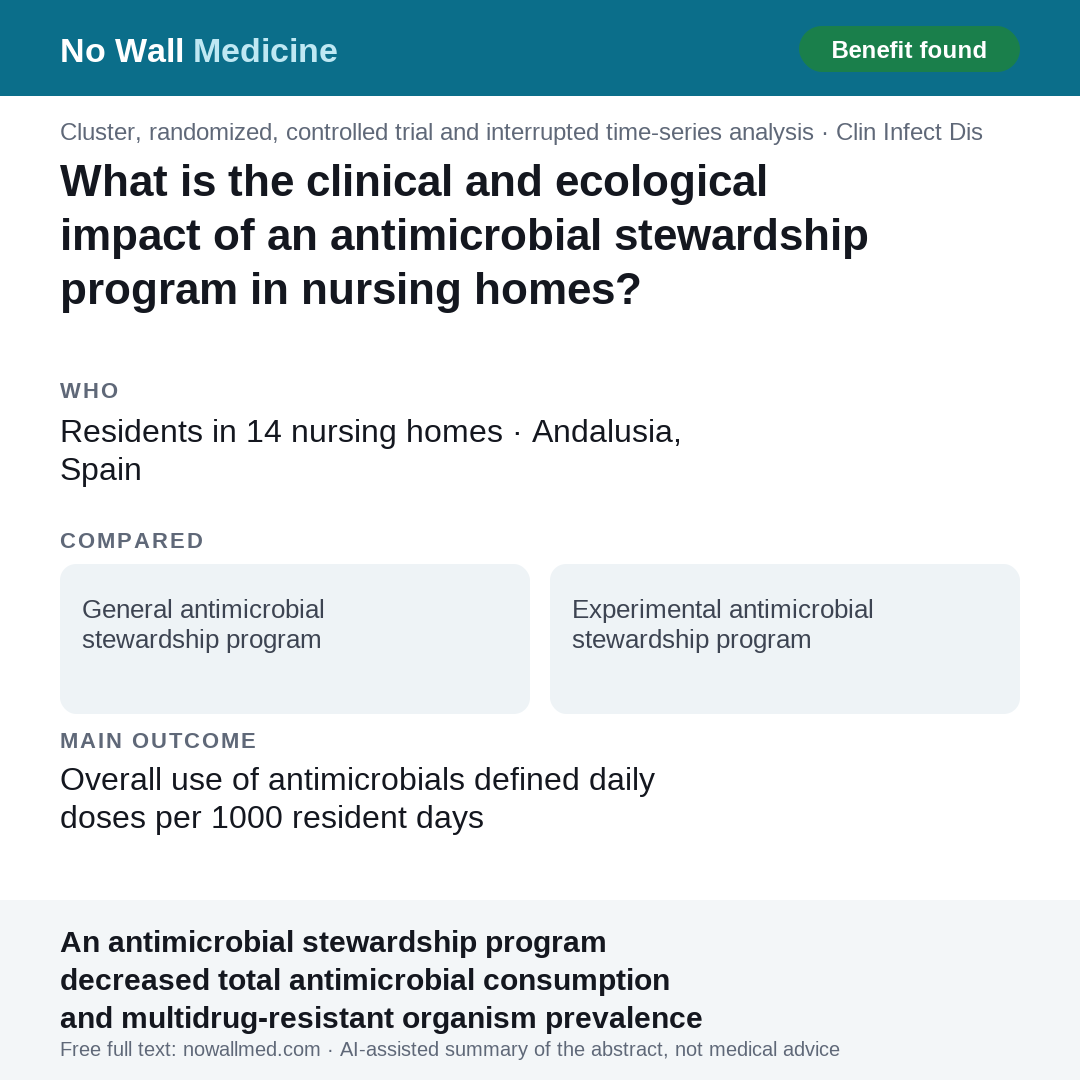
Clinical question: What is the clinical and ecological impact of an antimicrobial stewardship program in nursing homes?
Abstract
Background
Antimicrobial stewardship programs (ASPs) are recommended in nursing homes (NHs), although data are limited. We aimed to determine the clinical and ecological impact of an ASP for NHs. Methods
We performed a cluster, randomized, controlled trial and a before-after study with interrupted time-series analyses in 14 NHs for 30 consecutive months from July 2018 to December 2020 in Andalusia, Spain. Seven facilities implemented an ASP with a bundle of 5 educational measures (general ASP) and 7 added 1-to-1 educational interviews (experimental ASP). The primary outcome was the overall use of antimicrobials, calculated monthly as defined daily doses (DDD) per 1000 resident days (DRD). Results
The total mean antimicrobial consumption decreased by 31.2% (-16.72 DRD; P = .045) with respect to the preintervention period; the overall use of quinolones and amoxicillin-clavulanic acid dropped by 52.2% (P = .001) and 42.5% (P = .006), respectively; and the overall prevalence of multidrug-resistant organisms (MDROs) decreased from 24.7% to 17.4% (P = .012). During the intervention period, 12.5 educational interviews per doctor were performed in the experimental ASP group; no differences were found in the total mean antimicrobial use between groups (-14.62 DRD; P = .25). Two unexpected coronavirus disease 2019 waves affected the centers increasing the overall mean use of antimicrobials by 40% (51.56 DRD; P < .0001). Conclusions
This study suggests that an ASP for NHs appears to be associated with a decrease in total consumption of antimicrobials and prevalence of MDROs. This trial did not find benefits associated with educational interviews, probably due to the coronavirus disease 2019 pandemic. Clinical Trials Registration. NCT03543605.
Subject terms
Cite this article
Peñalva G, Crespo-Rivas JC, Guisado-Gil AB, Rodríguez-Villodres Á, Pachón-Ibáñez ME, Cachero-Alba B. Clinical and Ecological Impact of an Educational Program to Optimize Antibiotic Treatments in Nursing Homes (PROA-SENIOR): A Cluster, Randomized, Controlled Trial and Interrupted Time-Series Analysis. Clin Infect Dis. 2022. doi:10.1093/cid/ciac834
Spotted a mistake? Suggest a correction
Top studies every Monday
The week’s key trials and guidelines in your specialties, plus any topics you follow. By email, free.
Get the weekly digest