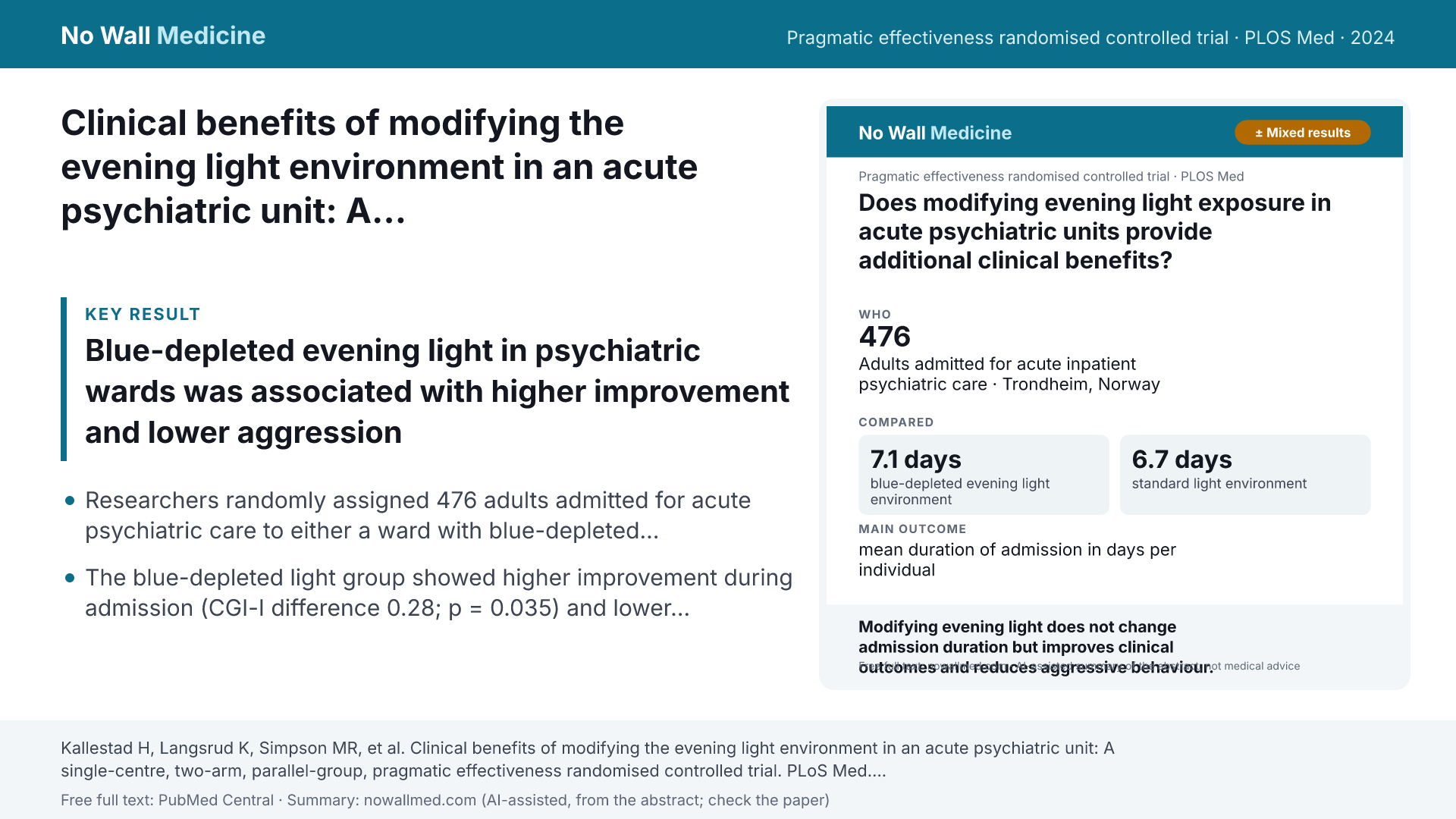
Blue-depleted evening light in psychiatric wards was associated with higher improvement and lower aggression
Clinical benefits of modifying the evening light environment in an acute psychiatric unit: A single-centre, two-arm, parallel-group, pragmatic effectiveness randomised controlled trial
Pragmatic effectiveness randomised controlled trialMixed results
Does modifying evening light exposure in acute psychiatric units provide additional clinical benefits?
Who
476
Adults admitted for acute inpatient psychiatric care · Trondheim, Norway
Compared
7.1 daysblue-depleted evening light environment
6.7 daysstandard light environment
Main outcome
mean duration of admission in days per individual
Result: estimated mean difference: 0.4 days (95% confidence interval [-0.9, 1.9])
Bottom line: Modifying evening light does not change admission duration but improves clinical outcomes and reduces aggressive behaviour.
PLOS Med · 2024-12-06Download image
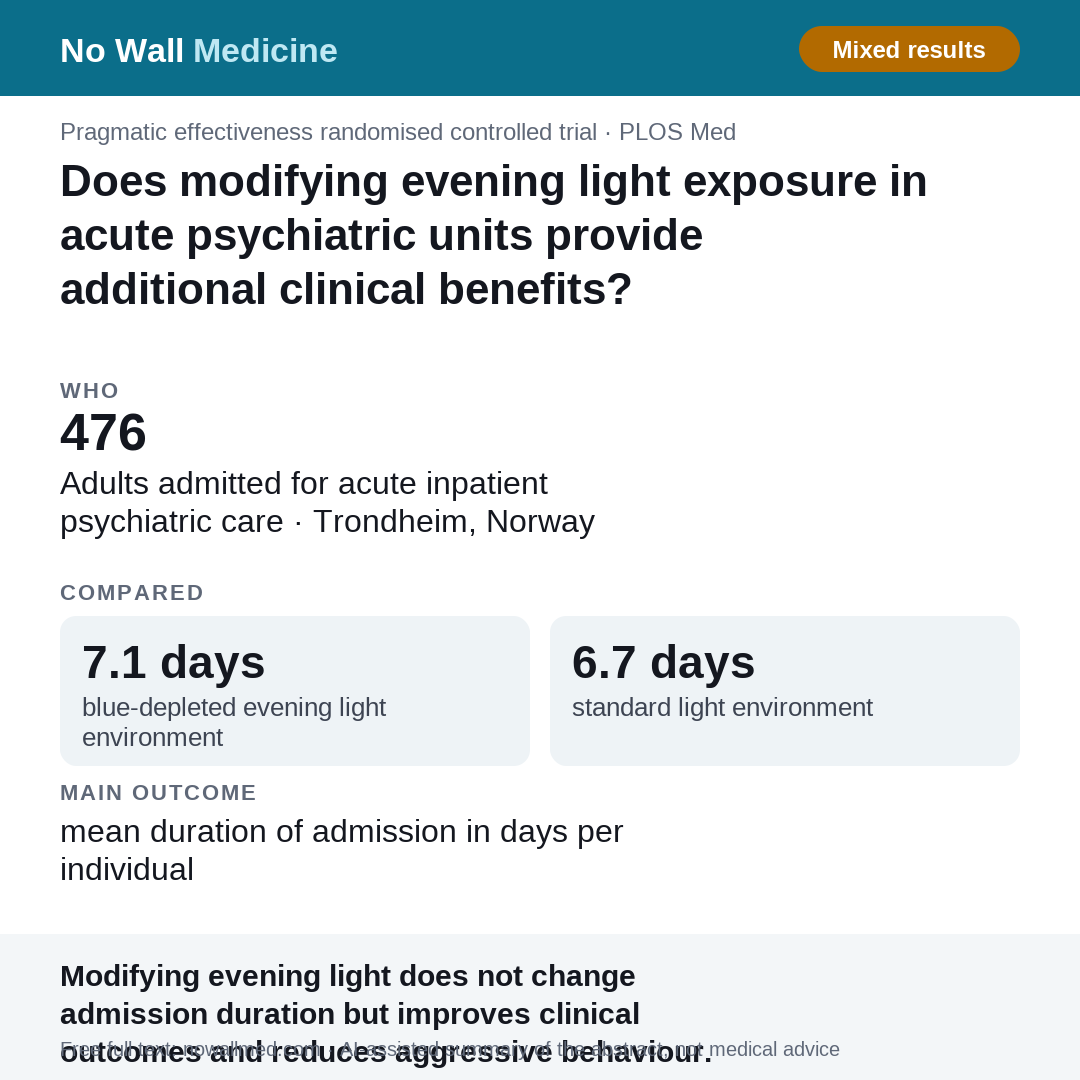
Clinical question: Does modifying evening light exposure in acute psychiatric units provide additional clinical benefits?
Key points
- Researchers randomly assigned 476 adults admitted for acute psychiatric care to either a ward with blue-depleted evening light or a ward with standard lighting.
- The blue-depleted light group showed higher improvement during admission (CGI-I difference 0.28; p = 0.035) and lower illness severity at discharge (CGI-S difference -0.18; p = 0.029).
- There was no difference in the mean duration of admission between the blue-depleted light group (7.1 days) and the standard light group (6.7 days; p = 0.523).
Headline and key points written with AI from the paper’s abstract, with every number checked against it. Read the paper before relying on them.
Was this summary helpful?
Subject terms
Headline, design, result, key points, caveat and citation as plain text.
Cite this article
Kallestad H, Langsrud K, Simpson MR, et al. Clinical benefits of modifying the evening light environment in an acute psychiatric unit: A single-centre, two-arm, parallel-group, pragmatic effectiveness randomised controlled trial. PLOS Med. 2024. doi:10.1371/journal.pmed.1004380
Spotted a mistake? Suggest a correction